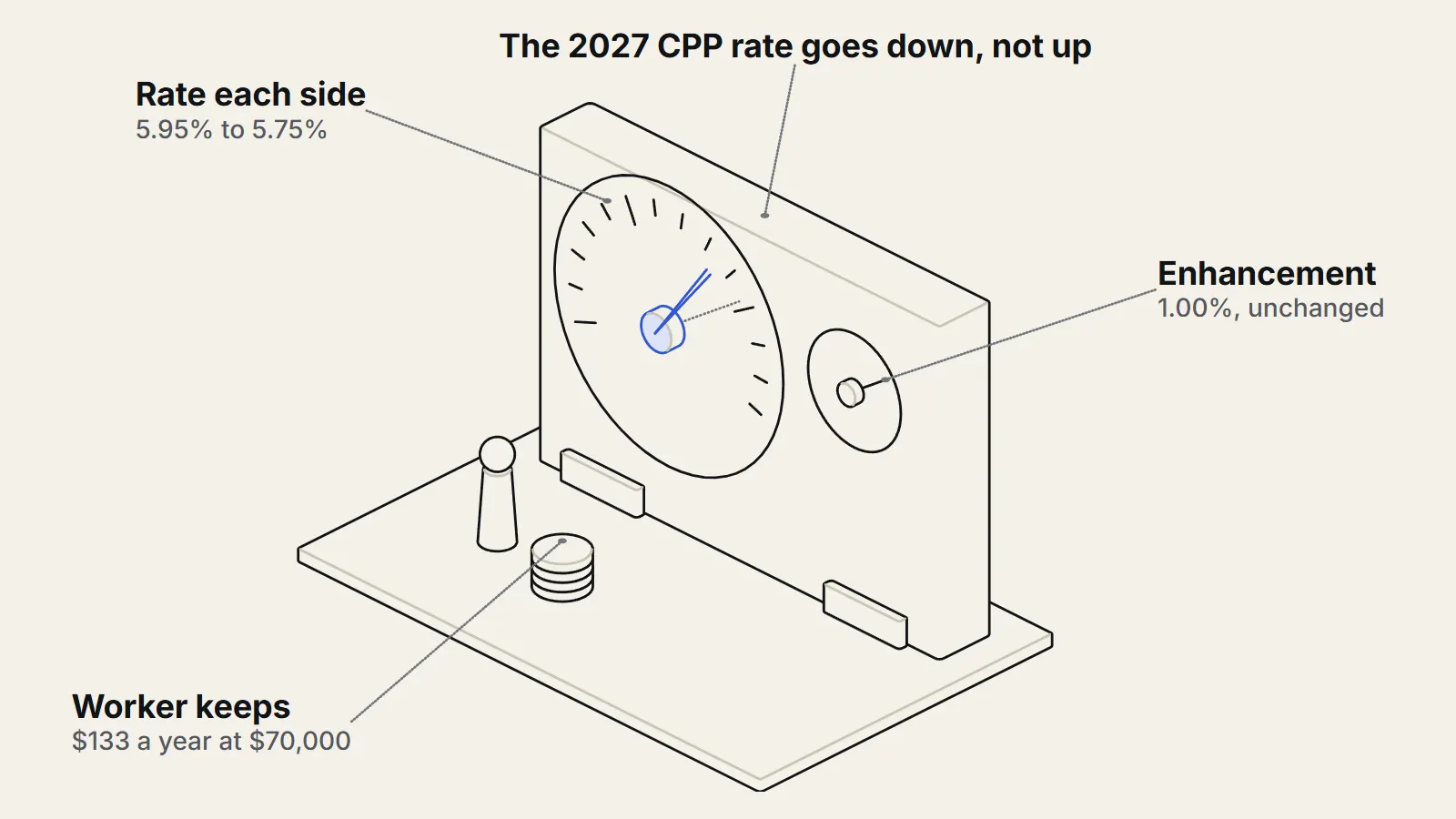
The CPP contribution rate for 2027 is going down, not up. Bill C-30, which implements the Spring Economic Update 2026, lowers the base CPP contribution rate from 9.9% to 9.5% starting in 20271. Employer and employee split that base rate equally, so each side's base rate falls from 4.95% to 4.75%2. Finance Canada (https://www.canada.ca/en/department-finance/news/2026/06/legislation-passes-to-implement-measures-from-the-spring-economic-update-2026.html) estimates that an employee earning $70,000 would save about $133 a year, with matching employer savings1. What may still rise is the earnings ceiling, which the Canada Revenue Agency had not published for 2027 when this piece was written.
What the CPP contribution rate is made of
Employees and employers each pay the same rate. In 2026 it is 5.95% of earnings between a basic exemption of $3,500 and maximum pensionable earnings of $74,600, which makes the maximum contribution $4,230.45 each3, according to the Canada Revenue Agency (https://www.canada.ca/en/revenue-agency/services/tax/businesses/topics/payroll/payroll-deductions-contributions/canada-pension-plan-cpp/cpp-contribution-rates-maximums-exemptions.html). That 5.95% covers two tiers: the base plan plus the first additional tier, the enhancement, which began on 1 January 20194. Above the first earnings ceiling a second tier, CPP2, adds 4% on earnings up to a second ceiling and began on 1 January 20244.
CPP contribution rate 2027: how the cut works
Only the base tier changes. The combined base rate falls from 9.9% to 9.5%, which is 4.95% to 4.75% for each side. The enhancement tier of 1.0% and CPP2 at 4% are unchanged2, according to a payroll-services summary of the law. Adding the unchanged 1.00% enhancement to the new base gives a first-tier rate of 5.75%, down from 5.95%. That 5.75% is our arithmetic from the CRA and Finance Canada figures, and the summary reports the same number. The bill became law in June 2026.
The arithmetic for one worker
The cut applies to pensionable earnings, which are earnings above the $3,500 exemption up to the ceiling. For someone earning $70,000 that is $66,500, and 0.20% of $66,500 is $133, the same figure Finance Canada gives. At the 2026 ceiling, a worker earning the maximum would pay 5.75% on $71,100, or $4,088.25, instead of $4,230.45, a drop of $142.20. The 2027 exemption and ceiling will differ, so read the table as an illustration at 2026 limits.
| 2026 rate | 2027 rate, 2026 limits | |
|---|---|---|
| First-tier rate, each side | 5.95% | 5.75% |
| Pensionable earnings at a $70,000 salary | $66,500 | $66,500 |
| Employee contribution | $3,956.75 | $3,823.75 |
| Change | -$133.00 |
Why the rate is being cut
Contribution rates are meant to match what the plan needs. The Chief Actuary's 32nd report, released on 8 December 2025, expects the CPP to remain sustainable, with base CPP contributions projected to exceed benefits paid until 20305. A payroll-services summary reports that finance ministers agreed the cut in the regular review that followed that report2. The Finance Canada release lists the change among measures that support workers and families, and the page we read gives no fuller rationale. Treat the reasoning as reported rather than official.
Does a lower contribution rate leave less room if investment returns disappoint? The actuary's projections say the plan stays sustainable, but projections that run for decades depend on assumptions about wages, births and returns.
What is not known yet
The CRA's rates page shows 2025 and 2026 figures and none for 20273. The earnings ceiling rose from $71,300 in 2025 to $74,600 in 20263, so a higher 2027 ceiling could lift the maximum dollar contribution even as the rate falls. Until the CRA publishes the numbers, any 2027 maximum is a guess. Some unofficial lists use the old 5.95% rate, which conflicts with the enacted cut, so they are not used here. The Quebec Pension Plan is separate, and this federal change does not directly govern it2.
Key takeaways
- The base CPP contribution rate falls from 9.9% to 9.5% combined in 2027; each side's first-tier rate goes from 5.95% to 5.75%.
- A worker earning $70,000 saves about $133 a year, matched by their employer.
- The enhancement tier and CPP2 are unchanged.
- The 2027 earnings ceiling is not yet published, so the 2027 maximum dollar contribution is unknown.
Sources
- 1Legislation passes to implement measures from the Spring Economic Update 2026 (opens the source in a new tab) · Department of Finance Canada, 2026 · Primary source · https://www.canada.ca/en/department-finance/news/2026/06/legislation-passes-to-implement-measures-from-the-spring-economic-update-2026.html
- 2CPP Base Rate Cut to 9.5% for 2027 (opens the source in a new tab) · RN Canada, 2026 · Reporting · https://rncanada.ca/blog/cpp-base-contribution-rate-cut-2027
- 3CPP contribution rates, maximums and exemptions (opens the source in a new tab) · Canada Revenue Agency, 2026 · Primary source · https://www.canada.ca/en/revenue-agency/services/tax/businesses/topics/payroll/payroll-deductions-contributions/canada-pension-plan-cpp/cpp-contribution-rates-maximums-exemptions.html
- 4CPP enhancement (opens the source in a new tab) · Canada Revenue Agency, 2026 · Primary source · https://www.canada.ca/en/revenue-agency/services/tax/businesses/topics/payroll/payroll-deductions-contributions/canada-pension-plan-cpp/cpp-enhancement.html
- 5Chief Actuary of Canada releases 32nd Actuarial Report on the Canada Pension Plan (opens the source in a new tab) · Office of the Superintendent of Financial Institutions, 2025 · Report · https://www.osfi-bsif.gc.ca/en/news/chief-actuary-government-canada-releases-32nd-actuarial-report-canada-pension-plan