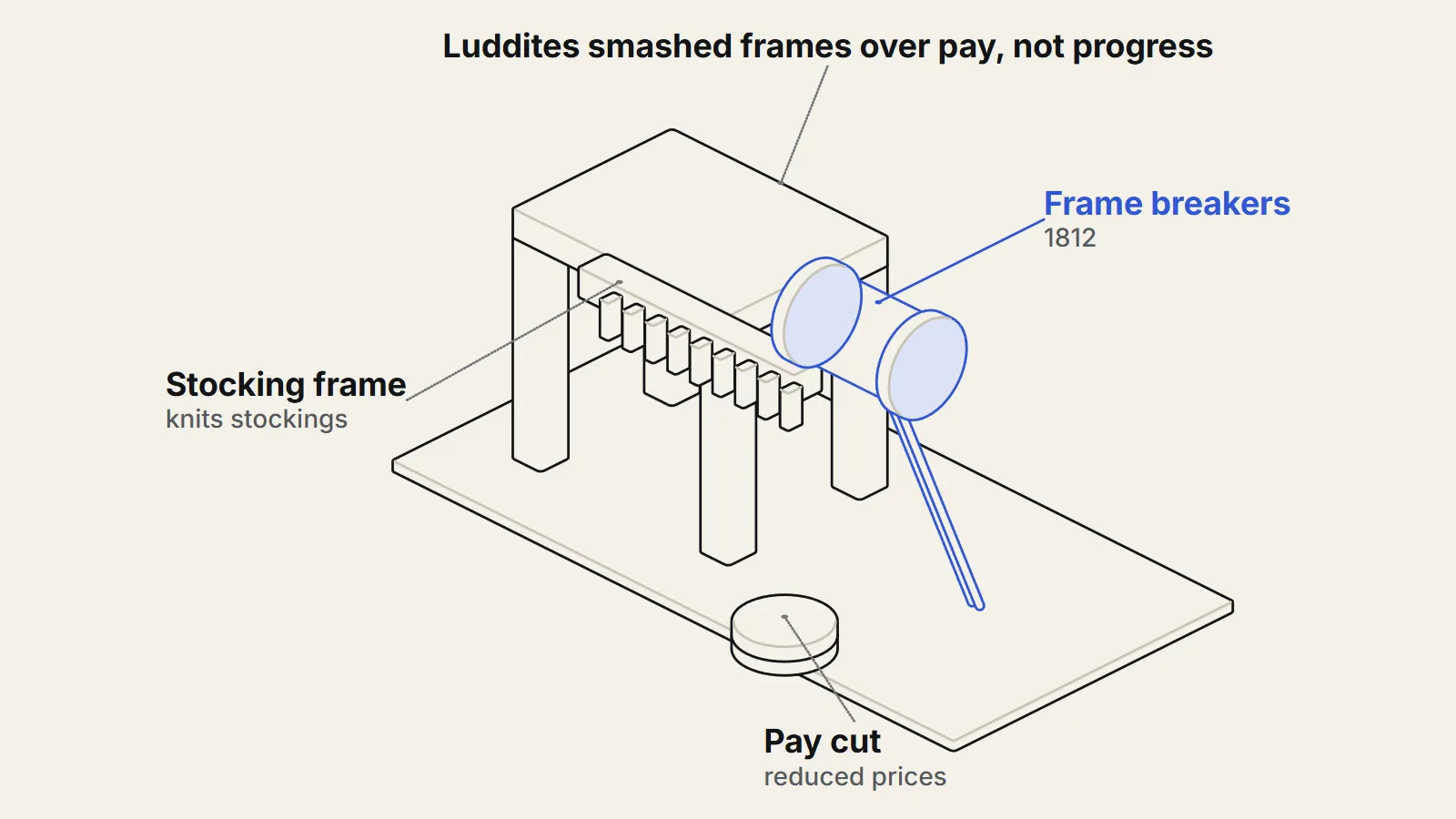
The Luddites were English textile workers who broke machines in 1811 and 1812, and what they wanted was mostly better pay and fairer terms of work rather than the end of technology. Today the word is used for anyone who distrusts new machines. The historical record suggests something narrower: a bargaining tactic by skilled workers who had few legal ways to press employers. This piece looks at who the Luddites were, what they targeted, how the state answered, and how the label shifted.
Who were the Luddites and what did they want?
The movement centred on the hosiery trade of the East Midlands, where framework knitters worked on stocking frames, and later spread to other textile districts. The best evidence of motive comes from people who saw it at the time. On February 6, 1812, a Nottingham magistrate named Robert Baker (http://www.nationalarchives.gov.uk/education/teaching-resources/why-did-the-luddites-protest/) wrote to the Home Office about the unrest. He said many frame workers were out of work, that some hosiers gave them work at reduced prices, and that hosiers who paid higher prices were being undersold in London. Together with a scarcity of corn, he wrote, this produced general discontent, and "resentment against those hosiers who paid the under-price has been the leading feature."1
In other words, the grievance was about pay and who set it. The same letter says the frame breakers went after the frames of those particular hosiers and after frames made wider than the old ones.1 The National Archives notes that wider frames allowed faster, cheaper work, so the machine and the pay dispute were tied together. On this evidence the objection was less to machines as such than to how they were being used against workers.
What did they target, and why?
The historian Eric Hobsbawm gave the most famous reading in a 1952 article (https://libcom.org/article/machine-breakers-eric-hobsbawm) in the journal Past & Present. He argued that machine wrecking was a tactic of trade unionism rather than a blanket rejection of technology. Workers used it to win concessions at a time when national unions were not available, and he claimed it could be at least as effective as other pressure tactics open to them.2 He said that the East Midland movements of 1811 and 1812 were not really aimed at new machinery as such.2
His evidence for selectivity comes from earlier wreckings too. In Lancashire in 1778 to 1780, wreckers spared small spinning jennies of 24 spindles or fewer and destroyed the larger ones suited to factories.2 Hobsbawm reads this as opposition to the way capitalists used machinery. Where a change left workers unharmed, as with power presses in printing, he found little resistance.2 Targets also included raw materials, finished goods and employers' property, not only machines.2
There is also a limit to the "selective" story. Baker's letter says that frames made wider than the old ones were attacked, which does point at a type of machine.1 Hobsbawm and the magistrate do not describe the same thing in the same terms, and the sources here do not settle whether the main target in Nottinghamshire was a type of frame, a group of employers, or the pay system. The likeliest reading from these two sources together is that it was both: particular machines used by particular masters on particular terms.
How did the state and the public respond?
The response was heavy. Hobsbawm notes that the 12,000 troops deployed against the Luddites exceeded the army that Wellington took to the Peninsula in 1808.2 Parliament took up a Frame Work Bill, and on February 27, 1812, the poet Lord Byron made his first speech in the House of Lords (https://api.parliament.uk/historic-hansard/lords/1812/feb/27/frame-work-bill) against it. He argued that the weavers had not destroyed their looms until the machines had become useless to them, and he asked whether the death penalty would deter men already driven to desperation. He told the Lords that around forty frames had been broken the previous evening on the day he left Nottinghamshire.3
Local silence is striking. Hobsbawm points out that in Nottinghamshire not a single Luddite was denounced, even though many small masters probably knew who had broken their frames.2 That is consistent with a movement that had support in local communities, though the sources here do not say how far that hampered the authorities.
How did "Luddite" come to mean opposing technology?
The idea that machine-breakers were simply against progress is almost as old as the riots. A handbill printed in Manchester in March 1812, titled "Fellow Weavers" and signed "An Old Weaver", argued that machinery makes goods cheaper and creates more jobs overall, and that four times as many people were employed since its invention.1 It was written to persuade workers to stop breaking machines, and it frames the issue as ignorance of economics.
Hobsbawm argues that later histories of Luddism inherited assumptions from nineteenth-century economists and from Fabian and Liberal labour historians, who read machine-breaking as a failure to understand progress.2 The label then travelled: someone who resists a new technology for any reason can be called a Luddite, whether or not their complaint is about pay, safety or power. The sources opened for this piece do not trace exactly when the generic meaning took hold.
What is disputed or unknown?
The fair counterargument to the bargaining reading is that it might understate real fear of technology. People whose skill was suddenly worth less had good reasons to hate the machines that did it, and for some groups, in some places, the machine itself may have been the target. Hobsbawm's account is also his interpretation, published in 1952, and later historians have tested it, though none of the sources opened here report how.
Other gaps remain. This piece does not have reliable counts of machines broken or of arrests across all counties, and Baker was a magistrate writing to the authorities, not a Luddite, so his view of their motives is secondhand. The surviving record mostly comes from the people who were trying to suppress the movement.
None of this settles whether new machines were good or bad for workers, which is a separate economic question. What it does show is that the Luddites were making an argument about wages, bargaining power and who gains from new technology, and that argument was easy to dismiss as hostility to machines. That is a point worth keeping in mind when the word is used today.
Key takeaways
- The Luddites were textile workers in 1811 and 1812 who broke machines mainly to protest pay cuts and unfair terms; a Nottingham magistrate described resentment of hosiers who paid under-prices as the leading feature.
- Hobsbawm argued that machine-breaking was a bargaining tactic, and that wreckers were often selective about which machines they destroyed.
- The state responded with 12,000 troops and a bill to punish frame breaking more harshly, which Lord Byron opposed on February 27, 1812.
- Critics at the time already presented machine-breaking as ignorance of how machines create jobs, which helped the label stick.
- The record is mostly from officials, and the sources here do not settle whether the target was machines, particular employers, or the pay system.
Sources
- 1Letter from Robert Baker, Nottingham, to the Home Office, 6 February 1812 (HO 42/120 f.3-4) (opens the source in a new tab) · The National Archives (education resource: Why did the Luddites protest?), 1812 · Primary source · http://www.nationalarchives.gov.uk/education/teaching-resources/why-did-the-luddites-protest/
- 2The Machine Breakers (opens the source in a new tab) · Past & Present, no. 1 (February 1952), 57-70 (reprint text on libcom.org), 1952 · Paper · https://libcom.org/article/machine-breakers-eric-hobsbawm
- 3Frame Work Bill, House of Lords debate, 27 February 1812 (Lord Byron) (opens the source in a new tab) · Historic Hansard, UK Parliament, 1812 · Primary source · https://api.parliament.uk/historic-hansard/lords/1812/feb/27/frame-work-bill