- Place
- Brazil
- Years
- 1994–1999
- Policy
- A fiscal fix, a daily-indexed virtual unit of account (the URV) from March 1994 and a new currency, the real, from 1 July 1994, with an exchange-rate anchor that was floated in January 1999.
- Outcome
- Annual average inflation fell from 2,076 percent in 1994 to 15.8 percent in 1996 without a recession, while the current account deficit grew from $1.2 billion to $35.0 billion by 1998.
The Brazil Real Plan of 1994 ended an inflation that had averaged more than 100 percent a year since 1980.2 It combined a fiscal fix, a virtual unit of account called the URV, and a new currency, the real, issued on 1 July 19943.3 Annual average inflation fell from 2,076 percent in 1994 to 66 percent in 1995 and 15.8 percent in 19961, but the exchange-rate policy behind it left external and fiscal gaps that ended in a float in January 1999.
Before
Why inflation had become a system, not a shock
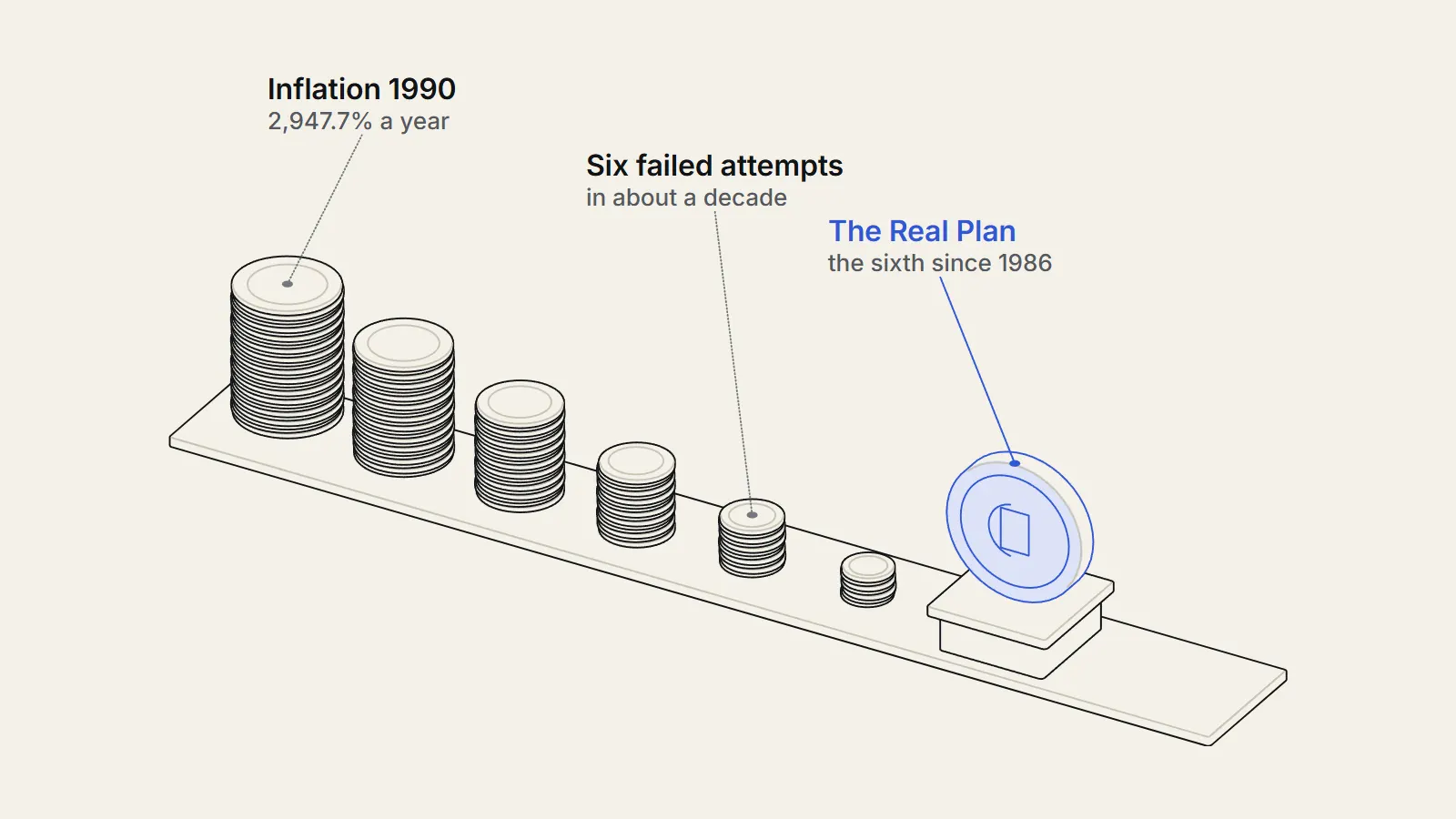
Before the Brazil Real Plan, by the early 1990s Brazil had lived with high inflation for so long that prices, wages, contracts and savings were all built around it. Inflation averaged above 100 percent a year between 1980 and 1994, and the Real Plan came after six failed stabilisation attempts in just over a decade.2 On the World Bank series annual inflation was 2,947.7 percent in 1990, 1,927.4 percent in 1993 and 2,075.9 percent in 1994.1
Gustavo Franco, a central bank (https://therealigned.com/story/what-a-central-bank-does) director who describes the plan from the inside in his 1996 paper (https://www.almendron.com/tribuna/wp-content/uploads/2015/12/rptpd.pdf), set out what that did to money. Foreign currencies were not used as a means of payment, so Brazil did not dollarise. Instead the cruzeiro lost its role as a unit of account: indexation to domestic price indices was so widespread that nominal values carried meaning only for cash transactions settled on the spot.4 We should note that this is an insider account, and we say so wherever we rely on it.
The state had its own reasons to live with inflation. Franco argues that the government had developed an "addiction" to it, because the budget was only an authorisation to spend and inflation eroded the real value of what was actually paid out.4 The 1988 constitution had raised the combined share of earmarked revenues from 46.1 percent of all revenues to 72 percent, which tied the hands of whoever ran the budget.4
Earlier plans had tried to cut the knot with price freezes. The Cruzado Plan of 28 February 1986 seemed at first to end inflation without a recession and failed by the end of the year, according to Baer and Beckerman.5 Their diagnosis was a large wage increase that shifted income and lifted demand, prices frozen in a disequilibrium pattern for too long, loose monetary policy and a decision to hold the freeze until the November 1986 elections.5 By 20 February 1987 Brazil had declared a moratorium on interest payments to commercial banks.5
Brazil’s public finances were also hard to read. Franco’s table of public-sector borrowing needs shows how much the answer depended on the definition used, since measures that count the monetary correction of debts and assets gave very different deficits from the operational and primary measures.4 He argues that the nominal figures were used by those who benefited from inflation to claim the deficit was a false problem.4
A balanced budget alone had not been enough either. The IMF working paper by Giambiagi and Ronci reports an average primary surplus of 2.9 percent of GDP in 1991 to 1994, years in which inflation stayed in the hundreds and thousands of percent.61 That does not show that fiscal policy was irrelevant, but it suggests that the fiscal numbers could not by themselves explain the inertia in prices.
The decision
Three steps: a fiscal fix, a virtual currency and a new real
Franco describes the Brazil Real Plan as three building blocks: a fiscal strategy centred on a constitutional amendment creating the Social Emergency Fund, a monetary reform carried out through a few months of voluntary use of a new unit of account, and a "big bang" opening of the economy with a new foreign-exchange policy.4 It was, he writes, the sixth stabilisation program since 1986, and when the question of fiscal correction was raised in May 1993 it was put forward as a precondition for another attempt, under Finance Minister Fernando Henrique Cardoso.4
The Social Emergency Fund passed early in 19944 and was aimed at the earmarking of revenues that had hemmed in the budget.4 Franco adds that the effort was made in the last year of a government seen as weak, with a presidential election less than a year away, and that the fear of a repeat of the 1989 hyperinflation (https://therealigned.com/story/hyperinflation-how-a-currency-collapses) during the campaign gave the finance minister the political leverage to trade fiscal correction for a serious stabilisation attempt.4
The centrepiece was the URV, the Unidade Real de Valor. Law 8,880 (https://www.planalto.gov.br/ccivil_03/leis/l8880.htm) made it legal tender "exclusively" as a standard of monetary value and set it at CR$ 647.50 on 1 March 1994.3 Franco says its starting value was about one US dollar at the market rate of 28 February, and that it was adjusted daily by a blend of price indices.4 The central bank was to sell dollars whenever a dollar cost one URV, so the exchange rate followed the URV, which followed current inflation.4
The point was to align prices without freezing them. Wages were converted into URVs using the average of the previous four months, new contracts had to be written in URVs, and prices could not be displayed in URVs, to keep the cost of repricing in place.4 Franco says the government deliberately avoided printing URV notes, because two competing means of payment, one indexed, had set off explosions in Hungary in 1946 and Germany in 1923 through the operation of Gresham’s law.4 Ayres and co-authors stress that the Real Plan itself involved no price freeze.2
On 1 July 1994 the URV became the real. The law withdrew legal tender from the cruzeiro real from that date, and the conversion was one real for 2,750 cruzeiros reais, which Ayres and co-authors write as 1 dollar = 1 real = 1 URV = 2,750 cruzeiros reais.342 In the first weeks the new currency floated and appreciated, which Franco calls "entirely unprecedented", taking the dollar as low as 83 cents of a real, after which a target zone was put in place.4
The Real Plan is certainly one of the most successful stabilization plans on record.
— Gustavo H. B. Franco, then Director of International Affairs, Central Bank of Brazil, 1996 (an insider assessment)
- Fiscal: the Social Emergency Fund amendment, passed early in 1994, loosened the earmarking of revenues.
- Money: the URV, adjusted daily, then the real at 2,750 cruzeiros reais on 1 July 1994, with no price freeze.
- Trade and exchange rate: tariff cuts, an initial float and later a target zone, then a crawl of about 0.6 percent a month from 1995.
- Debt: an agreement with foreign creditors signed in November 1993 and securitised in March 1994 restored access to capital markets.
- 28 Feb 1986Cruzado Plan announced, with a price freezeSource 5 (opens the source in a new tab)
- Nov 1993Debt agreement with foreign creditors signed under the Brady PlanSource 2 (opens the source in a new tab)
- Early 1994Social Emergency Fund amendment passedSource 4 (opens the source in a new tab)
- 1 Mar 1994URV set at CR$ 647.50Source 3 (opens the source in a new tab)
- 1 Jul 1994Real first issued; cruzeiro real loses legal tenderSource 3 (opens the source in a new tab)
- 1995Crawling band introduced, a crawl of about 0.6 percent a monthSource 7 (opens the source in a new tab)
- Aug 1998Russian default; net withdrawals of about $40 billion over four monthsSource 7 (opens the source in a new tab)
- 2 Dec 1998International support package of $41.5 billion approvedSource 7 (opens the source in a new tab)
- 13 to 15 Jan 19998 percent controlled devaluation, then a floatSource 7 (opens the source in a new tab)
- 21 Jun 1999Decree 3,088 makes inflation targets the guideline for monetary policySource 8 (opens the source in a new tab)
The strongest case against the design
The numbers behind that argument against the Brazil Real Plan come from several sources. The current account moved from a deficit of $1.2 billion in 1994 to $35.0 billion in 1998 on World Bank data.1 The CRS report says a consensus emerged that the real was overvalued by 15 to 30 percent, that the budget deficit reached 8 percent of GDP in 1998 and that the current account deficit exceeded 4 percent of GDP.7
Interest rates were the price of attracting that capital. The World Bank series for bank lending rates reads 78.2 percent in 1997 and 86.4 percent in 1998, although those are nominal rates charged to borrowers, not the central bank’s policy rate.1 The CRS review argues that high real rates were needed to bring in the foreign capital that financed the fiscal and current account gaps, which left monetary policy little room to support growth.7
Fiscal discipline weakened after the first year. Giambiagi and Ronci report that the primary balance, a surplus of 2.9 percent of GDP on average in 1991 to 1994, fell to an average deficit of 0.2 percent of GDP in 1995 to 1998.6 They add that the main cause of the deterioration was the primary balance rather than higher interest payments.6 Franco had predicted some of this, arguing that falling inflation would weaken the inflation-driven fiscal controls.4
Finally, the plan was a gamble on behaviour. Ayres and co-authors report that it did not have the IMF’s blessing, an uneasy relationship in earlier decades.2 Franco acknowledges that some complained that trade opening had gone too fast.4
The complaints are exactly the opposite: it was too fast !
— Gustavo H. B. Franco, 1996, on trade liberalisation (quoted as printed)
What happened
What the Brazil Real Plan did to inflation, growth and the external accounts
Under the Brazil Real Plan inflation fell fast. The World Bank annual average was 2,075.9 percent in 1994, 66.0 percent in 1995, 15.8 percent in 1996 and 6.9 percent in 1997.1 Franco’s own summary is that inflation went from rates above 50 percent a month to less than 20 percent a year in a very short time.4
The Brazil Real Plan also avoided a recession. The CRS review notes that growth slowed under the plan but did not turn negative, and the plan’s real minimum wage increases combined with lower inflation to redistribute income to poorer households.7 The World Bank series shows growth of 5.9 percent in 1994 and 4.2 percent in 1995.1 Saqib describes the early years as a consumption boom with a fall in poverty and income inequality.9
Inflation was not the only thing that changed. Ayres and co-authors show that between the twelve months to May 1994 and the twelve months to May 1995 the primary surplus rose from 2.8 to 4.0 percent of GDP while seigniorage, the revenue the state earns from printing money, fell from 2.7 to 0.7 percent of GDP2.2 In plain terms, the government lost a large hidden tax and had to replace it.
Trade changed too. Franco reports that exports plus imports rose from US$ 50.1 billion in 1991 to US$ 93.9 billion in 1995.4 The current account deficit went from $1.2 billion in 1994 to $18.1 billion in 1995 and $35.0 billion in 1998 on World Bank data.1
The 1999 float and what followed
After Russia’s default in August 1998 investors withdrew a net $40 billion from Brazil in four months7, and a package of $41.5 billion was approved on 2 December 1998.7 On 13 January 1999 Brazil tried an 8 percent controlled devaluation, which raised anxiety and outflows, and it floated the real two days later.7
Arminio Fraga, then governor of the central bank, reports that the real fell from 1.20 per dollar at the start of 1999 to 2.15 in February, and that the policy rate went from 39 percent before the float to 45 percent, then back down.10 Inflation, forecast by some to reach 30 to 80 percent, was 8.9 percent in 1999 on the central bank's own measure (the World Bank annual average for 1999 is 4.9 percent).10 The World Bank period average for 1999 is 1.81 reais per dollar.1
The new regime was written into law. Decree 3,088 (https://www.planalto.gov.br/ccivil_03/decreto/d3088.htm) of 21 June 1999 made inflation targets the guideline for monetary policy, with the National Monetary Council setting targets on the finance minister’s proposal and the central bank open to explaining a miss in a public letter.8 Fraga reports targets of 8, 6 and 4 percent for 1999, 2000 and 2001, with a band of two points either side.10 The fiscal side followed: Giambiagi and Ronci record an average primary surplus of 3.5 percent of GDP in 1999 to 2002.6
| Year | Inflation (%) | GDP growth (%) | Current account (US$ bn) | Reais per US$ |
|---|---|---|---|---|
| 1994 | 2,075.9 | 5.9 | -1.2 | 0.67 |
| 1995 | 66.0 | 4.2 | -18.1 | 0.92 |
| 1996 | 15.8 | 2.2 | -23.2 | 1.01 |
| 1998 | 3.2 | 0.3 | -35.0 | 1.16 |
| 1999 | 4.9 | 0.5 | -26.8 | 1.81 |
| 2000 | 7.0 | 4.4 | -26.5 | 1.83 |
What economists still disagree on
What actually ended Brazil’s hyperinflation? Where economists differ
The success of the Real Plan in conquering the hyperinflation is indisputable
— Ayres, Garcia, Guillen and Kehoe, 2019 (the authors then say its causes are debated)
Few dispute that inflation fell after the Brazil Real Plan. The dispute is over why, because several things changed within months of each other. Ayres and co-authors write that it is hard to say which of them mattered most.2 We can set out the candidates and what each source says.
- Fiscal change: Franco puts the fiscal strategy first, and Ayres and co-authors show the primary surplus rising and seigniorage falling after 1994.
- Ending indexation: the URV removed the staggered wage and price adjustments that kept inflation moving without a freeze.
- The exchange rate and trade opening: Franco says many observers saw the plan as exchange-rate-based stabilisation and that imports disciplined domestic prices.
- Foreign finance: Ayres and co-authors point to the return of capital inflows after the debt agreement.
- Tight money: the same authors call monetary tightness an important feature that persists to this day.
The list above draws on Franco and on Ayres and co-authors.42 Each claim has a source and each has an interested party. Franco was a central bank director writing about a plan in which he took part, and the IMF economists wrote with the benefit of hindsight about a first-term fiscal slide.46 Even the fiscal facts are contested: Ayres and co-authors note large discrepancies in fiscal statistics around the time of the plan and use a measure of the primary deficit that adds transfers.2
The inflation data have a similar problem. The CRS review says inflation declined from over 2,000 percent in 1993 to less than 20 percent by 1995, while the World Bank annual average for 1995 is 66.0 percent.71 We think the gap reflects the choice between a December-to-December rate and an annual average that carries over the high-inflation first half of 1994, which is a reasoning of ours and not something either source states.
A second argument is about the 1999 crisis. The CRS review blames an overvalued currency and large fiscal deficits, a dependence on volatile capital markets and two political events in January 1999.7 Saqib gives weight to political considerations, a divided coalition and a president facing elections that postponed adjustment.9 Fraga stresses the external shock of Russia’s August 1998 default.10 Giambiagi and Ronci see the attitude of the authorities as important as the pace of structural reform.6
These explanations are not mutually exclusive, and the sources we opened do not offer a way to apportion the blame. There is also a limit on the counterfactual. We cannot observe what Brazil would have gained or lost with a floating real from 1994, and the sources we opened do not say whether the capital inflows of the early years would have come without the anchor.
Could a floating exchange rate or faster fiscal reform in 1995 to 1998 have kept the 1994 gains while avoiding the 1999 crisis, or did the early anchor provide the credibility that made the gains possible?
Lessons
Key takeaways
- Brazil removed four-digit inflation without a price freeze, by first fixing the unit of account with the URV and then issuing the real at 2,750 cruzeiros reais.
- Inflation fell from 2,076 percent in 1994 to 15.8 percent in 1996 and growth stayed positive.
- The exchange-rate anchor left a current account deficit that grew to $35.0 billion by 1998, and the real was floated in January 1999.
- Economists agree the plan worked but not on why, since fiscal change, de-indexation, the exchange rate, foreign finance and tight money all arrived together.
What carries over is the sequence of fixing the measure of value before the money, and the importance of fiscal reform alongside it. What does not carry over is the exchange-rate path: Brazil also had a trade opening and a debt deal at the right moment. A country without those, or with a freely floating rate to start with, would be running a different experiment. The Brazil Real Plan also shows that the gains needed upkeep: the primary balance went from an average surplus of 2.9 percent of GDP in 1991 to 1994 to a deficit in 1995 to 1998 and back to a surplus of 3.5 percent in 1999 to 2002.6
Sources
- 1World Development Indicators, Brazil: consumer price inflation, GDP growth, current account balance, official exchange rate, lending interest rate (opens the source in a new tab) · World Bank Indicators API (data updated 2026-10-08), 2026 · Dataset · https://api.worldbank.org/v2/country/BRA/indicator/FP.CPI.TOTL.ZG?format=json&date=1985%3A2000
- 2The Monetary and Fiscal History of Brazil, 1960-2016 (opens the source in a new tab) · Monetary and Fiscal History of Latin America project (University of Chicago; IDB), working paper of 17 April 2019, 2019 · Paper · https://mafhola.uchicago.edu/wp-content/uploads/Brazil_Ayres_etal.pdf
- 3Lei n. 8.880, de 27 de maio de 1994 (Programa de Estabilizacao Economica e Sistema Monetario Nacional; institui a URV) (opens the source in a new tab) · Presidencia da Republica, Casa Civil, 1994 · Primary source · https://www.planalto.gov.br/ccivil_03/leis/l8880.htm
- 4The Real Plan (remarks at the University of Chicago, 2-3 November 1995) (opens the source in a new tab) · Central Bank of Brazil (author was Director of International Affairs), 1996 · Primary source · https://www.almendron.com/tribuna/wp-content/uploads/2015/12/rptpd.pdf
- 5The Decline and Fall of Brazil’s Cruzado (opens the source in a new tab) · Latin American Research Review 24(1), 1989 · Study · https://www.cambridge.org/core/services/aop-cambridge-core/content/view/C2C0A039AD70F31CBF30E141D7681D31/S0023879100022664a.pdf/decline_and_fall_of_brazils_cruzado.pdf
- 6Fiscal Policy and Debt Sustainability: Cardoso’s Brazil, 1995-2002 (IMF Working Paper WP/04/156) (opens the source in a new tab) · International Monetary Fund, 2004 · Paper · https://www.imf.org/external/pubs/ft/wp/2004/wp04156.pdf
- 7Brazil’s Economic Reform and the Global Financial Crisis (CRS Report 98-987) (opens the source in a new tab) · Library of Congress, Congressional Research Service, updated 19 June 2000, 2000 · Report · https://www.everycrsreport.com/files/20000619_98-987_04a5cebc7d79d70099579fa7c2af213353c38a80.pdf
- 8Decreto n. 3.088, de 21 de junho de 1999 (sistematica de metas para a inflacao) (opens the source in a new tab) · Presidencia da Republica, Subchefia para Assuntos Juridicos, 1999 · Primary source · https://www.planalto.gov.br/ccivil_03/decreto/d3088.htm
- 9An Investigation into the 1999 Collapse of the Brazilian Real (DIW Discussion Paper 304) (opens the source in a new tab) · DIW Berlin, German Institute for Economic Research, 2002 · Paper · https://www.diw.de/documents/publikationen/73/diw_01.c.38558.de/dp304.pdf
- 10Monetary Policy During the Transition to a Floating Exchange Rate: Brazil’s Recent Experience (opens the source in a new tab) · IMF Finance & Development, March 2000 (author was Governor of the Central Bank of Brazil), 2000 · Essay · https://www.imf.org/external/pubs/ft/fandd/2000/03/fraga.htm