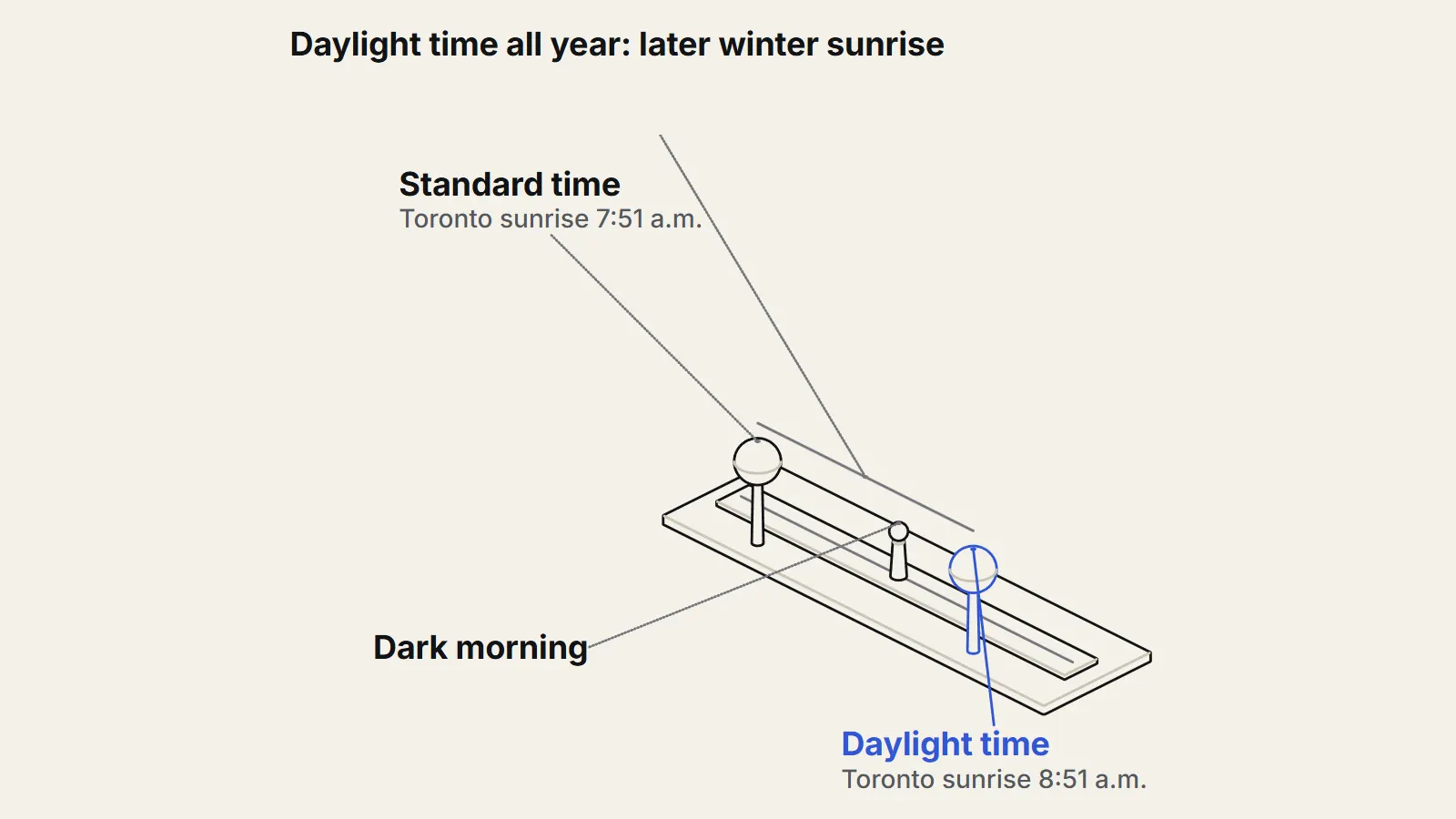
Permanent daylight saving time means moving the clocks one hour ahead and leaving them there all year, so winter mornings stay dark an hour longer and evenings stay light. This piece answers a news item we saw on 15 and 16 October 2026: an analysis in a Canadian medical journal says the health evidence favours permanent standard time instead. As of 17 October 2026, three questions matter. What would the switch change? Has the United States tried it? And what do the sleep, energy and pay studies show? Nothing here is medical, legal or investment advice.
What would permanent daylight saving time change?
It does not add daylight. It moves it, from the morning to the evening. The new analysis, published on 5 October 2026 in the Canadian Medical Association Journal, gives two examples. Under year-round daylight saving time, the latest winter sunrise in Toronto would be 8:51 a.m. rather than 7:51 a.m., and in Calgary 9:40 a.m. rather than 8:40 a.m.1 1 The lead author is Raymond Lam of the University of British Columbia, with Ralph Mistlberger of Simon Fraser University and Patrick Baylis of the University of British Columbia among the authors.1 It is a literature review, meaning it weighs earlier studies instead of running a new one.2
Several Canadian jurisdictions have already chosen daylight time for the whole year. Yukon did so in 2020, British Columbia in March 2026, and Alberta and the Northwest Territories a month later.1 The Canadian Press adds that Manitoba announced the same plan this year, so clocks in much of western Canada will not go back on 1 November.3 In the United States, the Sunshine Protection Act would do it nationally. The House passed a bill to make the change permanent on 14 July 2026, and the Sleep Foundation's July update says it must still pass the Senate and be signed by the president.4 Earlier, in March 2022, the Senate passed a similar bill by unanimous consent, but the House version never left committee.4
Has the US tried permanent daylight saving time before?
Yes, in 1974. Daylight saving time itself began in the US with the Standard Time Act: Congress passed it on 15 March 1918, President Wilson signed it on 19 March, and clocks first moved on 31 March 1918, according to the Library of Congress (https://guides.loc.gov/chronicling-america-daylight-saving). That was a seasonal change. The year-round version came during the 1973 oil embargo, as Public Law 93-182, with the trial starting on 6 January 1974.5 Support did not last. According to PolitiFact, citing the National Opinion Research Center, approval fell from 79% in December 1973 to 42% by February 19746, and Americans disliked the dark winter mornings.6 Congress moved to end the trial early, and the country returned to standard time on 27 October 1974.6
- 15-19 March 1918Congress passes and President Wilson signs the Standard Time Act; daylight saving time first applies on 31 March.Source 7 (opens the source in a new tab)
- 6 January 1974Year-round daylight saving time begins as an energy-saving trial during the oil embargo.Source 5 (opens the source in a new tab)
- 27 October 1974The US returns to standard time after Congress ends the trial early.Source 6 (opens the source in a new tab)
- 14 July 2026The House passes a bill to make daylight saving time permanent; the Senate has yet to pass it.Source 4 (opens the source in a new tab)
Other countries have backed out too. The Canadian Press notes that Russia adopted permanent daylight time in 2011 and reversed it three years later, and that most of Chile's 2015 change was also reversed.3 Past reversals are not proof that a new attempt would fail, since a 1970s oil emergency differs from a choice made in peacetime. Our explainer on what causes inflation (https://therealigned.com/story/what-causes-inflation) covers the economic side of the 1970s oil shocks.
Does daylight saving time save energy?
Energy was the original reason for the 1918 law and the 1974 trial, and the evidence for it is modest. A 1975 Department of Transportation study found possible benefits but described them as minimal and hard to separate from seasonal variation and energy prices. A 1976 review by the National Bureau of Standards found no significant energy savings.5 A later study covers the weeks Congress added in 2005 at the start and end of daylight time. The Department of Energy found that extended daylight saving time saved about 1.3 terawatt-hours of electricity, or 0.03% of annual electricity use5.5 That figure covers a few extra weeks, not a full year of daylight time, so it cannot be scaled up with confidence. The details are in the Congressional Research Service report (https://www.everycrsreport.com/reports/R44411.html).
Is permanent daylight saving time bad for sleep and mental health?
The CMAJ authors argue that it is a worse fit for the body clock than permanent standard time. Their reasoning is that morning light helps synchronise the body clock, and major sleep and chronobiology organisations recommend permanent standard time on that basis.2 The American Academy of Sleep Medicine formed a Coalition for Permanent Standard Time in 2023.4 The review says an estimated 1% to 3% of people in Canada have seasonal affective disorder, a form of winter depression, and up to 15% have milder seasonal shifts in mood, sleep, appetite and energy. A later morning light signal could weaken a treatment that already relies on morning bright light.21
The authors also single out groups who may be affected more. Puberty shifts sleep later while school often starts early, so children and adolescents may lose sleep. Shift workers, transit users, pedestrians, cyclists, and people in rural or lower-income areas are also named.2 If a government still picks daylight time, the review suggests safer morning travel, flexible start times, and tracking of sleep, mental health and injuries.2 This describes what researchers report, and it is not medical advice.
What do supporters of year-round daylight time say?
The survey has limits. Critics note that it offered only two options and left out permanent standard time.3 On money, the Canadian Press reports on a US study finding that an hour later sunset reduces long-run earnings by about 5%3, and a Florida study linking an extra hour of morning sunlight to higher maths and reading scores among adolescents.3 We did not open those two studies, so we cannot judge how they were designed. Whether lighter evenings change pay is a labour-market question; our guide to why wages rise (https://therealigned.com/story/why-wages-rise) covers the usual drivers. Choices like this move costs and benefits between groups, a pattern also seen in our short history of the tariff debate (https://therealigned.com/story/a-short-history-of-the-tariff-debate).
What is not known about the long-run effects?
Quite a lot. The CMAJ review compares the two permanent options and does not decide whether clock changes should end at all.1 The 1974 trial was short and tangled up with an oil crisis, so it says little about long-run health. The Canadian provinces that switched this year will give the first modern evidence, and the authors ask governments to track school absence, mental health, sleep, injuries, physical activity and heart events, split by age, region, income, rurality and shift work.1 We could not open the full text of the CMAJ article, which our fetch tool blocked, so we relied on its news release and two reports of it. Read them at the CMAJ news release (https://www.eurekalert.org/news-releases/1146225) and the PolitiFact history of the 1974 trial (https://politifact.com/factchecks/2026/jul/20/social-media/a-1973-law-made-daylight-saving-yearlong-for-a-trial-period-then-it-was-canceled-early/).
Key takeaways
- The switch moves daylight from morning to evening; it does not add any.
- The US tried year-round daylight time in 1974 and ended the trial within a year after approval fell from 79% to 42%.
- A CMAJ review of studies, published 5 October 2026, concludes the health evidence favours permanent standard time.
- Energy savings are small: extended daylight time saved about 0.03% of annual US electricity use.
- Supporters point to lighter evenings and survey support; the long-run effects of the switch are not yet measured.
Sources
- 1Permanent Daylight Saving Time Could Harm Sleep and Mental Health, Canadian Analysis Says (opens the source in a new tab) · Sci.News, 2026 · Reporting · https://www.sci.news/medicine/permanent-daylight-saving-time-15110.html
- 2Permanent daylight saving time: CMAJ news release on health analysis (opens the source in a new tab) · Canadian Medical Association Journal (via EurekAlert), 2026 · Report · https://www.eurekalert.org/news-releases/1146225
- 3Clocks stay in daylight saving, but analysis backs permanent standard time (opens the source in a new tab) · CP24 (The Canadian Press), 2026 · Reporting · https://www.cp24.com/news/canada/2026/10/05/clocks-stay-in-daylight-saving-but-analysis-backs-permanent-standard-time/
- 4Latest Updates on Daylight Saving Time in 2026 (opens the source in a new tab) · Sleep Foundation, 2026 · Reporting · https://www.sleepfoundation.org/sleep-news/latest-updates-daylight-saving-time-legislation-change
- 5Daylight Saving Time (CRS report R44411) (opens the source in a new tab) · Congressional Research Service (via EveryCRSReport), 2016 · Report · https://www.everycrsreport.com/reports/R44411.html
- 6A 1973 law made daylight saving yearlong for a trial period. Then it was canceled early. (opens the source in a new tab) · PolitiFact, 2026 · Reporting · https://politifact.com/factchecks/2026/jul/20/social-media/a-1973-law-made-daylight-saving-yearlong-for-a-trial-period-then-it-was-canceled-early/
- 7Daylight Saving: Topics in Chronicling America (opens the source in a new tab) · Library of Congress, 2024 · Primary source · https://guides.loc.gov/chronicling-america-daylight-saving