The efficient market hypothesis (EMH) says that the price of a traded asset already reflects all available information, so nobody can reliably beat the market after allowing for risk. The evidence is mixed in a specific way. Prices over days and weeks are very hard to predict, which supports the theory. Over years, prices swing further than company payouts seem to justify, which is where critics, led by Robert Shiller, push back. The Royal Swedish Academy of Sciences 2013 Nobel explainer (https://www.nobelprize.org/uploads/2018/06/popular-economicsciences2013.pdf) covers both findings, since the prize that year went to Eugene Fama, Shiller and Lars Peter Hansen for their work on asset prices. 1
What does the efficient market hypothesis claim?
The idea is that when investors compete, any known good news is quickly bought into the price. The Nobel committee's explanation runs like this: if investors could predict that a stock would rise a lot in the next year, they would buy it now and push the price up until the prediction no longer paid. What remains are random movements that reflect the arrival of news, a pattern called a random walk. 1
Fama's 1970 review sorted the tests into three levels by what information prices are supposed to reflect: past prices (weak form), all public information (semi-strong) and private information (strong). 2 A key practical point is that the hypothesis cannot be tested alone. To say a return is abnormal you need a model of what return is normal for the risk taken, so a failed test may mean the market is inefficient or that the risk model is wrong, and the test cannot tell which. This is the joint hypothesis problem. 2
What evidence supports it?
Two lines of evidence stand out. First, after a large amount of statistical work by Fama in the 1960s, researchers now agree that past prices are of very little use in predicting returns over the immediate future1. 1 Second, event studies show how quickly prices absorb news. A 1969 study by Fama, Fisher, Jensen and Roll looked at stock splits and found the market seemed to take in the information very swiftly, with no slow, predictable drift afterwards. 1
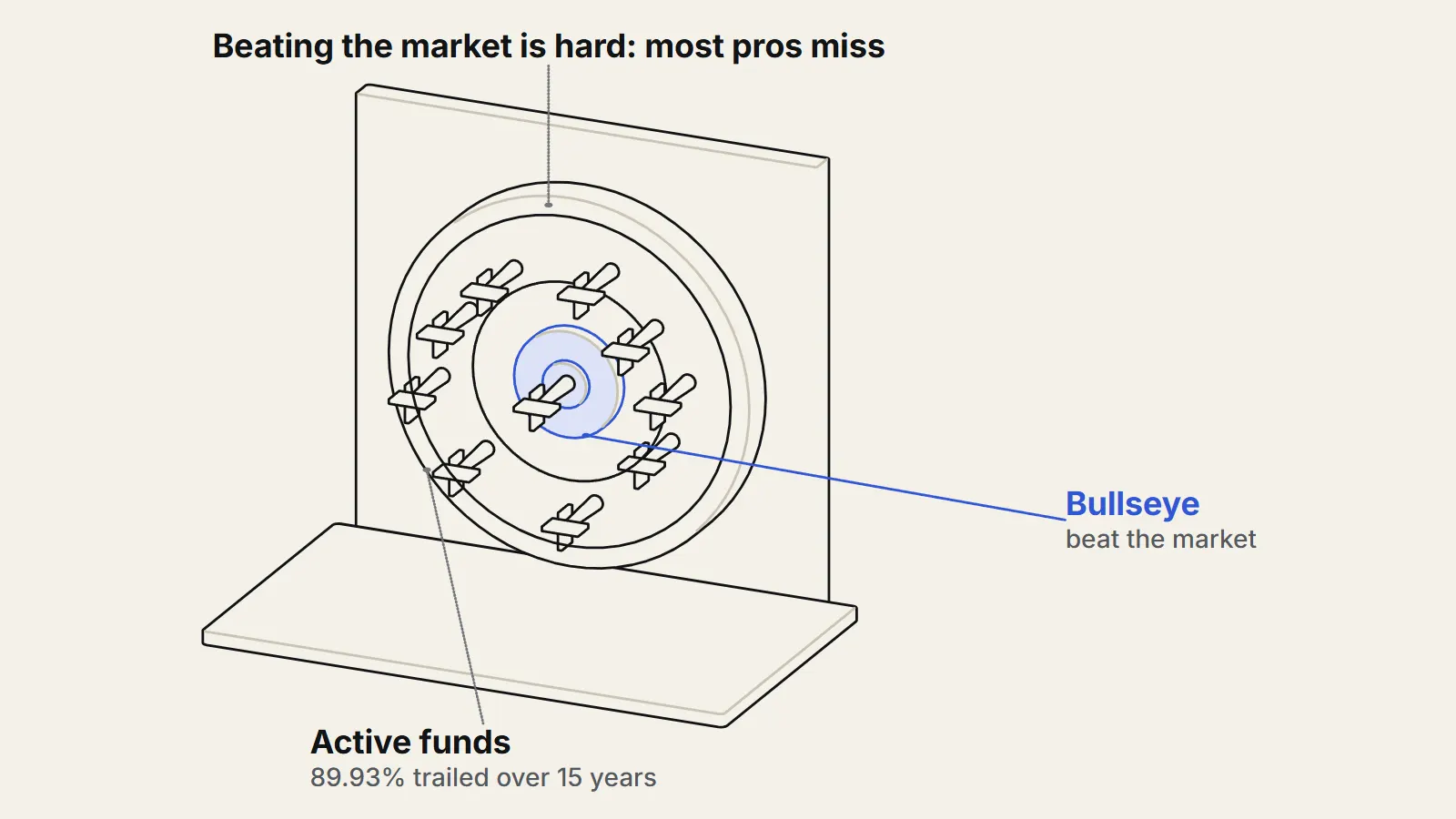
Fund performance gives a practical test. If prices are hard to beat, professional stock pickers should struggle. S&P Dow Jones Indices' SPIVA scorecard (https://www.ariesadvisors.com/files/spiva-us-year-end-2025.pdf) for year-end 2025 found that 89.93 percent3 of active large-cap U.S. equity funds trailed the S&P 500 (https://therealigned.com/story/what-the-sp-500-is-how-it-is-built) over 15 years, and 92.89 percent over 20 years. 3 The Nobel committee noted that research generally has not found funds earning more than their risk justifies, and that after fees their returns often come out negative, a finding that helped drive the growth of index funds (https://therealigned.com/story/index-funds-vs-active-funds-evidence). 1
What do the critics say?
Shiller's 1981 study found that stock prices move far more than the dividends they are supposed to reflect. 1 If prices were simply the sum of expected future dividends, they should not swing that much. One implication is that a high price relative to dividends tends to be followed, over the next several years, by a fall in that ratio, and a low one by a rise, which means returns are somewhat predictable in the longer run. 1 The Nobel committee describes this as a result that may seem both surprising and contradictory next to the short-run findings, and that broad price courses can be foreseen over periods such as three to five years. 1
The later work of Fama himself added a twist. He and others found that how closely a stock moved with the market was not the key predictor of its return, and that the size of a company and its book-to-market ratio (book value divided by market value) mattered more. Value stocks, those with a high ratio, tended to earn more than stocks with a low ratio. 1 Whether that is a reward for hidden risk or a sign of mispricing is, again, argued both ways, and each camp can claim the finding.
Behavioural economists add an explanation: mistakes by investors, such as overconfidence and overreaction, may push prices away from fundamental values. 2 A standard reply is that rational investors should bet against such mistakes and remove them. The behavioural answer is that institutional limits, such as credit constraints, can stop them from doing so at scale. 1
Is there a fair defence against the critics?
Yes, and it is the main counterargument. Predictability does not prove inefficiency, because a risky asset must on average pay more, and risk can change over time. The Nobel committee says that a well-functioning market can still show somewhat predictable prices because of risk. 1 Fama made a similar point about the 2008 crisis: that prices fell before the recession is what an efficient market would be expected to do. 2 Critics reply that predictability alone does not show how much of it could be exploited after costs.
What do we not know?
The core question, how much of long-run predictability reflects rational changes in risk and how much reflects mispricing, is unresolved. The Nobel committee wrote that it is too early to say. 1 The SPIVA figures describe one fund universe measured against one index, and cannot show whether a skilled investor exists. The evidence also cannot tell you what any one person should do with their savings. This piece describes the debate and does not recommend a strategy.
Key takeaways
- The EMH says prices reflect available information, so beating the market consistently after risk is not possible.
- Short-run prices are very hard to predict, and about 89.93 percent of active large-cap funds trailed the S&P 500 over 15 years to end-2025.
- Shiller found prices swing more than dividends explain, and long-run returns show some predictability.
- Whether that reflects changing risk or mispricing is still disputed, so the theory is a useful benchmark, not a settled law.
Sources
- 1Trendspotting in asset markets: Popular information, Prize in Economic Sciences 2013 (opens the source in a new tab) · The Royal Swedish Academy of Sciences, 2013 · Report · https://www.nobelprize.org/uploads/2018/06/popular-economicsciences2013.pdf
- 2Efficient-market hypothesis (opens the source in a new tab) · Wikipedia, 2003 · Reporting · https://en.wikipedia.org/wiki/Efficient-market_hypothesis
- 3SPIVA U.S. Scorecard, Year-End 2025 (opens the source in a new tab) · S&P Dow Jones Indices, 2026 · Report · https://www.ariesadvisors.com/files/spiva-us-year-end-2025.pdf