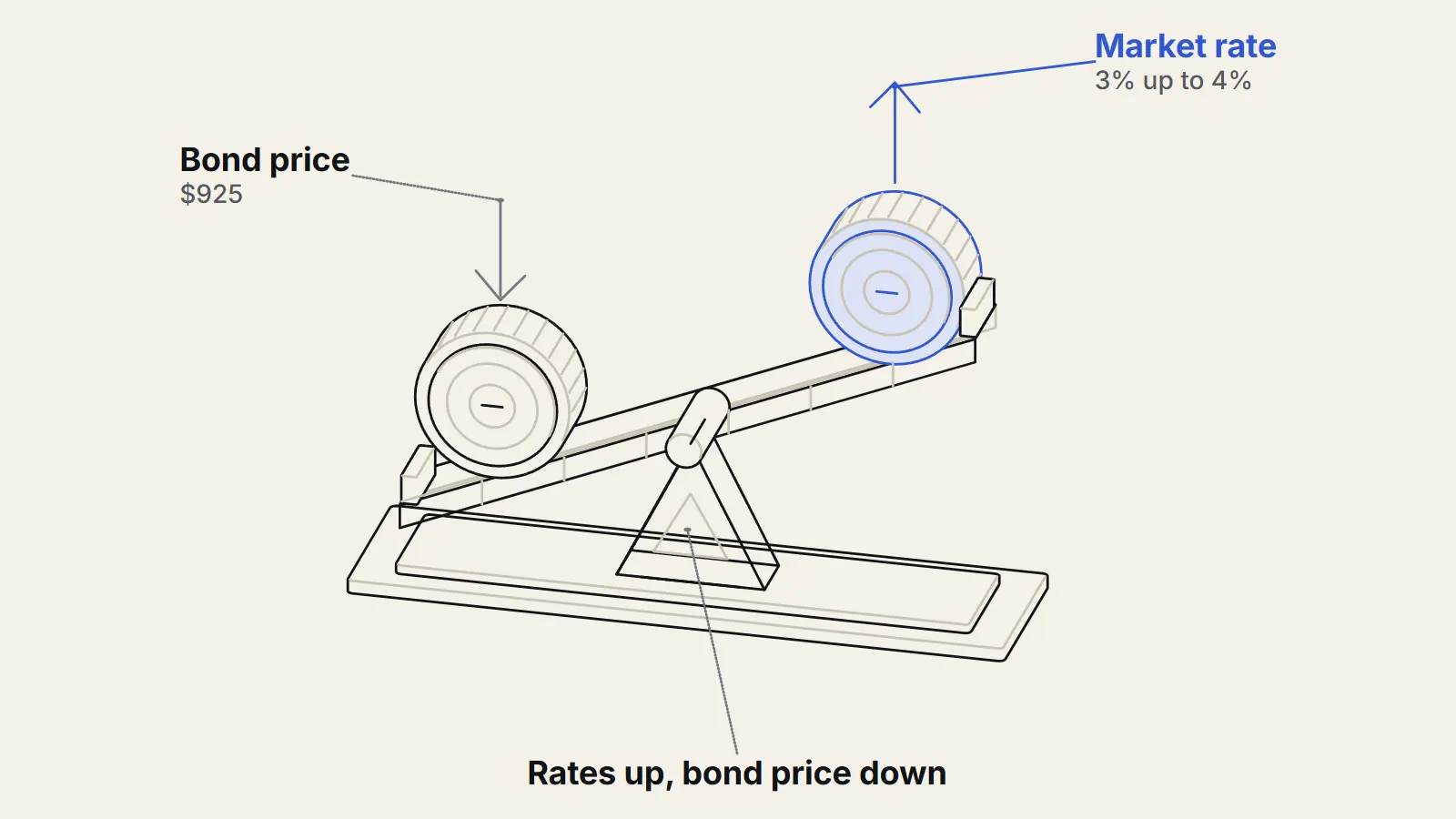
A bond is a loan that you can sell to someone else. Its price moves opposite to market interest rates because a bond pays a fixed amount, and what that fixed amount is worth depends on what new bonds pay. When rates on new bonds rise, an older, lower-paying bond is less attractive, so its price must fall until it offers a similar return. The U.S. Securities and Exchange Commission (https://www.sec.gov/files/ib_interestraterisk.pdf) calls this interest rate risk, and says it applies to bonds with fixed payments, even those issued by the U.S. government. 1
How does a bond work?
When you buy a bond, you lend money to a government or company. The issuer promises two things: regular interest payments, called coupon payments, and the return of the face value (also called par) on a set date, the maturity. A bond with a $1,000 face value and a 3% coupon pays $30 a year until it matures. 1
The yield is the return you earn given the price you actually paid. If you pay exactly $1,000 for that bond, your yield to maturity is 3%. If you pay less, say because the bond is older and rates have risen, you still collect the same $30 a year and the full $1,000 at the end, so your return is higher than 3%. Price and yield are two ways of describing the same fixed set of payments, which is why they cannot move together.
Why do bond prices fall when interest rates rise?
Imagine you hold a 3% bond and new bonds of the same type now pay 4%. Nobody will pay full price for your 3% bond when 4% is available elsewhere. A buyer will only take yours at a discount that makes up the gap. In the SEC's worked example, a 10-year Treasury bond with a $1,000 face value and 3% coupon would be priced at $9251 one year later if market rates rose to 4%, which lifts its yield to 4%. If market rates fell to 2% instead, the same bond would be worth $1,0821. 1 The SEC uses a seesaw to picture it: one end is the market interest rate, the other is the price of the fixed-rate bond.
Note what this does and does not mean. The issuer still pays every coupon and the full face value at maturity. The government guarantees that, but according to the SEC it does not guarantee the market price if you sell early. 1 If you hold to maturity, the price swings along the way do not change what you are owed, though you may have missed the chance to earn more elsewhere.
Which bonds are hit hardest?
Two features decide how far a price moves. The first is maturity: the longer the wait for repayment, the longer you are stuck with an out-of-date rate. The second is the coupon: a low coupon means less income to cushion the change. The SEC states that bonds with longer maturities and lower coupons generally carry more interest rate risk. 1
Investors summarise this with duration, stated in years, which signals how much a bond's price is likely to move. FINRA (https://syndication.finra.org/content/duration-what-interest-rate-hike-could-do-your-bond-portfolio), the US broker regulator, gives two examples. An investment-grade corporate bond with a 10-year maturity and 3.5% coupon, with a duration of 8.4, could lose about 15 percent2 of its value if rates rose by 2 percentage points. A 30-year bond with a 4.5% coupon, with a duration of 14.5, could lose about 26 percent. 2 A fund with a duration of 10 would fall roughly 10 percent for each 1 percentage point rise in rates, according to the same notice. 2 These are rules of thumb for small, quick changes, not exact predictions.
What happened to bonds in 2022?
In 2022 the Federal Reserve raised its policy rate (the federal funds rate (https://therealigned.com/story/how-the-fed-sets-interest-rates), the overnight rate banks charge each other) seven times. The target range went from 0.25 to 0.50 percent on March 17 to 4.25 to 4.50 percent on December 15. 3 Yields on existing bonds adjusted upward, and prices dropped.
The result was unusual. According to the investing site A Wealth of Common Sense, the Bloomberg U.S. Aggregate Bond Index, a broad measure of U.S. investment-grade bonds, returned about -13 percent4 in 2022. That was its worst year since the index began in 1976; the previous worst was a 2.9 percent loss in 1994. 4 U.S. stocks lost 18.1 percent the same year, so the usual cushion that bonds give a stock portfolio mostly failed. 4 Low starting yields likely made it worse, since there was little coupon income to offset the price fall, though that is an inference rather than a measured figure.
What is the case against "bonds are risky"?
The strongest counterargument is that bonds are safe if you hold them to maturity, because you get your money back regardless of the interim price. That is true for a bond whose issuer does not default. But it assumes you can wait. A fund never matures, investors may need to sell early, and a saver who locked in a low rate lost purchasing power while inflation was high. Whether bonds are safe depends on your time horizon and what you need the money for.
What do we not know?
Nobody knows where rates will go next, and prices already reflect the market's guesses. Duration figures assume small, parallel changes in rates; real yield curves move unevenly. And 2022 is one episode: it shows what a rapid rate rise can do, not what typically happens.
Key takeaways
- A bond's price and its yield move in opposite directions because its payments are fixed.
- When market rates rise, older lower-paying bonds must fall in price to compete; the SEC example shows $1,000 becoming $925.
- Longer maturity and lower coupon mean more price sensitivity, summarised as duration.
- In 2022, after seven Fed rate rises, the Bloomberg U.S. Aggregate lost about 13 percent, its worst year since 1976.
Sources
- 1Interest rate risk: When Interest Rates Go Up, Prices of Fixed-Rate Bonds Fall (Investor Bulletin) (opens the source in a new tab) · U.S. Securities and Exchange Commission, 2013 · Primary source · https://www.sec.gov/files/ib_interestraterisk.pdf
- 2Duration: What an Interest Rate Hike Could Do to Your Bond Portfolio (opens the source in a new tab) · Financial Industry Regulatory Authority, 2017 · Primary source · https://syndication.finra.org/content/duration-what-interest-rate-hike-could-do-your-bond-portfolio
- 3Open Market Operations: Policy Implementation (federal funds target range changes) (opens the source in a new tab) · Board of Governors of the Federal Reserve System, 2022 · Primary source · https://www.federalreserve.gov/monetarypolicy/openmarket.htm
- 42022 Was One of the Worst Years Ever For Markets (opens the source in a new tab) · A Wealth of Common Sense, 2023 · Essay · https://awealthofcommonsense.com/2023/01/2022-was-one-of-the-worst-years-ever-for-markets/