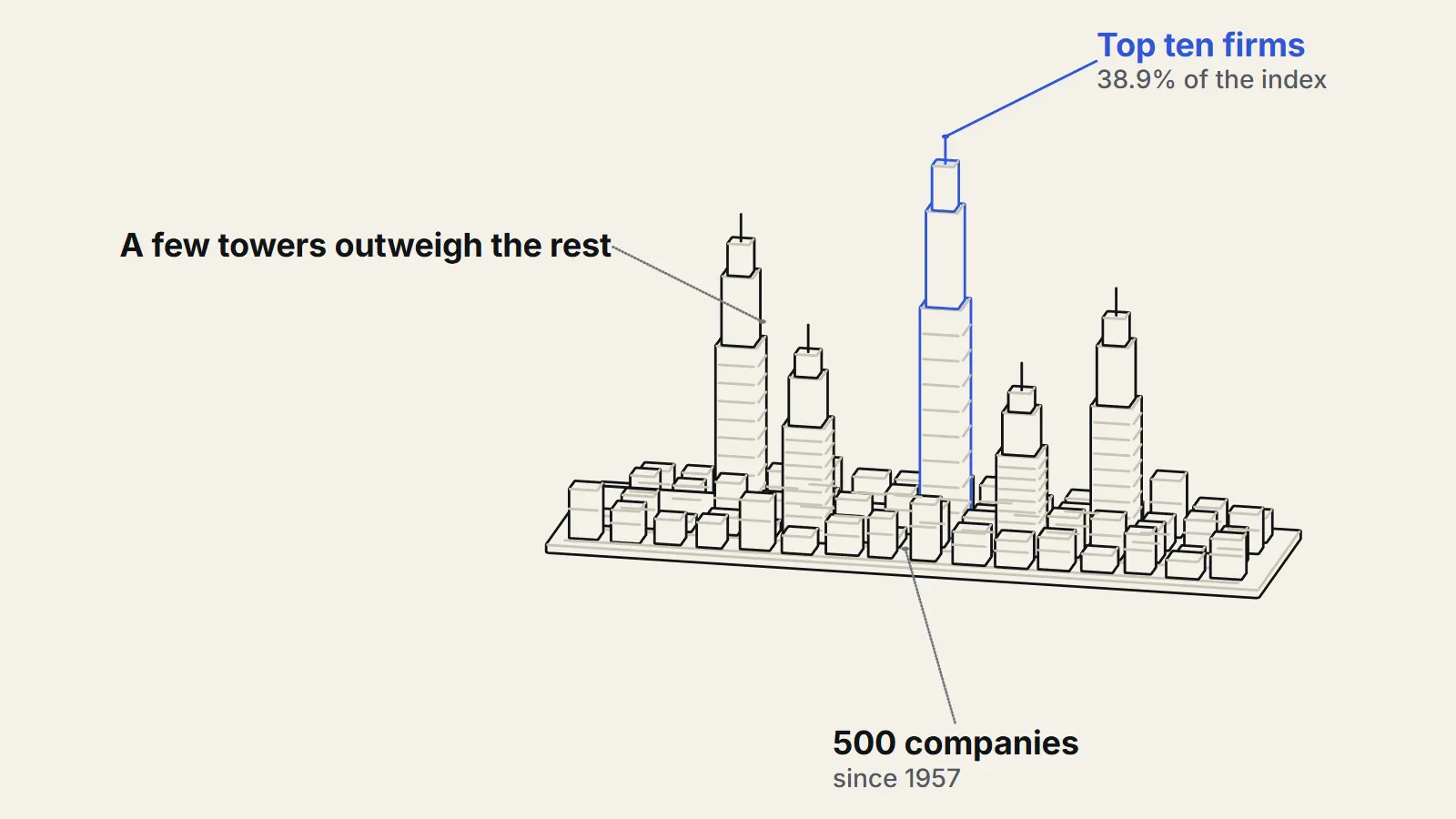
The S&P 500 is a list of 500 large U.S. companies, maintained by S&P Dow Jones Indices, whose combined share prices are used as a gauge of the U.S. stock market (https://therealigned.com/story/how-the-stock-market-works). A committee picks the companies using published rules, and each company counts in proportion to the market value of the shares the public can trade. S&P describes the index as covering approximately 80% of available market capitalization1. 1
What is the S&P 500, and where does it come from?
An index is a basket of stocks tracked as a single number, so you can see how a market moved without checking thousands of share prices. The S&P 500 was launched on March 4, 19572, when an earlier index expanded to cover 500 companies.2 S&P says it was the first U.S. market-cap-weighted stock index. 1 Its history (https://en.wikipedia.org/wiki/S%26P_500) runs back to 1923. 2 You cannot buy the index itself, but many funds are built to copy it, which is why it also works as the basis for investment products.
Who decides which companies are in?
The members are not simply the 500 biggest companies. A committee selects them. 2 Candidates must first pass a set of rules, which S&P summarises in its factsheet: the company must be a U.S. company, its market value must be at least USD 22.7 billion1 for additions since 1 July 2025 (it was USD 20.5 billion in the February 2025 factsheet), at least a tenth of its shares must be available to the public, and it must be profitable on a reported basis, meaning positive earnings in the latest quarter and across the latest four quarters added together.3 Its shares must also trade often enough relative to their value. 1
Passing the tests does not guarantee a place. S&P also considers whether the mix of industries in the index resembles the mix in the wider market. 1 Together with the other rules, that is why a large company can stay outside the index. The thresholds are a snapshot and the methodology document is the place to check the current ones. The details here come from S&P Dow Jones Indices factsheet (https://resources.carsongroup.com/hubfs/WMC-Source/2025/03-10-25-S&P-Dow-Jones-Indices%20-%202.pdf), which summarises its full methodology.
How does market-cap weighting work?
A capitalization-weighted index gives each company a weight based on the total market value of its shares, which is share price multiplied by the number of shares. 4 If one company is worth ten times another, it moves the index ten times as much when its price changes. 4 Think of 500 players in a tug of war, where the strongest pull hardest.
The S&P 500 goes one step further and counts only the shares the public can buy. Shares held by insiders or governments are set aside. 4 S&P calls its approach float-adjusted market cap weighting, and the index moved to that approach in 20052. 2 The index is reviewed and rebalanced quarterly, in March, June, September and December. 1
A simple made-up example shows the effect. Suppose a three-company index has firms worth $600 billion, $300 billion and $100 billion in publicly tradable value, $1 trillion in all. Their weights are 60, 30 and 10 percent. If the price of the smallest firm doubles, its value rises to $200 billion and the index rises by about 10 percent; if the price of the largest firm doubles, the index rises by 60 percent. The numbers are invented to show the arithmetic, not real companies, but the same logic applies to the 500 real ones. It also shows why the index can look healthy while most of its members lag: if the heaviest companies rise, the index rises, whatever the smaller ones do.
That point matters for how people read headlines. When a news report says the S&P 500 rose 1 percent, it is describing a weighted average that leans toward the largest names, not the experience of the typical company in the list. A fund that holds all 500 in index proportions will match that weighted result, while a portfolio with equal amounts in each company would behave differently. Neither is wrong; they answer different questions about what you want to measure or own.
What is the case against cap weighting?
The main objection is concentration. As of August 31, 2026, Wikipedia reports that the ten largest companies made up about 38.9 percent of the index and the largest twenty about 49.0 percent, with information technology the largest sector at 37.4 percent. 2 Because weights track market value, a small group of companies can drive the index even though it holds 500. A buyer of an S&P 500 fund is, in effect, making a big bet on them.
The defence is that cap weighting needs no judgment about which firms are good: it holds what the market holds, and it adjusts automatically as companies grow or shrink. An alternative, equal weighting, would force frequent trading and would give small firms the same influence as the largest ones. Which is better is a question about costs and risk preferences more than a settled fact.
What do we not know?
The committee's decisions involve judgment that the published rules do not fully spell out, so we cannot predict every addition or removal from the criteria alone. The factsheet thresholds are dated and change over time. And the concentration figures are a snapshot: they will differ by the time you read this. This piece explains how the index is built, not whether to own it.
Key takeaways
- The S&P 500 is 500 large U.S. companies chosen by a committee, covering about 80% of available U.S. market value.
- Entry requires being a U.S. company above a size threshold with positive reported earnings and enough public float and trading.
- Companies are weighted by the market value of their publicly tradable shares, so bigger firms count for more.
- That makes the index concentrated: the top ten companies were about 38.9% of it on August 31, 2026.
Sources
- 1S&P 500 factsheet (as of February 28, 2025) (opens the source in a new tab) · S&P Dow Jones Indices, 2025 · Primary source · https://resources.carsongroup.com/hubfs/WMC-Source/2025/03-10-25-S&P-Dow-Jones-Indices%20-%202.pdf
- 2S&P 500 (opens the source in a new tab) · Wikipedia, 2003 · Reporting · https://en.wikipedia.org/wiki/S%26P_500
- 3S&P Dow Jones Indices Announces Update to S&P Composite 1500 Market Cap Guidelines (opens the source in a new tab) · S&P Dow Jones Indices, 2025 · Primary source · https://press.spglobal.com/2025-07-01-S-P-Dow-Jones-Indices-Announces-Update-to-S-P-Composite-1500-Market-Cap-Guidelines
- 4Capitalization-weighted index (opens the source in a new tab) · Wikipedia, 2006 · Reporting · https://en.wikipedia.org/wiki/Capitalization-weighted_index