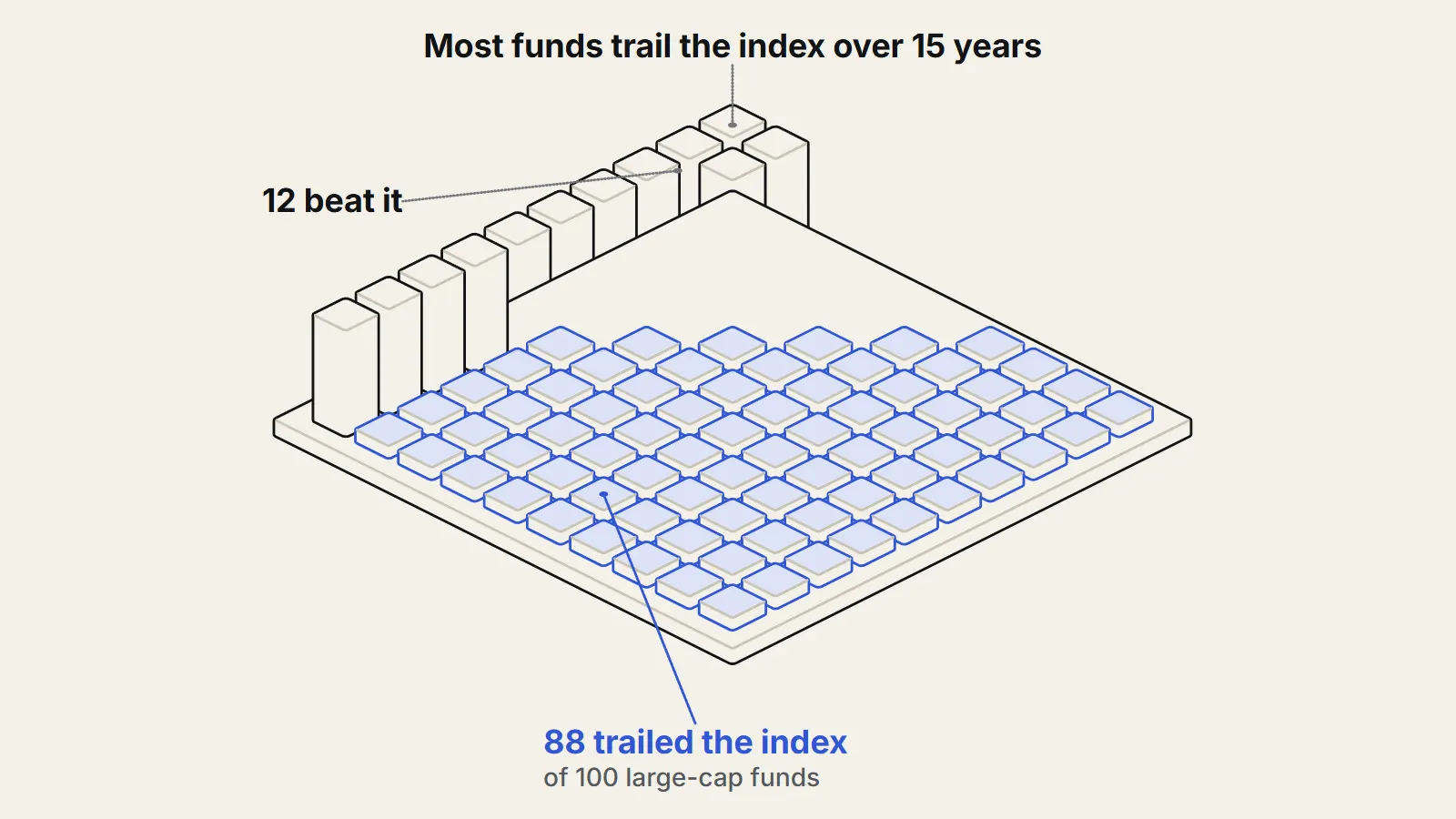
Over long periods, most actively managed US stock funds have earned less than the index they are measured against, after fees. That is the main finding of the SPIVA scorecards, which S&P Dow Jones Indices publishes twice a year. An index fund simply holds the stocks in an index, such as the S&P 500 (https://therealigned.com/story/what-the-sp-500-is-how-it-is-built), and charges little for doing so. An active fund pays managers to pick stocks and try to beat it. The evidence below describes past results for US funds. It is explanation, not advice, and it cannot say which fund will do better.
What do the SPIVA scorecards show about active funds?
The SPIVA method has three features worth knowing. It compares each fund with a benchmark suited to its category, so a small-company fund is not judged against the S&P 500. It counts every fund that existed at the start of a period, including those that later closed. And it publishes both simple averages across funds and averages weighted by fund size, since a very large fund affects more investors than a tiny one.1
The SPIVA U.S. Scorecard for mid-2025 (https://d1e00ek4ebabms.cloudfront.net/production/uploaded-files/spiva-us-mid-year-2025-bc7a7f61-4b27-48b0-b20a-856cc87521d0.pdf), with data to June 30, 2025, measures what share of funds trailed their benchmark. For large-cap funds, which buy big US companies, measured against the S&P 500, 88.29 percent underperformed over 15 years and 91.03 percent over 20 years1.1 Over five and ten years the figures were 86.91 and 85.98 percent. Mid-cap and small-cap funds, tested against their own benchmarks, also trailed over 15 years, at 83.72 and 85.41 percent.1
Short periods vary a lot. In the first half of 2025, 54.31 percent of large-cap funds trailed, an improvement on the 65 percent in full-year 2024.1 Reporting on the later year-end results says 79 percent of large-cap funds trailed in 2025, among the worst showings in the history of the scorecards.2 So a fund can beat the index in one year without changing the long-run picture, and the long-run share has stayed high.
Why do costs matter so much?
SPIVA uses fund returns net of fees, excluding sales loads.1 So the comparison is a fund after its costs against an index that has no costs, which is a hard test, though it is also what an investor in the fund actually received. An index fund passes on a small version of that gap; the active fund passes on a larger one.
A 2010 study by Eugene Fama and Kenneth French (https://mba.tuck.dartmouth.edu/bespeneckbo/default/AFA611-Eckbo%20web%20site/AFA611-S8C-FamaFrench-LuckvSkill-JF10.pdf), in the Journal of Finance, asks whether this is luck or skill. They found that the combined portfolio of actively managed US equity funds is close to the market portfolio3, but that the high costs of active management show up as lower returns to investors.3 Their simulations suggested that few funds produce returns big enough to cover their costs. Before costs, they found evidence of both inferior and superior managers, but the spread of skill they estimated was modest.3 The logic is arithmetic: if all investors together hold the market, active investors as a group must earn the market return before costs, so after costs they must trail it.3
What are the limits of this evidence?
First, the share of funds trailing says nothing about by how much. Second, the results are averages across thousands of funds; they do not rule out that some managers are skilled, and the Fama and French study itself found evidence of superior funds before costs.3 Third, the scorecards cover US mutual funds and ETFs, so they say little about other markets, hedge funds or private investments. Fourth, the scorecard itself points to the outperformance of the largest US stocks as a factor in recent results, so the period may have favoured the index in a way that may not repeat.1 The mid-cap and small-cap results in the first half of 2025, where only 25 and 22 percent of funds trailed, show the gap can shrink or reverse for a time.1
A fifth limit is survivorship. Funds that close or merge may well be the weaker performers. SPIVA corrects for this by counting all funds that existed at the start of the period. Over 15 years it began with 1,033 large-cap funds, and 49.95 percent of them were still active at the end1.1 A comparison that looked only at today's surviving funds would flatter active management.
What is not known?
The data cannot tell you in advance which funds will win. SPIVA also publishes a persistence report that asks whether winners keep winning, but we did not open it, so this piece makes no claim about it. It is also unclear whether the long run of index-beating results will continue if market leadership changes, and an index fund has its own risks: it falls when the market falls. Choices between funds also depend on taxes, time horizon and goals, which no scorecard measures.
Key takeaways
- Over 15 years to mid-2025, 88.29 percent of US large-cap funds trailed the S&P 500 after fees.
- Fees are a main reason: active funds as a group hold roughly the market, so costs show up as lower returns.
- Some funds do beat the index, and short periods vary widely, but picking them in advance is the hard part.
- The data cover US funds and a period led by a few big stocks, and the share trailing says nothing about how much.
- This is an explanation of evidence, not advice about what to buy.
Sources
- 1SPIVA U.S. Scorecard, Mid-Year 2025 (opens the source in a new tab) · S&P Dow Jones Indices, 2025 · Report · https://d1e00ek4ebabms.cloudfront.net/production/uploaded-files/spiva-us-mid-year-2025-bc7a7f61-4b27-48b0-b20a-856cc87521d0.pdf
- 2Active managers stumble again in 2025 as large caps dominate (opens the source in a new tab) · InvestmentNews, 2026 · Reporting · https://www.investmentnews.com/equities/active-managers-stumble-again-in-2025-as-large-caps-dominate/265541
- 3Luck versus Skill in the Cross-Section of Mutual Fund Returns (opens the source in a new tab) · The Journal of Finance, vol. 65, no. 5, 2010 · Paper · https://mba.tuck.dartmouth.edu/bespeneckbo/default/AFA611-Eckbo%20web%20site/AFA611-S8C-FamaFrench-LuckvSkill-JF10.pdf