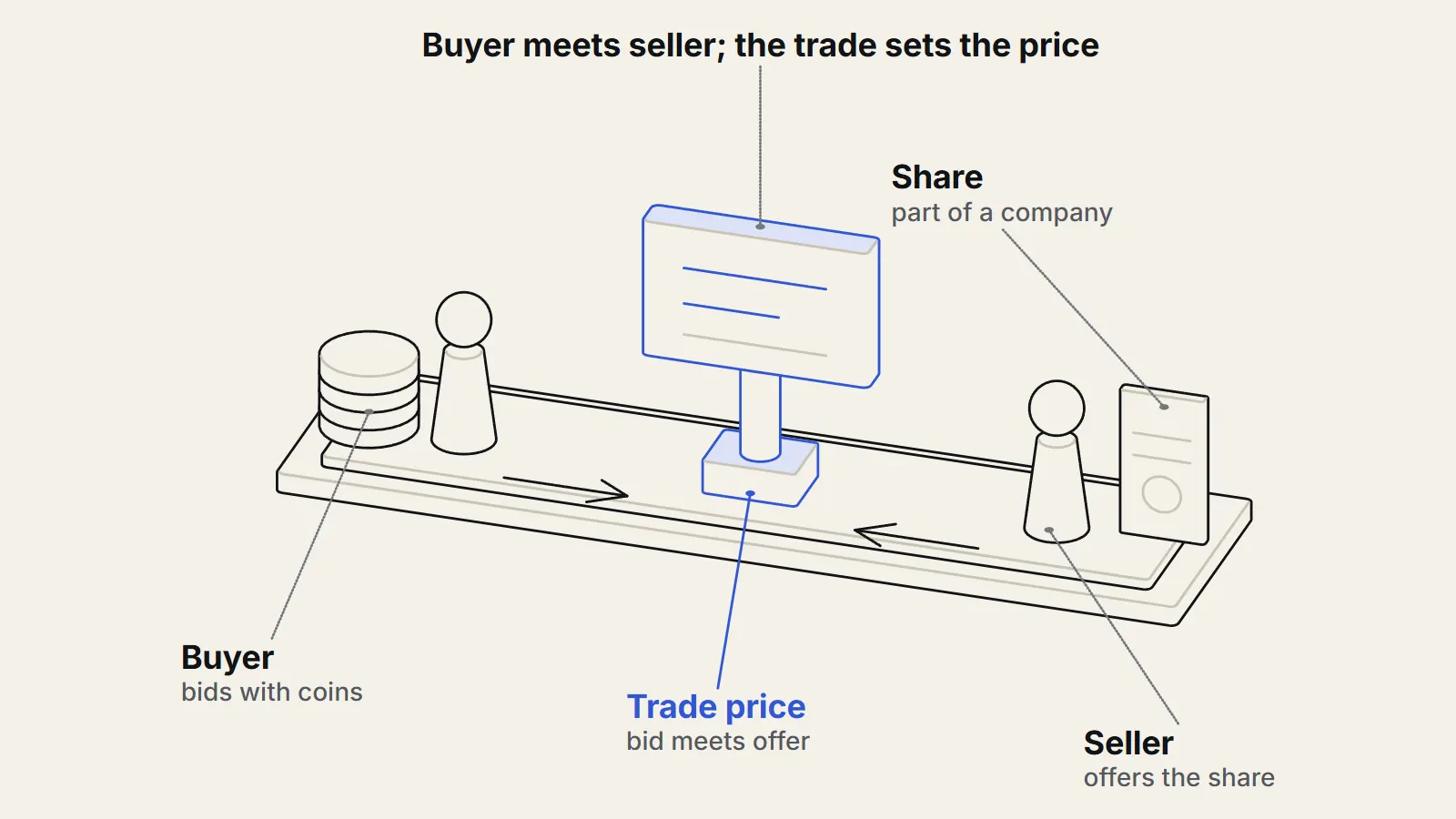
The stock market is a set of places where people buy and sell shares of companies. A share is a small slice of ownership in a company. When a company first sells shares to raise money, that is a one-time event; almost all later trading is between investors, who swap shares among themselves while the company is not directly involved. Prices move as buyers and sellers change their minds about what a company is worth. This piece explains what a share is, why prices change, and what an exchange does.
What is a share of stock?
The Washington State Department of Financial Institutions describes a stock as a security that gives holders a share of ownership in a company1.1 Companies issue shares, often in an initial public offering (IPO), to raise money to grow. After that, investors can resell the shares on the stock market.1 The company receives money only when it sells new shares, not when existing ones change hands.
Owners of common stock can vote at shareholder meetings and receive dividends, which are a portion of the company's earnings paid out to shareholders. Preferred stock usually carries no vote but is paid before common stock, including if a company goes bankrupt and its assets are sold. In that case common shareholders may be last in line and may not get their money back.1 A share price can therefore fall a long way, even to zero.1
Why do stock prices move?
The same state regulator says prices are typically driven by expectations of the company's earnings, meaning its profits.1 If investors come to expect higher profits, more of them want to buy and fewer want to sell at the old price, so the price rises until buyers and sellers are balanced again. If expectations fall, the reverse happens. Nothing about the company itself has to change for the price to move; only expectations have to.
At any moment, the price you see is the result of orders waiting in the market. An SEC staff report explains that stock prices are reflected in the best bid, which is an order to buy, and the best offer, which is an order to sell, resting on exchange order books.2 The gap between them is the bid-ask spread. A trade happens when a buyer is willing to pay what a seller is willing to accept.
What does an exchange do?
An exchange is a marketplace that collects buy and sell orders and matches them under set rules. The SEC staff report says that US stock trades execute either on one of 16 registered national securities exchanges2 or off exchange, for example on alternative trading systems or with off-exchange market makers.2 Each exchange has its own best bid and offer, and the best prices across all of them combine into the National Best Bid and Offer.2 Exchanges, the report says, play a central role in price discovery, meaning the process by which the market arrives at a price.
Ordinary investors do not send orders to an exchange themselves. They place an order with a broker, who decides where to send it, which could be an exchange, a market maker, an electronic network that matches orders automatically, or the broker's own firm.3 The SEC explains (https://www.sec.gov/reportspubs/investor-publications/investorpubstradexechtm.html) that a market order fills at the available price, which may differ from the quote you saw, while a limit order sets a specific price. Brokers must seek the best reasonably available execution.3 An SEC staff report (https://www.sec.gov/files/staff-report-equity-options-market-struction-conditions-early-2021.pdf) adds that market makers stand ready to buy and sell, and the spread normally pays them for the risk that prices move against them.2 Regular trading hours on exchanges run from 9:30 a.m. to 4:00 p.m. Eastern Time4.4
What goes wrong or is disputed?
Markets can be thin or stressed. After hours there is generally less trading interest and less price competition, which can mean wider bid-ask spreads or no quotes at all.4 In January 2021, trading in GameStop shares became unusually volatile: on January 28, the stock's average relative effective spread was 0.54 percent, three times its 2020 average of 0.18 percent, and its trading was paused 40 times in January under the Limit-Up, Limit-Down mechanism, against one pause in all of 2020.2 Those figures show how the machinery strains when orders pile up on one side.
There is also a long-running disagreement about what prices mean. One view holds that prices reflect available information and are hard to beat. Another holds that prices can drift from underlying value for long stretches. This piece does not settle that dispute, and none of the sources used here do.
What is not known?
No source here says how much of the price of any given stock reflects its profits, as opposed to mood or expectations about the economy, or how much trading volume is on exchange versus off it today; the exchange count above dates from the SEC staff report on early 2021 and can change. Nothing here is a view on whether to buy any stock.
Key takeaways
- A share is a slice of ownership in a company; the company gets money only when it first sells shares.
- Prices are typically driven by expectations of earnings, and they can fall a long way, even to zero.
- The price at any moment comes from the best bid and offer waiting in the market.
- Investors trade through brokers, who send orders to exchanges, market makers or other venues; brokers must seek best execution.
- Stress or after-hours conditions can widen spreads and thin out trading.
Sources
- 1The Basics of Investing in Stocks (opens the source in a new tab) · Washington State Department of Financial Institutions, 2026 · Reporting · https://dfi.wa.gov/financial-education/information/basics-investing-stocks
- 2Staff Report on Equity and Options Market Structure Conditions in Early 2021 (opens the source in a new tab) · U.S. Securities and Exchange Commission staff, 2021 · Report · https://www.sec.gov/files/staff-report-equity-options-market-struction-conditions-early-2021.pdf
- 3Trade Execution: What Every Investor Should Know (opens the source in a new tab) · U.S. Securities and Exchange Commission, 2013 · Primary source · https://www.sec.gov/reportspubs/investor-publications/investorpubstradexechtm.html
- 4Investor Bulletin: After-Hours Trading (opens the source in a new tab) · U.S. Securities and Exchange Commission, Office of Investor Education and Advocacy, 2011 · Primary source · https://www.sec.gov/files/afterhourtrading.pdf