The repeal of the Corn Laws in 1846 ended Britain's duties on imported grain, after decades of argument over whether those duties kept bread dear to protect landowners. It passed because of pressure from a mass campaign, the leadership of the prime minister Robert Peel, and the failure of the Irish potato crop. Its effects on prices and national income were smaller than the fight suggests, while its effects on politics and on who gained and lost were large.
What were the Corn Laws and why did they matter?
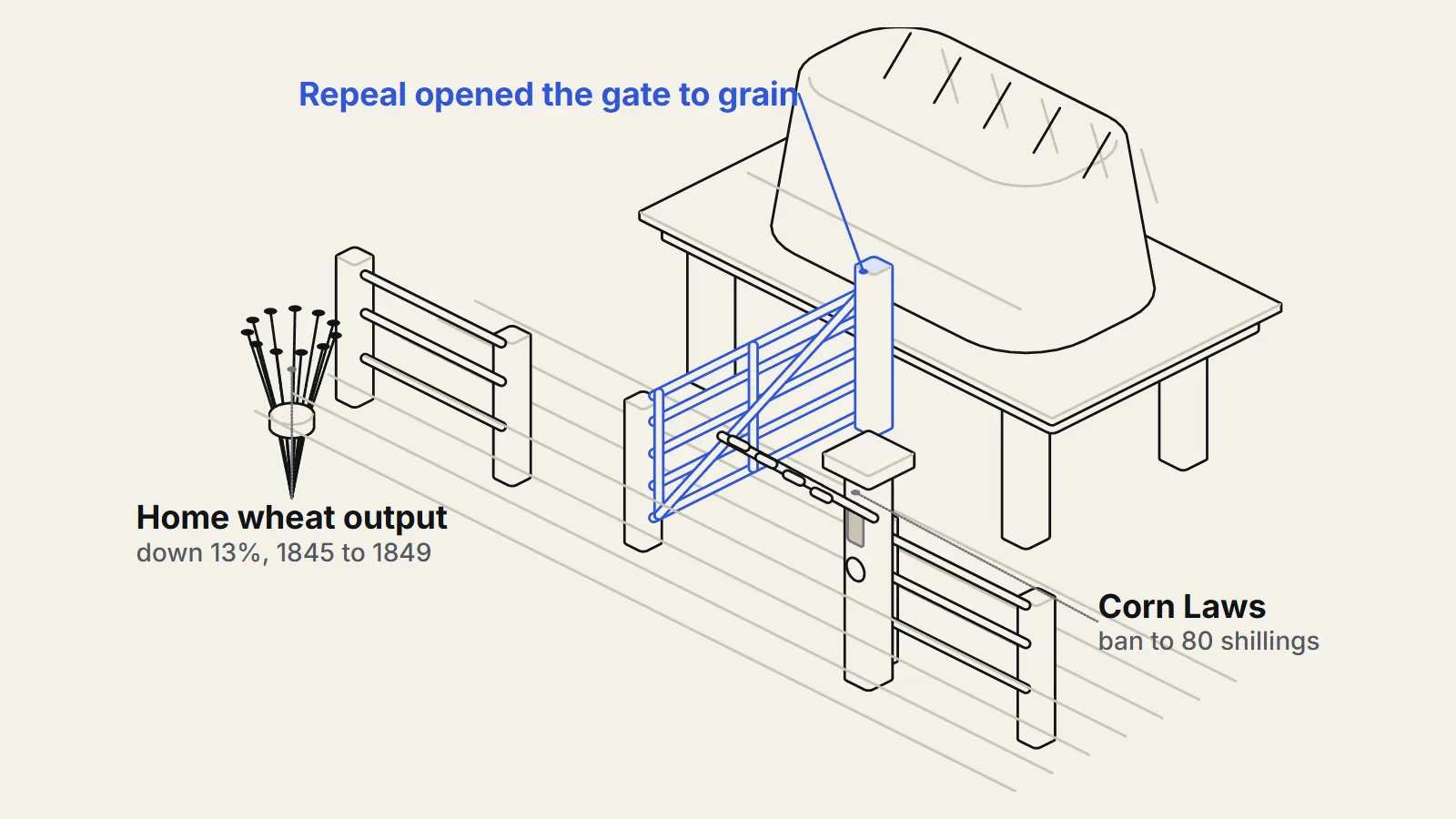
The Corn Laws were duties and rules on imported grain. In Britain "corn" meant grain, above all wheat. Economists Douglas Irwin and Maksym Chepeliev (https://www.nber.org/system/files/working_papers/w28142/revisions/w28142.rev0.pdf) write that they began in the mid-seventeenth century as duties meant to shield domestic farmers from low prices, and that they became an explosive political issue after the Napoleonic Wars ended in 1815, when restrictions on imports were significantly tightened.1 One encyclopedia account says the 1815 law banned wheat imports until the home price reached 80 shillings a quarter2.2 In 1828 a sliding scale replaced that: duties fell as prices rose and rose as prices fell.2
Protection had winners and losers. Landowners gained from higher grain prices and rents. Households paid more for bread. The Anti-Corn Law League (https://www.encyclopedia.com/history/modern-europe/british-and-irish-history/corn-laws), centred in the Lancashire cotton industry, blamed recurring industrial depressions on agricultural protection and attacked the laws as a symbol of aristocratic privilege.2
How did the campaign for repeal unfold?
An Anti-Corn Law League was founded in London in 1836 with little effect, and an Anti-Corn Law Association was founded in Manchester in September 1838.3 After a motion to end the laws was defeated in February 1839, the groups merged into a single League based in Manchester, led by Richard Cobden and John Bright.3 It was one of the first modern pressure groups.
Britain's Conservatives, who were largely protectionist, won the election of 1841 against a Whig plan for a fixed duty.2 Peel, their leader, did not repeal at first. One account says the industrial crisis of 1842 helped push him toward giving up the laws, and that he feared high food prices, League agitation and mass unemployment.2 The trigger was Ireland: the potato harvest there failed almost entirely, and Peel cited it in arguing for immediate repeal.3
How was repeal passed?
The House of Commons passed repeal on May 15, 18463, with a majority of Tory members voting against their own government.3 The Duke of Wellington carried it through the House of Lords on June 15.3 Peel was defeated soon afterward on an Irish measure and resigned. The Tories divided into Peelites and protectionists, and the protectionists later re-formed as the Conservative Party under Benjamin Disraeli.3 The encyclopedia account adds that the protectionists did not give up the idea of protection until 1852, and that repeal took full effect from 1849.2
What did repeal change in the economy?
Less than many expected, in the short run. Irwin and Chepeliev built a model of Britain in 1841 and treated repeal as removing an average implicit tariff (https://therealigned.com/story/who-pays-a-tariff) of 28 percent1 on grain, using an estimate by Sharp.1 They found that overall national welfare was roughly unchanged, or perhaps negligibly (0.1 percent) lower, because the efficiency gains were offset by worse terms of trade: Britain was so large a buyer that its demand pushed up the prices it paid abroad.1
The gains and losses were uneven. In the model landowners' incomes fell about 3 to 5 percent, while labour and capital gained slightly. Because poorer households spent more of their budgets on food, the bottom 90 percent of earners gained and the top 10 percent lost.1 The pattern fits the League's argument that protection mainly helped landowners, though the size of the gain for workers was small.
What happened afterwards was gradual. Irwin and Chepeliev report that domestic wheat production fell 13 percent between 1845 and 1849, and that repeal did not bring an immediate sharp drop in wheat prices. Prices rose in 1846 and 1847, probably because of the potato famine, then fell after the commercial crisis of 1847.1 The encyclopedia account says the main effect of repeal was delayed until the 1870s, when cheap transatlantic grain caused sharp falls in food prices and an acute agricultural depression.2
What is disputed, and what is not known?
Irwin and Chepeliev conclude that repeal mattered more in British political life than its underlying economic weight would suggest. That is one modern estimate resting on assumptions about trade elasticities, and the authors note that earlier models gave bigger price falls.1 The 28 percent figure is an average, since the sliding scale meant protection varied from year to year. It is also hard to separate repeal from other things that happened at once, including the famine, the 1847 crisis, industrial growth and later tariff cuts.1
Key takeaways
- The Corn Laws taxed or blocked grain imports; the 1815 law banned wheat imports until the home price reached 80 shillings a quarter.
- Repeal passed in 1846 after the Anti-Corn Law League's campaign, the Irish potato failure and Peel's decision to split his party.
- A modern model finds national income barely changed, with landowners losing about 3 to 5 percent and the bottom 90 percent of earners gaining.
- The large fall in grain prices came decades later, in the 1870s, with cheap transatlantic grain.
Sources
- 1The Economic Consequences of Sir Robert Peel: A Quantitative Assessment of the Repeal of the Corn Laws (opens the source in a new tab) · NBER Working Paper 28142, 2020 · Paper · https://www.nber.org/system/files/working_papers/w28142/revisions/w28142.rev0.pdf
- 2Corn Laws (opens the source in a new tab) · Encyclopedia.com, 2016 · Reporting · https://www.encyclopedia.com/history/modern-europe/british-and-irish-history/corn-laws
- 3British Parliament Repeals the Corn Laws (opens the source in a new tab) · EBSCO Research Starters, 2023 · Reporting · https://www.ebsco.com/research-starters/history/british-parliament-repeals-corn-laws/