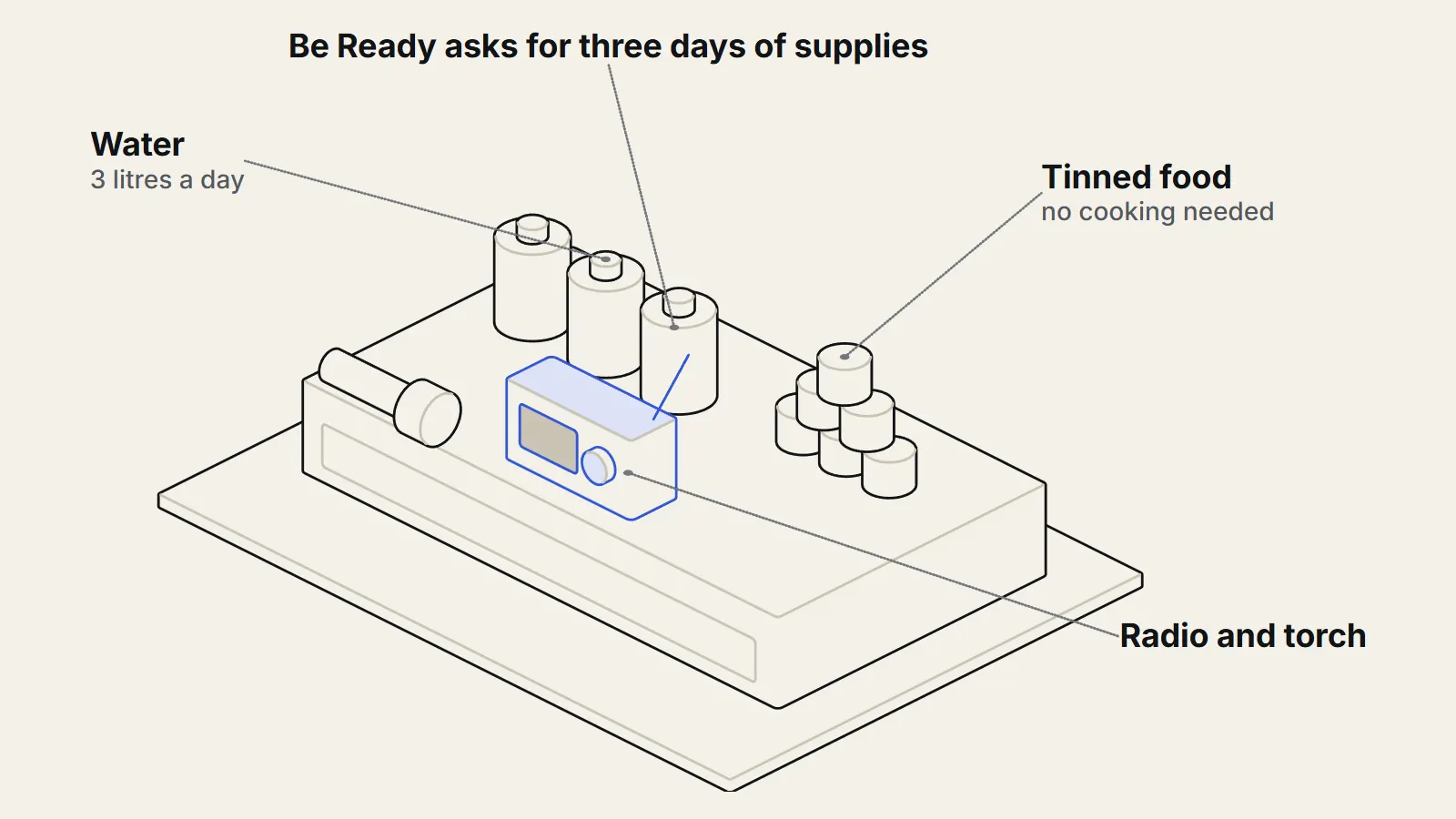
On 22 October 2026 the Cabinet Office launched Be Ready, updated household advice that asks people to be able to manage for three days if services are disrupted. Within days some retailers reported sharp rises in sales of radios, torches and tinned goods, and headlines spoke of a stockpiling rush. The picture in the numbers is more mixed: the British Retail Consortium said food availability remains strong1, and the advice itself tells households to build up gradually.
What does the Be Ready advice actually ask for?
The Cabinet Office describes Be Ready as the first stage of a three-year campaign3. The checklist is short. It asks for bottled water for three days at three litres per person per day for drinking, with more needed for cooking and washing, and for non-perishable food that needs no fridge or cooking, such as tinned meat, fish or vegetables, dried fruit and nuts2. It also lists a torch with spare batteries, warm clothing and blankets, a battery or wind-up FM radio, a charged power bank, cash, copies of important documents, and medicines, baby and pet supplies where needed2.
The checklist tells households to build up gradually, picking up missing items on regular shopping trips to spread the cost, and to check expiry dates every six months2. The checklist text we read does not use the words "stockpile" or "panic buying"; the headlines did. The Cabinet Office gives the reason for three days as helping households manage while support reaches those most in need3.
Build it gradually: Pick up missing items when you can during your regular shopping trips to help spread the cost.
— Be Ready checklist, Cabinet Office, October 2026
What did sales do after the announcement?
The figures are retailers' own statements, not audited market data, and most come without a baseline, so treat the percentages as signals rather than measurements. They are also very different in size: Maplin said radio sales rose 92%, torches 284% and power banks 106% since the announcement, compared with the same period a month earlier; Robert Dyas reported radio sales up 160% on the previous week; Iceland said tinned product sales rose 40% over the weekend4. Big percentages on small bases are easy to produce: one specialist seller reported selling about 300 wind-up radios against a usual 151.
| Retailer | Item | Change reported | Comparison given |
|---|---|---|---|
| Maplin | Radios | +92% | same period last month |
| Maplin | Torches | +284% | same period last month |
| Maplin | Power banks | +106% | same period last month |
| Robert Dyas | Radios | +160% | previous week |
| Iceland | Tinned products | +40% | weekend before 27 Oct, baseline not given |
Groceries tell a quieter story. Several large supermarkets told the Guardian they saw no material change in tinned goods demand and said the cold, stormy weather was more likely to lift soup and bean sales1. The one report of emptied shelves we found at supermarket scale is a single unnamed shopper describing an Asda store in Colchester5, with no sales data. And water was already rising before the campaign: NielsenIQ's figures for the four weeks to 3 October, before the advice, show mineral water sales up 17.4%6. No Kantar or NielsenIQ figures for tinned food or water after 22 October had been published when we checked, so the size of any effect is unknown.
Do warnings cause the shortages they warn about?
There is a long-running argument. Stockpiling is not new: in March 2020 the Office for National Statistics recorded the strongest monthly growth on record in food store sales volumes, 10.4% in its first estimate, with retailers citing panic buying or stockpiling7. A theory paper from the University of Alberta explains how it can snowball. When supply is short and prices cannot adjust, stockpiling and shortages reinforce each other, but stockpiling needs a real imbalance between supply and demand to start8. In other words a warning alone does not create a shortage; it can magnify a small one.
The retail industry's worry is about wording. The British Retail Consortium's Jim Bligh told MPs that panic buying is easy to generate, particularly if people are told to buy a particular type of product9, as The National reported. The government's answer is that the advice is gradual and general, and that preparedness is cheap insurance. The National Audit Office cites a Cabinet Office survey from 2025 in which 51% of respondents said their household was slightly or not at all prepared, and 75% had not seen or heard preparedness advice in the past year10.
Official guidance elsewhere shows how the timing question is handled. Finland's public guide says to gather supplies in normal times to avoid demand spikes and not to hoard during incidents11. The periods also differ across countries:
| Country | Household supply period | Water guidance |
|---|---|---|
| UK (Be Ready, October 2026) | 3 days | 3 litres per person per day (drinking) |
| Sweden (June 2026) | at least 1 week | at least 3 litres a day |
| Finland (updated June 2026) | at least 72 hours | no litre figure on the page we read |
| Germany (BBK) | 10 days if possible; 3 days helps | no litre figure on the page we read |
Why is the UK asking now? The National Audit Office notes that just-in-time stock, where retailers hold little or no stock on site, lowers cost but relies on continuous restocking and so is more vulnerable to disruption10. Supporters of household preparedness see advice as a cheap part of a wider fix. Critics of the way it was communicated, and the retailers, see a risk that it moves demand faster than shelves can be refilled.
What does stocking up cost a household?
Our own sample, not an official list: some of the food and water the checklist describes, at prices read on the Aldi UK website on 28 October 2026. It is not a full three days of meals and is not nutritionally checked. It leaves out the radio, torch, power bank and cash, because we did not find a retailer price page for them, and the government has not published a total.
| Item (one adult) | Quantity | Price each | Cost |
|---|---|---|---|
| Still water, 6 x 2 litres (12 litres) | 1 | £2.19 | £2.19 |
| Tuna, 145 g tin | 3 | £0.59 | £1.77 |
| Sweetcorn, 285 g tin | 3 | £0.55 | £1.65 |
| Corned beef, 340 g tin | 1 | £2.19 | £2.19 |
| Total for one adult | £7.80 |
For four adults the same sample costs about £29.01: three water packs at £2.19 (£6.57) and four times the £5.61 of food (£22.44). That is small beside a weekly shop, but the sums look different for a household on a tight budget, and the National Audit Office records Defra's view that further household resilience work may mean higher up-front costs, depending on income, storage space and capability10. The checklist's own answer is to spread the cost across normal shopping trips.
What to watch next
The Office for National Statistics put food and non-alcoholic beverages inflation at 1.3% in September 2026, with headline inflation at 3.5%14. Those figures predate the campaign. The next ONS inflation release, on 18 November, is the first official reading that could show any price effect. Until then the evidence for a stockpiling surge is retailers' statements, and the evidence against a broad shortage is the industry's own view that stocks are healthy.
Did the sales rise come from the advice, from the storm weekend, or both? The reports we read cannot separate the two.
Related on The Realigned: Basic Economics, a book brief on prices and incentives (https://therealigned.com/book/basic-economics), F. A. Hayek on what prices tell people (https://therealigned.com/thinker/f-a-hayek) and our piece on helium and supply chains (https://therealigned.com/story/helium-critical-material-why-the-us-added-a-gas).
Primary documents: the Be Ready checklist (https://beready.campaign.gov.uk/wp-content/uploads/sites/252/2026/10/Be-Ready-Checklist_English.pdf) and the Cabinet Office announcement (https://www.gov.uk/government/news/households-encouraged-to-take-small-simple-steps-to-stay-prepared-in-an-emergency).
Key takeaways
- Be Ready asks for three days of supplies, including 3 litres of drinking water per person per day, and says to build up gradually.
- Retailer-reported sales rises are large for radios and torches, but are company statements without audited baselines.
- Supermarkets and the British Retail Consortium say food availability is strong; the theory says warnings can magnify, not create, a shortage.
- A basic sample of water and tinned food for one adult cost £7.80 at Aldi on 28 October; a full kit has not been priced.
Sources
- 1Bottled water and tinned food sales surge after UK government issues emergency stockpile advice (Guardian, syndicated copy) (opens the source in a new tab) · The Guardian via finwire.io, 2026 · Reporting · https://finwire.io/news/world-news/bottled-water-and-tinned-food-sales-surge-after-uk-government-issues-emergency-stockpile-advice
- 2Be Ready Checklist (English PDF) (opens the source in a new tab) · Cabinet Office, GOV.UK Campaign, 2026 · Primary source · https://beready.campaign.gov.uk/wp-content/uploads/sites/252/2026/10/Be-Ready-Checklist_English.pdf
- 3Households encouraged to take small, simple steps to stay prepared in an emergency (opens the source in a new tab) · Cabinet Office, GOV.UK, 2026 · Primary source · https://www.gov.uk/government/news/households-encouraged-to-take-small-simple-steps-to-stay-prepared-in-an-emergency
- 4Retailers report rise in essential goods sales after public urged to stockpile (Press Association) (opens the source in a new tab) · Nation.Cymru (PA), 2026 · Reporting · https://nation.cymru/news/retailers-report-rise-in-essential-goods-sales-after-public-urged-to-stockpile/
- 5'Panic buyers' leave supermarket shelves 'empty' after gov's Be Ready campaign (opens the source in a new tab) · SWNS via Yahoo News UK, 2026 · Reporting · https://uk.news.yahoo.com/panic-buyers-leave-supermarket-shelves-133250255.html
- 6October Total Till Release, UK (four weeks to 3 October 2026) (opens the source in a new tab) · NielsenIQ, 2026 · Report · https://nielseniq.com/global/en/news-center/2026/uk-shoppers-stuck-between-seasons-as-summer-favourites-remain-in-the-supermarket-basket/
- 7Retail sales, Great Britain: March 2020 (opens the source in a new tab) · Office for National Statistics, 2020 · Primary source · https://www.ons.gov.uk/businessindustryandtrade/retailindustry/bulletins/retailsales/march2020
- 8Stockpiling and Shortages (opens the source in a new tab) · Klumpp and Su, University of Alberta, 2024 · Paper · https://sites.ualberta.ca/~klumpp/docs/tp8.pdf
- 9UK government advises stockpiling water and food (opens the source in a new tab) · The National, 2026 · Reporting · https://www.thenationalnews.com/news/uk/2026/10/23/uk-government-advises-stockpiling-water-and-food/
- 10Resilience of the food supply chain to disruptions (HC 587) (opens the source in a new tab) · National Audit Office, 2026 · Primary source · https://www.nao.org.uk/wp-content/uploads/2026/09/Resilience-of-the-food-supply-chain-to-disruptions.pdf
- 11Home emergency supplies (Suomi.fi, preparing for incidents and crises) (opens the source in a new tab) · Suomi.fi, Finnish public authorities, 2026 · Primary source · https://www.suomi.fi/guides/preparedness/how-to-prepare-for-incidents-and-crises/general-instructions-on-preparedness-home-emergency-supplies-and-on-what-to-do-in-different-situations
- 12Important information to all residents of Sweden: In case of crisis or war (MCF0180, June 2026) (opens the source in a new tab) · Swedish Civil Defence and Resilience Agency (MCF), 2026 · Primary source · https://rib.msb.se/filer/pdf/31523.pdf
- 13Aldi UK product pages: water; tins, cans and packets (opens the source in a new tab) · Aldi UK, 2026 · Reporting · https://www.aldi.co.uk/products/drinks/water
- 14Consumer price inflation, UK: September 2026 (opens the source in a new tab) · Office for National Statistics, 2026 · Primary source · https://www.ons.gov.uk/economy/inflationandpriceindices/bulletins/consumerpriceinflation/september2026