- Place
- United States
- Years
- 2011–2023
- Policy
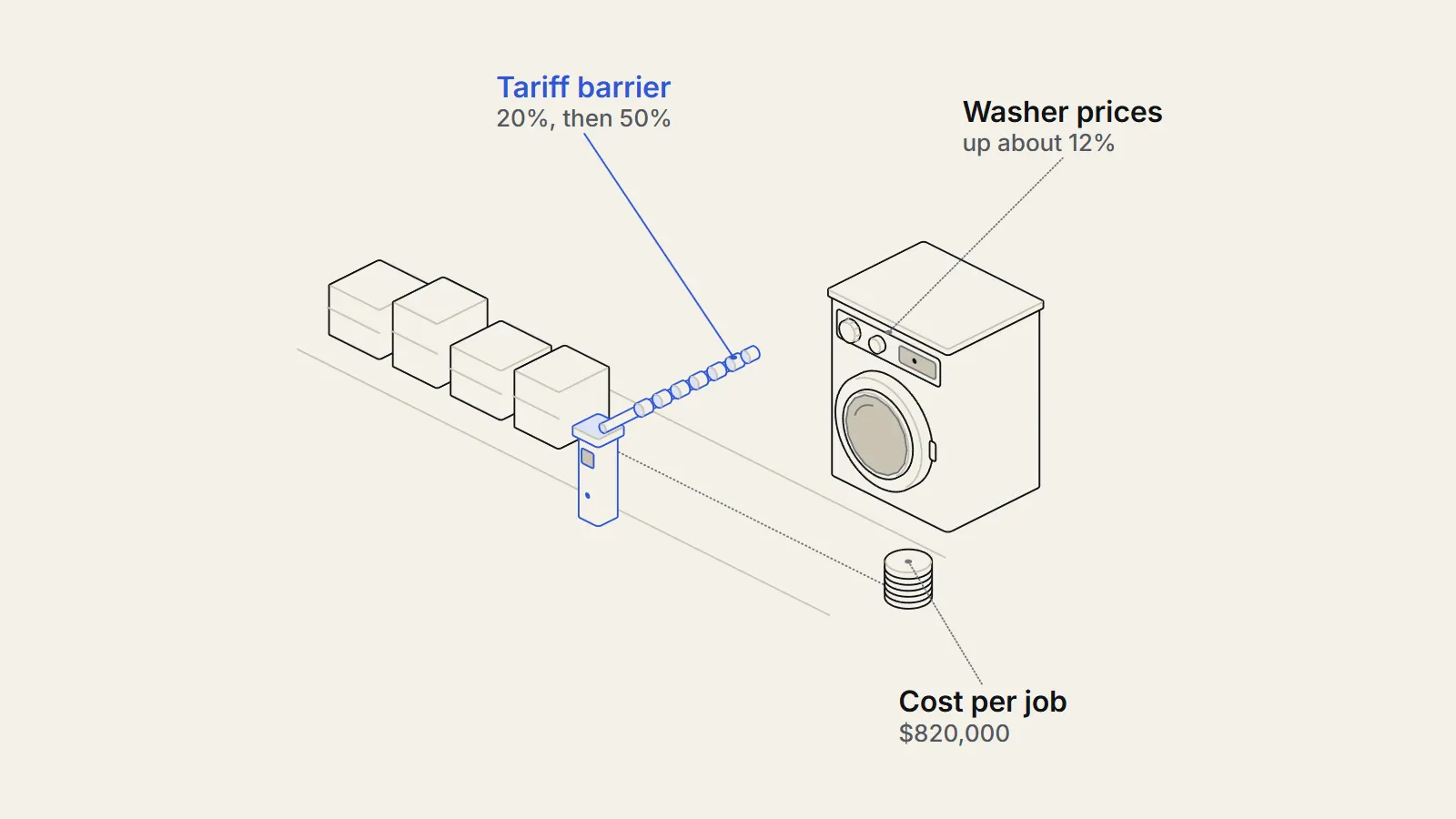
- After two rounds of country-specific antidumping duties, the U.S. imposed a global safeguard (set for three years, later extended to early 2023) in February 2018: 20 percent on the first 1.2 million washers, 50 percent above that.
- Outcome
- Washer and dryer prices rose about 12 percent in 2018; about 1,800 jobs were reported; one study puts the cost near $820,000 per job. Whether prices stayed high is disputed.
The 2018 washing machine tariffs were a safeguard that the United States placed on imported large washers and their parts in February 2018, set for three years and later extended to early 2023, with a 20 percent tariff on the first 1.2 million machines and 50 percent above that1.1 The goal was to rescue Whirlpool and other American makers from years of falling prices. Our reading of the evidence is that the tariffs did bring factory jobs, but retail prices rose about 12 percent, and one careful study, published as an NBER working paper (https://www.nber.org/system/files/working_papers/w25767/w25767.pdf), put the consumer cost near $820,000 for each job created3.3
Before
This case study follows the washing machine tariffs from the first complaint in 2011 to the price data that came after. We set out what the American makers argued, what the Korean makers argued, and what the numbers can and cannot prove.
Why washing machine tariffs began: two rounds that did not work
Washing machines were a trade fight for years before the 2018 safeguard. In late 2011, Whirlpool filed an antidumping petition against imports from Mexico and South Korea.3 An antidumping case claims that a foreign seller is charging less in the United States than it charges at home, or less than its costs justify, and that this harms a domestic industry. The remedy is a duty on that country's exports only.
The 2012 duties ranged from 9.2 to 82.4 percent on individual firms, and in the following two years imports from Korea fell by roughly 75 percent.3 The imports did not stop. Samsung and LG, the two Korean firms that made most of the imported washers, shifted production to China, and China became the main source.1
Whirlpool filed again in late 2015, this time against Chinese-built machines. Final duties announced in 2016 ranged from 38.4 percent for LG to 57.4 percent for Samsung, and imports from China fell from 3 million units a year in 2015 to roughly 300,000 in 2017.3 Production moved again, this time to Thailand and Vietnam.
Economists call this country-hopping. A tariff aimed at one country gives a firm a reason to move its factory, not necessarily to raise its price. The Chicago economists who studied the episode found that after the 2012 duties production relocated to China and the move lowered U.S. washer prices, and that the 2016 duties produced only small price movements.4 Washer prices in fact kept falling from 2012 to 2017.2
The U.S. government's own brief to the WTO describes the same pattern from the other side. It says each antidumping measure, on washers from Korea, Mexico and China, prompted a shift in production to a country where washers for the U.S. market were not covered, and it presents that as the reason the domestic industry finally asked for a global remedy.5
A shopper in 2017 who was deciding when to buy a washer had little reason to hurry, because prices had been drifting down for about five years. That is the starting point against which the 2018 results should be read.2
| Round | Who was targeted | Duty rates | What happened next |
|---|---|---|---|
| 2012 to 2013 antidumping | Korea and Mexico | 9.2 to 82.4 percent on named firms | Korean imports fell about 75 percent in two years; China became the main source |
| 2016 to 2017 antidumping | China | 38.4 percent (LG) to 57.4 percent (Samsung) | Chinese imports fell from 3 million to about 300,000 units a year; Thailand and Vietnam rose |
| 2018 safeguard | All sources of large washers | 20 percent in quota, 50 percent above, in year one | Retail washer and dryer prices rose about 12 percent in 2018 |
The American makers' case: losses and underselling
Whirlpool and the other domestic producers had a real complaint on paper. The U.S. Trade Representative's summary of the case says imports rose sharply from 2012 to 2016, domestic producers lost market share, and by 2016 they were running multimillion-dollar net operating losses.1 The U.S. International Trade Commission, an independent agency that investigates import injury, found that imports of large washers had nearly doubled between 2012 and 2016.5
The commission also compared prices. It found imported washers priced below comparable American ones in 70 of 92 quarterly comparisons5, or 76.1 percent of the time, with an average margin of 14.2 percent. Domestic sales prices fell on all six tracked products, by between 6.2 and 43.7 percent, while demand and production costs rose.5
the domestic industry's financial performance declined precipitously during the period of investigation
— U.S. International Trade Commission finding, as quoted in the U.S. first written submission to the WTO, December 2019
This is the factual core of the case for protection. Prices were falling while costs and demand rose, and the commission read that as imports pushing the domestic industry into losses. The commission also rejected an argument that Whirlpool's growing losses on washers were inconsistent with the profit margin of its whole North American business, because that wider result rested mostly on other products.5
The decision
The 2018 safeguard: a global tariff-rate quota
In 2017 Whirlpool asked for something different, a global safeguard under Section 201 of the Trade Act of 1974. Unlike antidumping, a safeguard does not require proof of unfair pricing. The commission only has to find that a product is being imported in such increased quantities that it is a substantial cause of serious injury to the domestic industry.3
The commission opened its investigation on June 5, 2017, at Whirlpool's request, covering 2012 to 2016.1 A Congressional Research Service review counts 75 Section 201 investigations between 1975 and 2018, with relief granted 28 times. No new Section 201 case was begun between 2001 and the cases started under the Trump administration.6
On January 22, 2018, the U.S. Trade Representative announced that the President had approved the remedy.1 It was a tariff-rate quota, which means two tariff levels. The first 1.2 million imported finished washers each year paid an additional 20 percent in year one, then 18 and 16 percent. Everything above that paid 50, 45 and 40 percent. Covered parts paid the higher rate, with an exempt volume of 50,000 units in year one.
A safeguard leaves the President a wide menu. The Congressional Research Service lists the options as follows.6
- proclaim a tariff, a tariff increase, a tariff-rate quota or a quota on imports
- implement adjustment measures for U.S. firms and workers
- negotiate and implement agreements limiting exports with other countries
- proclaim procedures for the auction of import licenses
- initiate international negotiations
- submit legislative proposals to Congress
- use any combination of these actions
By law the President must weigh costs and benefits. The U.S. Trade Representative's fact sheet (https://ustr.gov/sites/default/files/files/Press/fs/201%20Cases%20Fact%20Sheet.pdf) states that any action must facilitate positive adjustment to import competition and provide greater economic and social benefits than costs.1 The tariffs took effect in February 2018, and the quota was used up in October 2018, when the higher tier applied.3
Under the law, relief can last up to four years at first and be extended to a maximum of eight. The commission must monitor the measure while it is in force.6 In December 2020 it recommended an extension, and the tariffs were extended, finally expiring in early 2023.
- December 2011Whirlpool files an antidumping petition against washers from Korea and MexicoSource 3 (opens the source in a new tab)
- February 2013Final antidumping duties on Korea and Mexico go into effectSource 3 (opens the source in a new tab)
- December 2015Whirlpool files a second antidumping petition, against ChinaSource 3 (opens the source in a new tab)
- July 2016Antidumping duties on Chinese-built washers first appliedSource 3 (opens the source in a new tab)
- June 5, 2017The commission opens its Section 201 investigation at Whirlpool's requestSource 1 (opens the source in a new tab)
- January 22, 2018U.S. Trade Representative announces the safeguard tariffs on washersSource 1 (opens the source in a new tab)
- February 2018Safeguard tariffs first appliedSource 3 (opens the source in a new tab)
- May 14, 2018South Korea requests WTO consultations on the washer safeguardSource 6 (opens the source in a new tab)
- October 2018Quota limit reached; the higher second tier of tariffs appliesSource 3 (opens the source in a new tab)
- December 14, 2020The commission recommends extending the safeguardSource 6 (opens the source in a new tab)
The case against: country-hopping, consumers and a WTO challenge
LG and Samsung did not accept the injury finding. According to the U.S. account of the proceedings, they argued that American brands had lost ground because consumers had cooled on them, not because of imports, and that imported machines offered features and innovation that justified their position.5 The commission rejected both points, noting for example that survey data from the respondents themselves showed more consumers naming Maytag and Whirlpool as good brand names than LG and Samsung in 2016. South Korea took the dispute to the World Trade Organization in 2018.6
Korea also raised a legal point. World Trade Organization safeguard rules ask whether imports increased because of unforeseen developments, and Korea's first claim was that the commission had not shown this. The United States answered that the unforeseen element was the speed at which Samsung and LG expanded production and transferred it from one country to another after each round of duties.5 The point matters because it is the same country-hopping that makes the economic case against the tariff.
The deeper objection was economic and came from the earlier rounds. If a tariff on Korea only moved production to China, and one on China only moved it to Thailand, a global tariff is the only kind that bites. But a tariff that bites is a tax that someone pays, and the question was who.
Part of this objection could be seen in advance from the earlier rounds, and part could only be tested afterwards. The next section covers the test.
What happened
Did the washing machine tariffs raise prices?
Prices turned sharply. The Chicago study compared washers with other appliances and found that after the 2018 safeguard, washer prices rose about 12 percent in the first half of the year.2 Dryers, which were not tariffed, rose by about the same amount. The authors found that in about 85 percent of matching electric washer and dryer sets the two carried the same price, so retailers appear to price the pair together.2
All the large brands raised prices, domestic ones included. In the paper's brand estimates Whirlpool raised washer prices by 13 to 17 percent depending on the time horizon, Samsung by 15 to 17 percent, and G.E. by about 7 percent.3 Domestic makers did not pay the tariff on their own machines, so their increases are the part that surprised researchers. LG raised prices about 8 percent over four months and about 13 percent over eight months, and Maytag about 14 percent.3 The authors offer possible explanations, among them rising marginal costs of domestic production, and cite earlier work finding that plants shielded from antidumping duties tend to show higher prices and markups.
The earlier rounds are the contrast. A Brookings summary of the study stressed that the country-specific tariffs on Korea in 2012 and China in 2016 produced production shifts with small price movements or even decreases, while the 2018 global tariff raised consumer costs by about $1.5 billion.7
The timing of imports also fits an anticipation story. Imports spiked at the end of 2017 and then fell steeply once the tariffs were applied, which the Chicago brief reads as firms front-running the change.2 A Yahoo Finance column later reported that washer imports fell about 33 percent in the first tariff year and stayed below the earlier level through 2022.8
The authors put the median increase at $86 per washer and $92 per dryer. Multiplied by about 10 million washers and 7.7 million dryers sold a year, that is more than $1.5 billion in extra consumer spending3, set against about $82 million in tariff revenue collected from February 2018 to January 2019.3
How many jobs did the washer tariffs create?
The jobs side of the ledger was real but modest. Samsung planned about 1,000 workers by 2020 at a South Carolina plant, LG about 600 at a Tennessee plant, and Whirlpool reported adding 200 workers explicitly because of the safeguard.3 The Chicago authors took roughly 1,800 jobs and netted out tariff revenue to reach a cost of more than $815,000 for each job created3.3
The Tax Foundation (https://taxfoundation.org/blog/international-trade-commission-tariffs/), summarising the commission's later evaluation, set that against average pay of $47,000 a year for a production worker in the industry in 2020, about 17 times as much.9 The same evaluation found the industry as a whole increased employment, but production workers and wages at incumbent producers fell while those at new entrants rose.
The long run: did prices fall back?
The commission's evaluation found that prices of domestically produced washers rose after the safeguards and were higher in 2022 than in 2017.9 A 2024 Yahoo Finance column reported that laundry equipment prices rose 34 percent from February 2018 to February 2023, against 21 percent for all items and 23 percent for appliances overall, and then fell 11 percent in the following year.8
What did the washing machine tariffs achieve?
The tariffs brought factory jobs but also higher prices. The Chicago authors counted roughly 1,800 jobs and put the consumer cost at more than $815,000 for each job created.3 Washer prices rose about 12 percent in the first half of 2018.2 Whether that rise lasted is still argued, because the answer depends on the baseline chosen.
What economists still disagree on
Where economists and advocates still disagree
The most contested point is how long the price rise lasted. The Coalition for a Prosperous America, a group that backs tariffs, wrote in 2024 that the laundry equipment price index rose 12.4 percent from January to June 2018 but then fell 10.7 percent over the next 14 months. It added that the laundry equipment index fell 2.1 percent from January 2018 to January 2020 while the broad price index rose 4.1 percent.10 On its reading, the tariffs had little lasting effect on prices. It also criticises the 2019 study for using a narrow window of four to eight months after the tariffs took effect.
The other side points to the longer span. The Yahoo column argues that prices fell mainly after the tariffs ended, which it reads as evidence that the tariffs held them up.8 Both camps are using the same kind of data. The difference is the baseline: whether prices should be compared with where they stood before 2018, or with where they would have gone without the tariff.
The second dispute is about jobs. The tariff supporters count more than 2,000 jobs at LG and Samsung, with about 1,000 workers at LG's Clarksville plant and 1,200 at Samsung's Newberry plant, and they add investment of $360 million at Clarksville and $350 million at Newberry.10 The Chicago study counts about 1,800, and the Yahoo column 1,700 to 2,000.8 These counts are close. The disagreement is about whether jobs are the right unit of account, since the tariff-supporting view stresses investment and local payrolls while the Chicago view stresses the price paid for them.
The third is timing. Samsung and LG announced their U.S. factories in 2017, while the safeguard case was still pending.1 The data cannot separate how much of the investment responded to the actual tariff, to the threat of one, or to plans that would have gone ahead anyway.
Local payrolls are part of the tariff-supporting case. The same essay reports that LG initially hired 700 workers and later 300 more, that the Clarksville industrial park added 4,514 direct jobs over five years, and that average pay in Clarksville grew 77 percent in the ten years to 2022 against 62 percent nationally.10 The Chicago study does not test these claims, and they cover the whole local economy, not only washer production. Whirlpool itself employs 23,000 Americans in the essay's account, which puts the 200 washer-related hires in proportion.
The essay also cites a commission finding that tariffs raised domestic prices by 10 to 20 percent of the headline rate, which would imply a much smaller pass-through than the Chicago estimate.10 We could not open the commission report to check the figure, so we treat the two estimates as competing, not settled.
The minuses are that the costs largely fell on consumers
— Felix Tintelnot, economist, quoted by Yahoo Finance, December 2024
How many of the factory jobs would have existed without the safeguard, given that Samsung and LG announced their U.S. plants in 2017 while the case was still pending?
Limits of the evidence also matter. The cost-per-job figure is a partial equilibrium calculation, and the authors say they lacked information on supplier linkages.3 Higher appliance prices could also reduce spending on other goods, which would cost jobs in other industries, and the data cannot say by how much.
Lessons
Key takeaways
- Tariffs aimed at a single country tend to move factories, not prices. The 2012 and 2016 washer duties barely changed what shoppers paid.
- A tariff on every source passes through to prices, and it can reach untariffed goods sold as a pair, as dryers showed.
- The jobs were real but small: roughly 1,800 by the Chicago count, at a cost the authors put near $820,000 each.
- Whether the price rise lasted is still argued, because the answer depends on the baseline chosen.
What carries over is the mechanism: whether a tariff raises prices depends on whether firms can move production to an untouched country, and on whether the product is sold alongside others. What does not carry over is the size. Washers are an unusually well-measured case, with detailed retail price data, and the authors themselves say that for most products such data are unavailable.2
Another thing that carries over is the accounting. Tariff revenue was small next to consumer cost, so the policy worked as a transfer from buyers to a few producers and their workers. Whether that transfer is worth it is a political judgment about who should bear the cost, and the numbers alone do not decide it.
Our own caution is that this is one product in one period. It tells us how the washer market responded, not whether tariffs on other goods would behave the same way.
Sources
- 1Fact Sheet: Section 201 Cases, Imported Large Residential Washing Machines and Imported Solar Cells and Modules (opens the source in a new tab) · Office of the U.S. Trade Representative, 2018 · Primary source · https://ustr.gov/sites/default/files/files/Press/fs/201%20Cases%20Fact%20Sheet.pdf
- 2Production, Relocation, and Price Effects of US Trade Policy: The Case of Washing Machines (research brief) (opens the source in a new tab) · Becker Friedman Institute, University of Chicago, 2019 · Report · https://bfi.uchicago.edu/wp-content/uploads/BFI_RB_HortacsuTintelnot_041619_V02.pdf
- 3The Production Relocation and Price Effects of U.S. Trade Policy: The Case of Washing Machines (opens the source in a new tab) · National Bureau of Economic Research (Working Paper 25767), 2019 · Paper · https://www.nber.org/system/files/working_papers/w25767/w25767.pdf
- 4The Production Relocation and Price Effects of US Trade Policy: The Case of Washing Machines (opens the source in a new tab) · American Economic Review 110(7), 2020 · Study · https://www.aeaweb.org/articles?id=10.1257%2Faer.20190611
- 5United States - Safeguard Measure on Imports of Large Residential Washers (DS546): U.S. First Written Submission (opens the source in a new tab) · Office of the U.S. Trade Representative, 2019 · Primary source · https://ustr.gov/sites/default/files/enforcement/WTO/US.Sub1.fin.(public)_1.pdf
- 6Safeguards: Section 201 of the Trade Act of 1974 (IF10786) (opens the source in a new tab) · Congressional Research Service, 2021 · Primary source · https://www.everycrsreport.com/reports/IF10786.html
- 7Hutchins Roundup: High-achieving classmates, washing machine tariffs, and more (opens the source in a new tab) · The Brookings Institution, 2019 · Reporting · https://www.brookings.edu/articles/hutchins-roundup-high-achieving-classmates-washing-machine-tariffs-and-more/
- 8Higher prices, extra jobs: Lessons from Trump's washing machine tariffs (opens the source in a new tab) · Yahoo Finance, 2024 · Reporting · https://finance.yahoo.com/news/higher-prices-extra-jobs-lessons-from-trumps-washing-machine-tariffs-185047360.html
- 9Trump's Previous Tariffs Foreshadow the Economic Harm of Latest 10% Tariff Proposal (opens the source in a new tab) · Tax Foundation, 2023 · Reporting · https://taxfoundation.org/blog/international-trade-commission-tariffs/
- 10Economic View: Tariff-Jumping Investment, the Success of the 2018 Washing Machine Tariffs (opens the source in a new tab) · Coalition for a Prosperous America, 2024 · Essay · https://prosperousamerica.org/economic-view-tariff-jumping-investment-the-success-of-the-2018-washing-machine-tariffs/