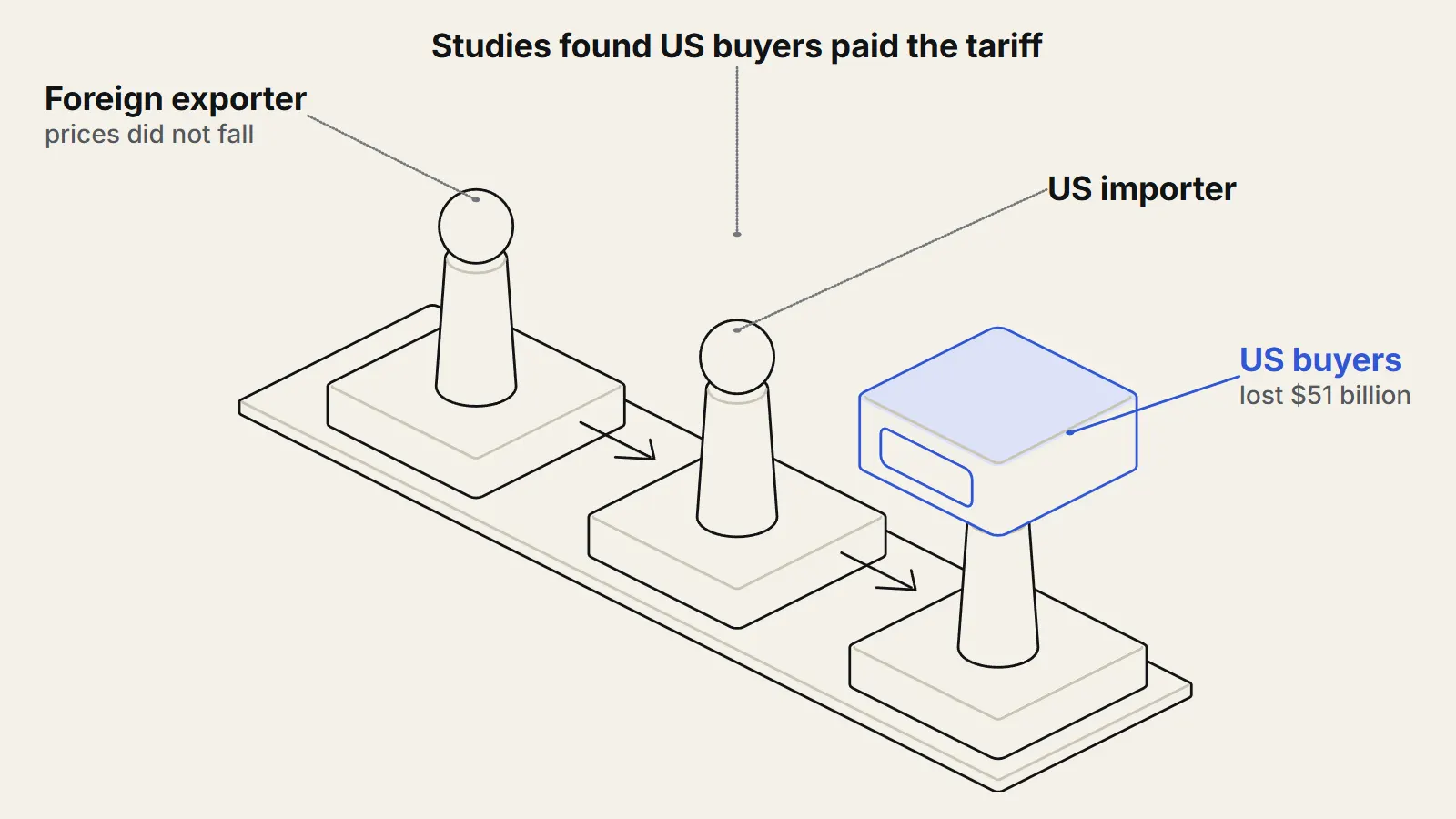
Who pays a tariff? In the studies of the 2018 and 2019 United States tariffs, the answer was mostly American importers and consumers, not the foreign exporters who sell the goods. Researchers measured this by checking whether the prices foreign sellers charged before the tariff fell when it arrived. If they had fallen, the foreign side would have borne part of the cost. Mostly they did not. This piece sets out what the main studies found, where they differ, and what they do not settle.
How do economists measure who pays a tariff?
A tariff is a tax collected at the border when a good is imported. The legal payer is the importing firm. Whether that firm also bears the cost depends on what happens next. Three outcomes are possible. The foreign exporter can cut its price to keep its customers, so the foreign side absorbs some of the tax. The importer can absorb it by accepting smaller margins. Or the importer can raise prices to its own customers, passing it on. Economists call the share passed on to buyers the pass-through. Complete pass-through means the price paid by the importer, tax included, rose by the full amount of the tariff.
Measuring this is not simple, because prices move for other reasons and the tariffs hit some products and not others. The studies below compare goods that were hit with goods that were not, before and after the tariffs took effect.
What did the main studies find?
Mary Amiti, Stephen Redding and David Weinstein studied the tariffs of 2018. In their published abstract (https://www.aeaweb.org/articles?id=10.1257/jep.33.4.187) they report that the tariffs were fully passed into the domestic prices of imported goods, and that the burden had so far fallen on U.S. consumers and importers rather than foreign exporters.1 They estimated a $1.4 billion a month1 reduction in aggregate U.S. real income by the end of 2018, and found that countries which retaliated with their own tariffs showed similar patterns.1
A second team, Pablo Fajgelbaum, Pinelopi Goldberg, Patrick Kennedy and Amit Khandelwal, built a model of the whole economy. Their abstract (https://www.nber.org/papers/w25638) says that prices of the targeted imports did not fall, which they read as complete pass-through into prices that include the duty. They estimate that U.S. buyers of imports lost $51 billion, or 0.27 percent of GDP2, and that the net loss to the country, after counting tariff revenue and gains to domestic producers, was $7.2 billion, or 0.04 percent of GDP2.2
Did the picture hold as the trade war grew? Amiti, Redding and Weinstein returned to the question with later data that included further escalation. They found that the tariffs were still almost entirely borne by U.S. firms and consumers3.3 They also found that the response of import values grew in size over time, which they link to firms needing time to rebuild their supply chains.3
Did shoppers see it in store prices?
Not always. Alberto Cavallo, Gita Gopinath, Brent Neiman and Jenny Tang compared prices at the border with prices at the store. They report that the tariffs were almost fully passed through to the total prices paid by importers, but that at retail the difference between affected and unaffected products was generally quite modest, which suggests retailers absorbed costs by cutting their margins.4 They also note that retailers increased imports after the tariffs were announced but before they took full effect, so the pass-through they saw at that stage may not last.4 So the cost at the border and the cost on the shelf are different questions, and the first is better measured than the second.
What is disputed, and where did foreigners pay?
The research has one notable exception. In steel, Amiti, Redding and Weinstein found that foreign exporters cut their prices substantially and exported relatively more than in sectors with complete pass-through.3 So the answer can differ by industry. Cavallo and co-authors also note that U.S. exporters, unlike foreign exporters facing U.S. tariffs, cut prices on goods hit by foreign retaliation.4 In other words, the retaliation side showed the opposite pattern from the headline one.
What do these studies not tell us?
They measure prices and incomes, not every aim of a tariff. A government may impose tariffs to protect a strategic industry, to win a concession in negotiations, or to shift supply chains for security, and a tariff can succeed at those aims while costing consumers money. The studies do not judge those aims. They also cover a short window, so they cannot say what happens years later, when firms have moved production and prices have settled. And the net loss estimated by Fajgelbaum and co-authors is small as a share of GDP, but it hides winners and losers, including the regional differences they describe, in which they say tradeable-sector workers in heavily Republican counties were the most negatively affected by retaliation.2 None of this settles whether the policy was right. It describes who paid.
Key takeaways
- Studies of the 2018 and 2019 U.S. tariffs found the cost fell mostly on U.S. importers and consumers, not on foreign exporters.
- Complete pass-through means the importer's tax-inclusive price rose by the full tariff; most studies found this.
- Steel was an exception where foreign exporters cut prices, and shelf prices rose less than border prices, which one study infers means retailers absorbed some cost.
- The studies measure prices and income over a short period; they do not judge a tariff's security or bargaining aims.
Sources
- 1The Impact of the 2018 Tariffs on Prices and Welfare (opens the source in a new tab) · Journal of Economic Perspectives (AEA), 2019 · Paper · https://www.aeaweb.org/articles?id=10.1257%2Fjep.33.4.187
- 2The Return to Protectionism (opens the source in a new tab) · NBER, 2019 · Paper · https://www.nber.org/papers/w25638
- 3Who's Paying for the US Tariffs? A Longer-Term Perspective (opens the source in a new tab) · NBER / AEA Papers and Proceedings, 2020 · Paper · https://www.nber.org/papers/w26610
- 4Tariff Pass-Through at the Border and at the Store: Evidence from US Trade Policy (opens the source in a new tab) · NBER, 2019 · Paper · https://www.nber.org/papers/w26396