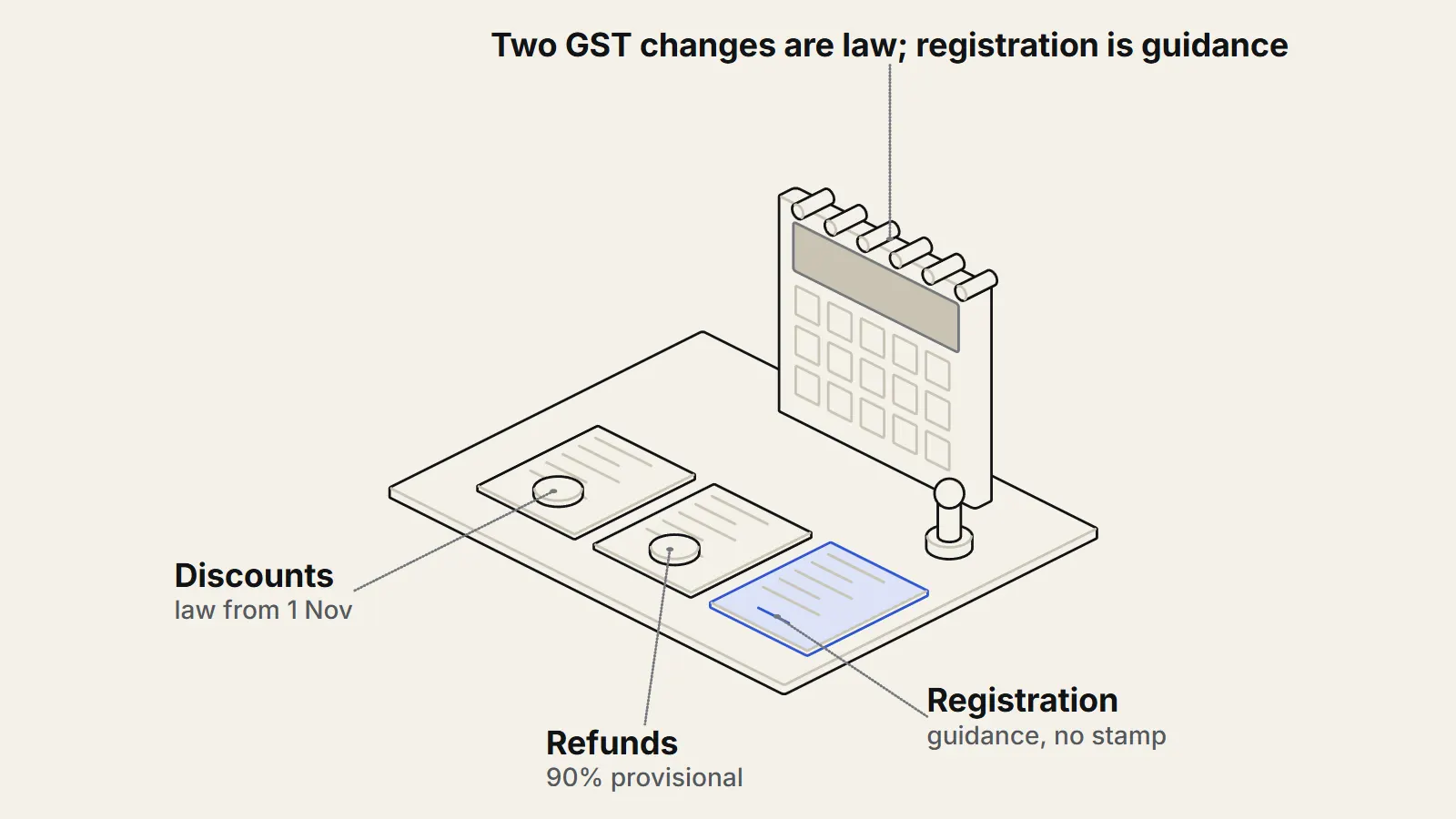
Three GST measures are being reported together as "changes from 1 November 2026". They are not the same kind of change. Two are law: a notification dated 26 October 2026 brings sections 153 to 155 of the Finance Act, 2026 into force on 1 November1. They change how a discount given after a sale is treated, let some refund claims be paid 90% up front, and drop a Rs 1,000 refund minimum for some exports. The third, easier GST registration, is guidance to tax officers in Circular 257/03/2026-GST2, issued the same day. No tax rate changes in any of them.
What is law from 1 November?
The Finance Act, 2026 was passed in March, but sections 153 to 155 were left to start on a date the Central Government would appoint by notification3. The notification chose 1 November. It only fixes that date; one tax firm notes it prescribes no new procedures or forms4. Here is what the three sections do.
A discount given after the sale
Think of a supplier who sells goods all year and in March gives the buyer a 2% year-end rebate. GST is charged on the price at the time of sale. A rebate given later only reduces the supplier's taxable value if the law says so. Under the old section 15(3)(b), the discount had to be agreed at or before the time of the sale and linked to specific invoices, and the buyer had to reverse the matching input tax credit5 (the GST the buyer had already claimed back on the purchase). With no such prior agreement, a rebate was hard to treat as a reduction in value.
From 1 November the clause is rewritten: a discount given after the supply is left out of taxable value if the supplier has issued a credit note and the recipient has reversed the input tax credit attributable to the discount3. The test about a prior agreement is gone from the text. Section 154 also adds these discounts to the cases in which section 34(1) allows a credit note3, so the route is written into the law.
| Illustration (assumed numbers) | Amount |
|---|---|
| Sales in the year, before GST | Rs 10,00,000 |
| GST at an assumed 18% | Rs 1,80,000 |
| Year-end rebate of 2% | Rs 20,000 |
| GST on the rebate (18% of Rs 20,000) | Rs 3,600 |
| Credit note to the buyer (rebate plus its GST) | Rs 23,600 |
| Supplier's GST after the credit note | Rs 1,76,400 |
| Buyer reverses input tax credit of | Rs 3,600 |
Practitioners point to gaps. Supplies made before 1 November but discounted afterwards are not addressed in the text, credit notes still face the time limit in section 34(2), and a buyer with no input tax credit to reverse, such as an unregistered one, creates a problem for the supplier6.
Faster refunds when inputs are taxed more than outputs
A business has an inverted duty structure (IDS) when it pays a higher GST rate on what it buys than it charges on what it sells. Credit then piles up with nothing to set it against, and section 54 lets the business claim a refund. Before the change, the 90% provisional refund in section 54(6) applied only to zero-rated supplies, which means mainly exports7. Section 155(a) extends it to refunds of unused input tax credit under the IDS clause3.
This formalises a practice that already existed. A CBIC instruction of October 2025, as summarised by a tax firm, gave IDS claims filed from 1 October 2025 the 90% provisional refund as an interim measure, pending an amendment to the Act8. Only claims the system rates low-risk qualify. Illustration with assumed rates: a manufacturer that buys Rs 10,00,000 of inputs at 18% and sells Rs 12,00,000 of output at 5% has Rs 1,80,000 of input tax against Rs 60,000 of output tax, so Rs 1,20,000 of credit has built up. Ninety percent of that is Rs 1,08,000, with Rs 12,000 held back until verification. The real claim is set by a formula in the rules and can be lower.
A refund minimum dropped for some exports
Section 155(b) removes the Rs 1,000 minimum refund where tax is refunded on goods exported out of India with payment of tax3. The minimum still applies to other refund claims7. It is a small change, but for a small exporter shipping low-value parcels it removes a floor.
What changes for GST registration?
Less than the headlines suggest. Circular 257/03/2026-GST says an Udyam (MSME) certificate is neither required nor valid as proof of a business's place of business, and lists asking for one among the unwarranted documents officers should not demand2. That is a real relief for a small shopkeeper who was being asked for it. But it is guidance under section 168 of the CGST Act: one tax commentator points out that circulars bind the department, not taxpayers or courts9. The text we read carries no 1 November start date.
The "seven-day limit" is also not new. The circular describes seven working days as the period under rule 9 for applicants who choose Aadhaar authentication and pass it, and thirty days if Aadhaar is not used, fails, or physical verification is triggered2. It presents this as existing law. If the officer takes no action within the rule 9 period, registration is deemed approved2.
What the circular does add is discipline on queries. An officer can raise a query only within seven working days of submission and only for a short list of reasons, such as illegible documents or an incomplete address; the applicant then has seven working days to reply and the officer seven more to decide2. Adding the three periods gives up to 21 working days on that route (our sum, not a figure in the circular). Small taxpayers who pass on input tax credit below Rs 2.5 lakh a month can instead use simplified registration under rule 14A, which the circular says is granted automatically within three working days2, and that route has existed since November 2025.
The circular also explains why scrutiny stays. CBIC says some people obtain fake registrations in other people's names in order to pass on ineligible input tax credit, which costs revenue and hurts honest taxpayers2. Easier entry and fraud control pull in opposite directions, and the circular tries to hold both.
What does red tape cost a small firm?
Compliance cost is the money and time a firm spends on rules, apart from the tax itself. Two published studies give a sense of scale, but they cover different firms and years. A study using national survey data for 2022-23, reported by BusinessToday, puts GST compliance cost for small unincorporated firms at 3.28% to 13.90% of annual turnover10. A Madras School of Economics paper found 1.45% of turnover for the smallest firms in a Tamil Nadu sample and about 0.02% for the largest, in 2019-2011. For a firm with Rs 10,00,000 turnover (an assumed figure), 1.45% is Rs 14,500 a year and 13.90% is Rs 1,39,000.
Both point the same way: the smaller the firm, the heavier the share. That is the case for cutting document demands and delays. The case against loosening checks, made by CBIC itself, is fake registrations. Neither study measures the 1 November changes, so what they save is not yet known.
What is still pending?
The 57th GST Council on 8 October recommended that the system pay 90% of zero-rated and IDS refund claims automatically, without officer intervention, based on risk evaluation12, and that refunds of accumulated credit on input services in IDS cases cover credit availed on or after 1 November 2026, with capital goods spread over 60 months from 1 April 2027. These need changes to the law, rules and forms. One review dated 27 October counts 72 of 82 Council decisions as still pending and says the amendment enabling the input-services refund had not yet been made9.
Will CBIC amend the refund rules and forms in time for the 90% automatic sanction, and how many registrations will actually be approved in seven working days? No post-circular data has been published yet.
This is general information about public rules, not tax advice. A registered tax professional can say how the changes apply to a particular business.
Related on The Realigned: How taxes work: who really pays? (https://therealigned.com/story/who-really-pays-taxes), Is London really the most-taxed city for banks? (https://therealigned.com/rethink/is-london-really-the-most-taxed-city-for-banks) and the British Columbia carbon tax case study (https://therealigned.com/case/british-columbia-carbon-tax).
Primary documents: PIB release on the 57th GST Council (https://www.pib.gov.in/PressReleasePage.aspx?PRID=2320934) and CBIC Circular 257/03/2026-GST (https://cdn.taxo.online/wp-content/uploads/2026/10/Circular-No-257-03-2026.pdf).
Key takeaways
- Two changes are law from 1 November 2026: the discount rule and the 90% provisional refund for IDS claims, plus a Rs 1,000 refund minimum dropped for some exports.
- Easier GST registration is CBIC guidance (no Udyam certificate), not a new law, and its seven working days restate an existing period.
- No GST rates change.
- Many Council decisions still need rules and forms, so the full effect is not in place yet.
Sources
- 1GST post-supply discount and refund amendments effective 1 November 2026 (reproduces Notification 03/2026-Central Tax) (opens the source in a new tab) · TaxGuru, 2026 · Reporting · https://taxguru.in/income-tax/gst-post-supply-discount-refund-amendments-effective-1-november-2026.html
- 2Circular No. 257/03/2026-GST: guidelines for handling GST registration applications (26 October 2026) (opens the source in a new tab) · Central Board of Indirect Taxes and Customs (copy hosted by Taxo Online), 2026 · Primary source · https://cdn.taxo.online/wp-content/uploads/2026/10/Circular-No-257-03-2026.pdf
- 3The Finance Act, 2026 (Gazette of India Extraordinary, 30 March 2026), sections 153 to 155 (opens the source in a new tab) · Ministry of Law and Justice (copy hosted by Taxo Online), 2026 · Primary source · https://taxo.online/wp-content/uploads/2026/03/FinanceAct2026-1.pdf
- 4Major GST reforms effective from November 1, 2026 (A2Z Taxcorp LLP) (opens the source in a new tab) · A2Z Taxcorp LLP, 2026 · Reporting · https://a2ztaxcorp.net/major-gst-reforms-effective-from-november-1-2026-government-notifies-simplified-post-sale-discount-rules-credit-note-provisions-90-provisional-refunds-for-inverted-duty-structure-and-relief-for-sm/
- 5Section 15(3) in The Central Goods and Services Tax Act, 2017 (opens the source in a new tab) · Indian Kanoon, 2017 · Other · https://indiankanoon.org/doc/48149503/
- 6GST amendments effective 1 November 2026: discounts, credit notes and refunds (CA Rajender Arora) (opens the source in a new tab) · TaxGuru, 2026 · Reporting · https://taxguru.in/goods-and-service-tax/gst-amendments-effective-1-november-2026-discounts-credit-notes-refunds.html
- 7BGM on GST, chapter 12 Refunds (compilation of section 54 CGST Act and refund rules, 2024) (opens the source in a new tab) · BGM on GST (unofficial compilation), 2024 · Report · https://d23z1tp9il9etb.cloudfront.net/download/pdf24/12.%20Refund.pdf
- 8CBIC Instruction 06/2025-GST on 90% provisional refund through risk identification (summary) (opens the source in a new tab) · VJM Global, 2025 · Reporting · https://www.vjmglobal.com/blog/cbic-issued-instructions-on-sanction-of-90-provisional-refund-through-risk-identification-and-evaluation
- 957th GST Council decisions vs CBIC circulars 257-264: implementation status (Vipin Jain) (opens the source in a new tab) · TaxGuru, 2026 · Reporting · https://taxguru.in/goods-and-service-tax/council-circular-cbic-implemented-57th-gst-council-current-title.html
- 10GST compliance burden weighs more heavily on smaller unincorporated firms (opens the source in a new tab) · BusinessToday, 2026 · Reporting · https://www.businesstoday.in/latest/economy/story/gst-compliance-burden-weighs-more-heavily-on-smaller-unincorporated-firms-558531-2026-09-29
- 11Compliance Costs of GST for Small Business Enterprises in Tamil Nadu (Working Paper 229/2022) (opens the source in a new tab) · Madras School of Economics, 2022 · Paper · https://mse.ac.in/wp-content/uploads/2022/10/Working-Paper-229.pdf
- 12Recommendations of the 57th Meeting of the GST Council (PIB release, 8 October 2026) (opens the source in a new tab) · Press Information Bureau, Ministry of Finance, 2026 · Primary source · https://www.pib.gov.in/PressReleasePage.aspx?PRID=2320934