Chancellor John Healey's Budget on 28 October 2026 is being searched for "income tax freeze" and "council tax bands". Neither is quite what it sounds like. The Treasury's costing annex shows income tax and National Insurance thresholds were already frozen up to and including 2030-31, and it excludes changes made at this Budget1. The Budget also did not raise the headline rates of income tax, National Insurance or VAT2. Council tax bands were not changed either: the council tax measure is a one-off payment. This piece sets out what did change, what fiscal drag is, and what critics say.
What did the Budget change?
| Measure | What changes | From |
|---|---|---|
| Household Energy Payment | £100 for households in council tax bands A to D in England | January 2027 |
| National Living Wage | £12.71 to £13.21 an hour for ages 21 and over | April 2027 |
| Savings and property income tax | Rates up by a further 2 percentage points | 6 April 2027 |
| Business Asset Disposal Relief | Lifetime limit cut from £1 million to £500,000 | 6 April 2027 |
| Founders' Relief | New 10% Capital Gains Tax rate on up to £10 million for qualifying founders | 6 April 2027 |
| Bank corporation tax surcharge | Raised from 3% to 6% for 15 months | 1 January 2027 |
| Machine Games Duty | 20% to 25% for machines with a stake over £1 or prize over £100 | 1 April 2027 |
| Cash ISA limit | Stays at £20,000 a year; a "Starter ISA" is promised, with no design yet | 6 April 2027 |
The £100 payment goes to households in council tax bands A to D, costs £2.625 billion in 2026-27 and is paid from January 2027 through local authorities2. The bank surcharge rise raises £1.475 billion over three years and the Government says it will not be extended2. The savings and property income rise comes on top of a 2-point rise announced in 2025, taking the rates to 24% basic, 44% higher and 49% additional2. Business Asset Disposal Relief gives an 18% Capital Gains Tax rate on qualifying business sales, and the Treasury says three in four claimants still get relief on their whole gain2. The new Founders' Relief is costed at £260 million in 2027-28 rising to £300 million a year by 2031-321.
Did the Budget freeze tax thresholds?
No new freeze was decided. The 2025 Budget set the freeze, and the Treasury's costing annex lists the Personal Allowance, the basic rate limit, the additional rate threshold and the National Insurance primary threshold as maintained at fixed levels to 2030-31, with the employer secondary threshold at £5,0001. An adviser's commentary gives the values as a £12,570 allowance and a £50,270 higher-rate threshold4; the Treasury annex confirms the freeze but not the figures.
The government is keeping to its commitments on tax, with no increase to the headline rates of income tax, National Insurance contributions or VAT.
— HM Treasury, Budget 2026 document, paragraph 2.29
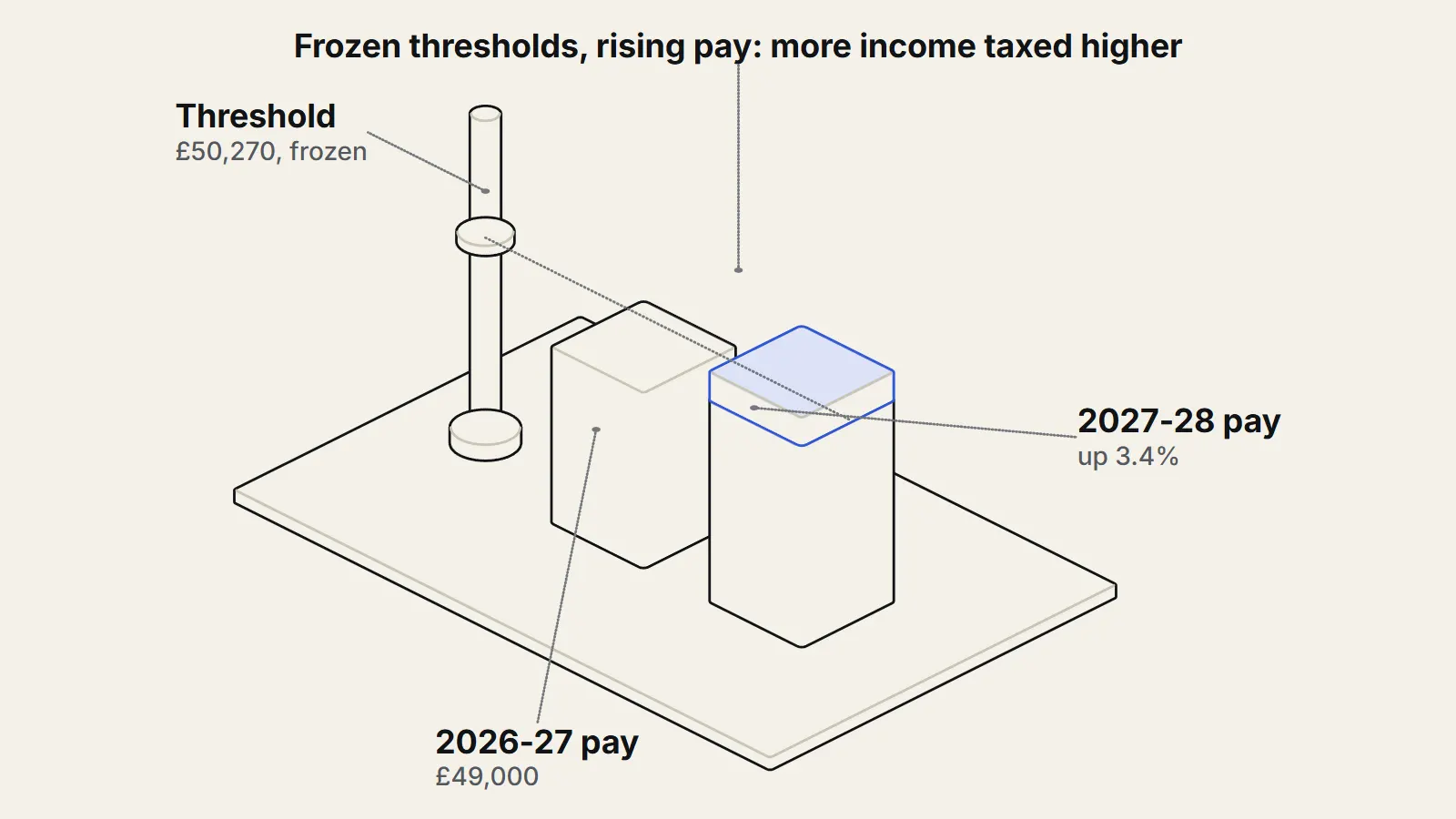
Fiscal drag is what a freeze does over time. When thresholds stay fixed while pay rises, more of each person's pay falls into a higher band, so tax rises without any change in tax rates. Here is an illustration with assumed numbers, using England, Wales and Northern Ireland income tax only: a worker earning £49,000 who gets a 3.4% pay rise, the Office for Budget Responsibility's forecast for consumer price inflation in 20272.
| Illustration (income tax only) | Amount |
|---|---|
| Pay in 2026-27 | £49,000 |
| Pay in 2027-28 after a 3.4% rise | £50,666 |
| Tax in 2026-27 | £7,286 |
| Tax in 2027-28 with frozen thresholds | £7,698.40 |
| Tax in 2027-28 if both thresholds rose 3.4% | £7,533.72 |
| Extra tax caused by the freeze | £164.68 |
We could not read the Office for Budget Responsibility's own October estimate of how many more people the freeze pulls in, because its site blocked automated access. An AJ Bell article in April, attributing figures to the OBR's earlier forecast, put the number at over six million more people in the income tax system and 4.8 million more higher-rate taxpayers by 2030-315. That is an earlier forecast reported second-hand, so treat it as indicative.
Why is "council tax bands" trending?
Because of the £100 payment. The bands themselves were not revalued. The Resolution Foundation notes that eligibility rests on 1991 property valuations, and says the payment reaches roughly four in five properties in England but misses about one in eight bottom-half-income households, who live in band E or above6. In London and the South East 20% of bottom-half households live in bands E and above, against 5% in the North East, North West and Yorkshire and The Humber6.
There is a measure at the other end. The Budget confirmed the High Value Council Tax Surcharge, which applies to properties in England valued at £2 million and above from April 20281.
What does it do to pay?
The National Living Wage for people aged 21 and over rises 3.9%, or 50p, to £13.21 an hour from 1 April 2027; the 18 to 20 rate rises to £11.27 and the 16 to 17 and apprentice rates to £8.313. The Treasury says this is worth £910 a year in gross earnings to a full-time worker on the minimum, and expected to benefit around 2.3 million workers2. The Low Pay Commission says its recommended rate is above its range of inflation forecasts for April 2027 to March 20283, and the OBR's inflation forecast for 2027 is 3.4%, so the real rise is small (our comparison).
The Resolution Foundation says median hourly pay grew 5.9% in the year to April 2026, which would have supported a rise of around 5.7%7, and that the Commission chose a lower figure. The Commission's chair said economic growth has been better than expected but is not leading to hiring3.
Who pays?
The Treasury's case is that the tax rises are concentrated at the top. Its distributional analysis says that in 2027-28 all but the top 20% of households will benefit on average, excluding the minimum wage and business taxes8. It says 84% of income tax payers are unaffected by the savings and property rate rise, while the Chancellor's speech said 88% of people would pay no more tax on savings2. The two figures use different bases and the documents do not reconcile them.
Critics read it differently. The Institute for Fiscal Studies' director Helen Miller said the Budget has a raft of fiddly measures but very little that will move the dial on growth9, as reported. The IFS says the plan effectively implies real-terms cuts for some public services at next year's spending review10; "brutal" is the newspaper's word, not the IFS's. The Institute for Government argues that big decisions on defence, public services, welfare and tax were delayed until 202711. The Resolution Foundation says the energy payment is badly targeted6. From the other side, the TaxPayers' Alliance says the tax burden is at another record high to pay for gimmicks and giveaways12. Tax Policy Associates calculates the Budget itself adds only about £6 billion of tax by 2030-3113.
What do the fiscal numbers say?
The OBR forecasts borrowing of £133.2 billion, 4.2% of national income, in 2026-27, falling to £68.3 billion in 2031-32, with public sector net debt at 95.5% of national income in 2026-272. The Treasury says there is a buffer of £15 billion against its stability rule in 2029-302. The Resolution Foundation puts headroom at £14.5 billion, down from £23.6 billion in March, and says higher debt interest, about £14 billion a year more than in March, more than accounts for the fall7.
What to watch next
- January 2027: the £100 payment begins and the bank surcharge rises to 6%.
- 20 January 2027: consultation closes on moving Machine Games Duty liability to machine suppliers.
- 1 and 6 April 2027: the new minimum wage, the savings and property rate rise, the lower Business Asset Disposal Relief limit and Founders' Relief start.
- 2027: the spending review, and a Treasury "Tax Update" the Government has promised.
Will the threshold freeze be extended beyond April 2031? This Budget made no decision, and the Treasury's Tax Update is due in 2027.
This is general information about public policy, not tax advice.
Key takeaways
- The Budget did not add a new threshold freeze: income tax and National Insurance thresholds were already frozen to 2030-31, and headline rates did not rise.
- The council tax measure is a £100 payment for bands A to D from January 2027, not a change to the bands.
- The National Living Wage rises 3.9% to £13.21 in April 2027, about in line with forecast inflation.
- Critics on the left and right agree the Budget leaves big decisions for 2027, but disagree on whether the answer is more or less tax.
Sources
- 1Budget 2026 Policy Costings (opens the source in a new tab) · HM Treasury, 2026 · Primary source · https://www.gov.uk/government/publications/supporting-documents-for-budget-2026
- 2Budget 2026 (HC 726) (opens the source in a new tab) · HM Treasury, 2026 · Primary source · https://www.gov.uk/government/publications/budget-2026-document
- 3LPC recommendations take the National Living Wage to £13.21 (opens the source in a new tab) · Low Pay Commission, GOV.UK, 2026 · Primary source · https://www.gov.uk/government/news/lpc-recommendations-take-the-national-living-wage-to-1321
- 4The Budget 2026: key changes to tax, pensions and ISAs (opens the source in a new tab) · The Private Office (adviser commentary), 2026 · Reporting · https://theprivateoffice.com/insights/budget-2026-key-changes-tax-pensions-and-isas
- 5What five years of tax freeze has cost you (opens the source in a new tab) · AJ Bell, 2026 · Reporting · https://www.ajbell.co.uk/news/what-five-years-tax-freeze-has-cost-you
- 6Budget balancing act leaves families braced for tough winter and four-year living standards downturn (opens the source in a new tab) · Resolution Foundation, 2026 · Report · https://www.resolutionfoundation.org/press-releases/budget-balancing-act-leaves-families-braced-for-tough-winter-and-four-year-living-standards-downturn/
- 7Spread thin: Analysing the Autumn 2026 Budget (opens the source in a new tab) · Resolution Foundation, 2026 · Report · https://www.resolutionfoundation.org/app/uploads/2026/10/Spread-thin.pdf
- 8Impact on households: distributional analysis to accompany Budget 2026 (opens the source in a new tab) · HM Treasury, 2026 · Primary source · https://assets.publishing.service.gov.uk/media/6ae1850f16428df53760627d/Impact_on_households.pdf
- 9British families face the worst decade for household incomes on record, IFS warns after Budget (opens the source in a new tab) · LBC, 2026 · Reporting · https://www.lbc.co.uk/article/british-families-face-the-worst-decade-for-household-incomes-on-record-ifs-warns-5Hjdkcr_2/
- 10Healey's budget paves way for 'brutal' spending review next year, warns IFS (Guardian, syndicated copy) (opens the source in a new tab) · The Guardian via finwire.io, 2026 · Reporting · https://finwire.io/news/economy-news/healeys-budget-paves-way-for-brutal-spending-review-next-year-warns-ifs
- 11John Healey's underwhelming budget punts big decisions into 2027 (opens the source in a new tab) · Institute for Government, 2026 · Report · https://www.instituteforgovernment.org.uk/comment/john-healeys-underwhelming-budget
- 12TaxPayers' Alliance responds to the 2026 budget (opens the source in a new tab) · TaxPayers' Alliance, 2026 · Report · https://taxpayersalliance.com/taxpayers-alliance-responds-to-the-2026-budget/
- 13Budget 2026: what it means (opens the source in a new tab) · Tax Policy Associates, 2026 · Report · https://taxpolicy.org.uk/2026/10/28/budget-2026-what-it-means/