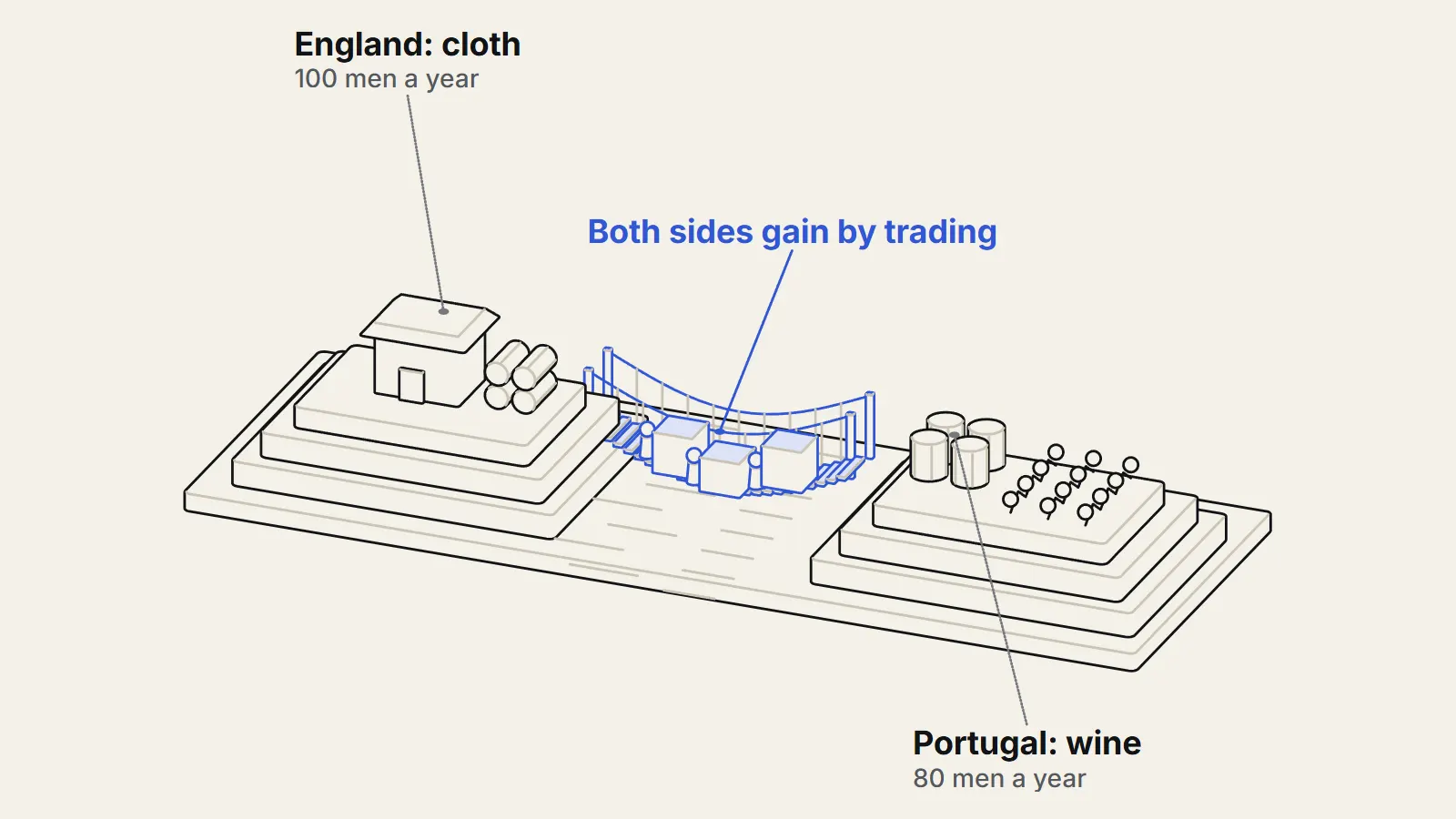
Comparative advantage is the idea that two parties can both gain from trading even when one of them is better at making everything. What matters is not who is more productive in absolute terms, but what each must give up to make a good. The economist David Ricardo set this out in his 1817 book1, Principles of Political Economy and Taxation.1 Each side should make what it gives up least to produce, then swap. This piece walks through the logic with Ricardo's own numbers and then looks at where the simple story stops short.
What does comparative advantage mean?
Start with a distinction. A producer has an absolute advantage if it can make something with fewer resources than another producer. It has a comparative advantage if the thing it makes is cheaper for it in terms of what it must forgo, which economists call opportunity cost. Opportunity cost is the next-best use of the time or resources you spend.
The two can point in different directions. A country can be better at making both cloth and wine and still have a comparative advantage in only one of them, because using its workers on one good means fewer workers on the other. Since one side's sacrifice is rarely the same as the other's, there is usually a swap that leaves both better off. The Concise Encyclopedia of Economics (https://www.econlib.org/library/Enc/ComparativeAdvantage.html) puts the core point as relative ability: what counts is ability in producing one good compared with another.1
How does the worked example work?
Ricardo used England and Portugal, cloth and wine. In his example (https://www.econlib.org/library/Ricardo/ricP2a.html), making a given amount of cloth takes England the labour of 100 men for a year2 and the same amount of wine takes 120 men2. In Portugal the same wine takes 80 men2 and the cloth takes 90.2 Portugal is better at both goods.
Look at what each country gives up. In England, one unit of wine costs the labour that could have made 1.2 units of cloth (120 divided by 100). In Portugal, one unit of wine costs only about 0.89 units of cloth (80 divided by 90). So Portugal gives up less cloth to make wine, and England gives up less wine to make cloth. Portugal has the comparative advantage in wine; England in cloth.
Now let each country put all its workers on its stronger good. England has 220 men-years of labour in the example (100 plus 120) and Portugal has 170 (80 plus 90), which is what it takes each of them to make one unit of both goods. If England puts all 220 on cloth, it makes 2.2 units. If Portugal puts all 170 on wine, it makes about 2.125. Before specialising the pair made 2 units of cloth and 2 of wine; afterwards they make more of both. These totals are our own arithmetic from Ricardo's figures, and the extra output is what the two can share through trade.
Ricardo's own phrasing is that the produce of the labour of 100 Englishmen may be given for the produce of the labour of 80 Portuguese.2 That looks like a bad deal for England, which hands over the product of 100 men and gets back that of 80, until you see that the wine would have cost it 120 men at home. Portugal gains too, getting cloth for the labour of 80 men that would have cost it 90. The same works at any price between the two opportunity costs. A simpler modern illustration on Econlib uses two people who can each catch fish or gather bananas, with the same result: any trading price between the two opportunity costs leaves both better off.1
Why does it hold when one side is better at everything?
Many people find this the hard part. Paul Krugman has argued that comparative advantage is a difficult concept (https://web.mit.edu/krugman/www/ricardo.htm) even for educated readers, and that critics often revive arguments such as low foreign wages making trade unfair, which the model was built to answer.3 The model says a poorer, lower-wage country can still gain from trade, and so can a richer one, because the gain comes from the difference in opportunity costs, not from matching wages.
Where do the gains stop being shared?
The example says trade can raise total output. It does not say everyone inside each country gains. Krugman notes that economists have long known trade can raise national income while shifting income within a country in ways that hurt large groups.3 If England specialises in cloth, wine makers there lose their work. The model assumes they find jobs elsewhere without delay or cost.
Research on the rise of Chinese imports in the United States tests that assumption. Economists David Autor, David Dorn and Gordon Hanson found that adjustment in local labor markets was remarkably slow4, with wages and labour-force participation staying depressed and unemployment elevated for at least a decade in affected places.4 They also write that offsetting job gains in other industries had not appeared, and call for better understanding of when trade is costly.4 That is a finding about adjustment costs, not a refutation of the underlying gains.
What is not known?
The example is a model with two countries, two goods and one input, labour. Real trade involves many goods, capital, technology and changing costs, so the model shows a direction of gain rather than predicting its size for a particular country or year. Nor does it say how large a share of the gains can be redistributed to the people who lose, or how quickly displaced workers move on. The evidence above suggests that for some places this takes much longer than the model assumes, and the right response is a policy question this piece does not try to settle.
Key takeaways
- Comparative advantage turns on opportunity cost, what a producer gives up, not on who is better at everything.
- In Ricardo's example Portugal is better at both goods, yet both countries gain by specialising and swapping.
- The model shows gains in total output; it says little about how they are split inside each country.
- Studies of the China import surge found local adjustment was slow, so uneven and lasting costs are real even when the overall gain holds.
Sources
- 1Comparative Advantage (Concise Encyclopedia of Economics) (opens the source in a new tab) · Library of Economics and Liberty, 2018 · Reporting · https://www.econlib.org/library/Enc/ComparativeAdvantage.html
- 2On the Principles of Political Economy and Taxation, Chapter VII On Foreign Trade (opens the source in a new tab) · Library of Economics and Liberty, 1817 · Primary source · https://www.econlib.org/library/Ricardo/ricP2a.html
- 3Ricardo's Difficult Idea (opens the source in a new tab) · MIT, 1996 · Essay · https://web.mit.edu/krugman/www/ricardo.htm
- 4The China Shock: Learning from Labor Market Adjustment to Large Changes in Trade (opens the source in a new tab) · NBER / Annual Review of Economics, 2016 · Paper · https://www.nber.org/papers/w21906