Where you’ve heard it
“when you have a trade deficit of $2 trillion I consider that loss.” — President Donald Trump, interview with TIME, 22 April 2025 (transcript published 25 April 2025). In the same interview: "We were losing $2 trillion a year on trade, and you can't do that." Read the transcript (https://time.com/7280114/donald-trump-2025-interview-transcript/).
when you have a trade deficit of $2 trillion I consider that loss.
Why people believe it
What the evidence shows
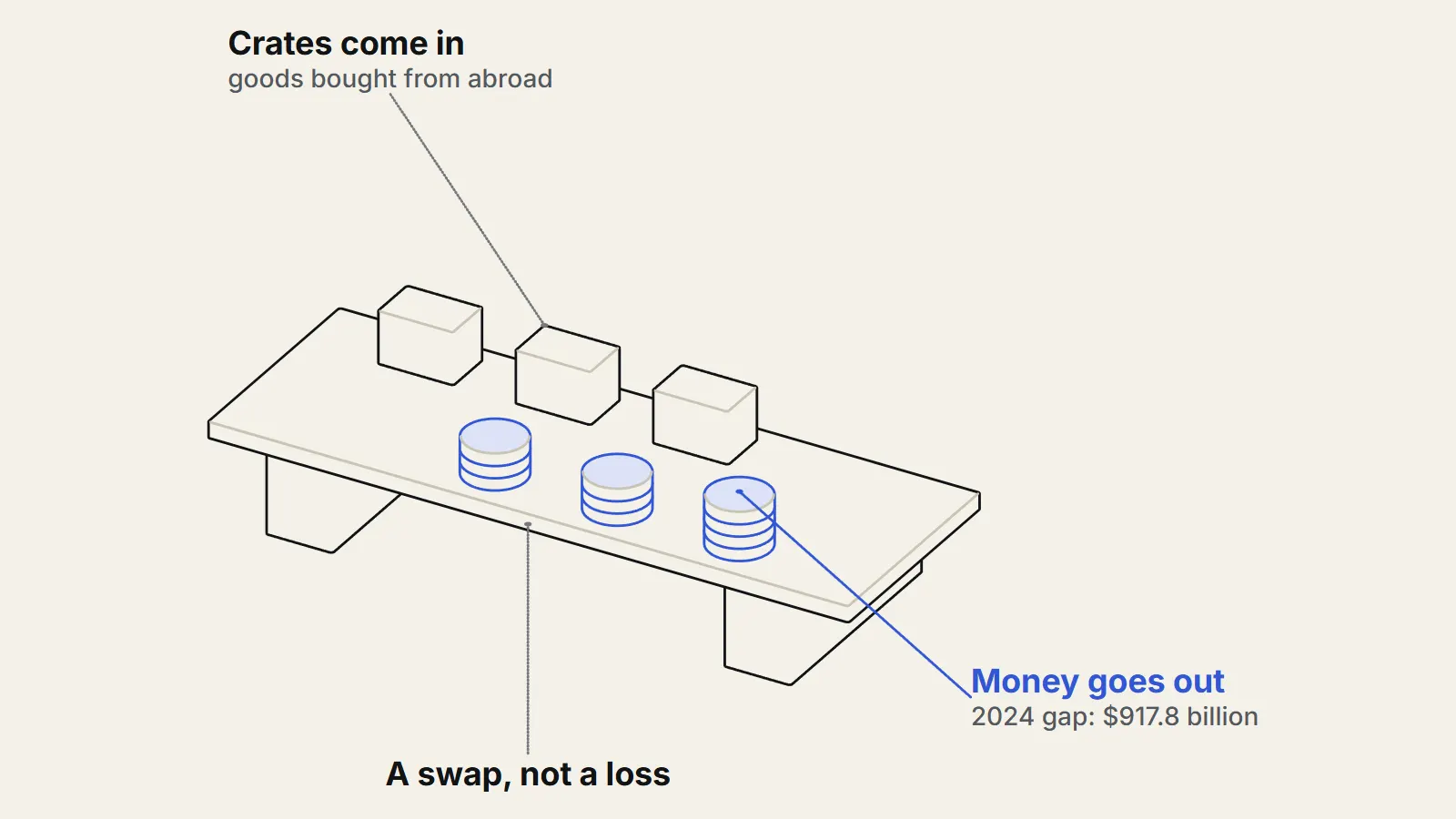
A trade deficit is the amount by which a country’s imports of goods and services exceed its exports. TIME’s fact-check of the interview put the US figure for 2024 at $917.8 billion2, using Bureau of Economic Analysis data, and stressed that it is not money lost: it shows that the country imports more than it exports.2 That is well below the $2 trillion in the quote.
The same number can be written another way. The current account, of which the trade balance is the largest part, equals national saving minus investment.3 Then Federal Reserve Governor Ben Bernanke put it this way in 2005: the country’s current account deficit equals the excess of its investment over its saving4.4 A deficit therefore means the country is using other countries’ savings to pay for some of its own investment. Whether that is good or bad depends on what the money buys. The IMF says that, without diagnosing the causes, it is not meaningful to label a deficit as categorically good or bad. Read the IMF explainer (https://www.imf.org/en/publications/fandd/issues/series/back-to-basics/current-account-deficits).
The late 1990s show how a growing deficit can go with a strong economy. Bernanke notes that the US deficit rose as capital investment increased, spurred by perceived profit opportunities.4 Real US GDP grew 4.4 percent in 1997, 4.5 percent in 1998 and 4.8 percent in 19995.5 This does not prove that the deficit caused the growth, and some deficits do arise from weak saving. The point is only that the same sign on the trade balance can come from very different situations.
What is not known: the research here does not give a size of deficit beyond which borrowing becomes a problem, and it cannot say how much of the loss of manufacturing jobs would have happened without trade, since technology also changed factories. The study looked only at Chinese import competition from 1990 to 2007, not at why a country runs a deficit; whether a deficit comes from low saving or a strong investment pull depends on the period and the country.1 Read the study in the American Economic Review (https://www.aeaweb.org/articles?id=10.1257/aer.103.6.2121).
The better question
A better question: what is the deficit financing, and who gains and loses from the imports behind it, in this country and in this particular region?
Sources
- 1The China Syndrome: Local Labor Market Effects of Import Competition in the United States (opens the source in a new tab) · American Economic Review, 2013 · Paper · https://www.aeaweb.org/articles?id=10.1257%2Faer.103.6.2121
- 2Fact-Checking What Trump Said in His “100 Days” Interview (opens the source in a new tab) · TIME, 2025 · Reporting · https://time.com/7280129/donald-trump-fact-check-2025-interview/
- 3Current Account Deficits (Back to Basics) (opens the source in a new tab) · IMF Finance & Development, 2017 · Report · https://www.imf.org/en/publications/fandd/issues/series/back-to-basics/current-account-deficits
- 4The Global Saving Glut and the U.S. Current Account Deficit (opens the source in a new tab) · Federal Reserve Board (speech, 10 March 2005), 2005 · Primary source · https://www.federalreserve.gov/boarddocs/speeches/2005/200503102/default.htm
- 5Real Gross Domestic Product, percent change from preceding period (A191RL1A225NBEA) (opens the source in a new tab) · FRED, Federal Reserve Bank of St. Louis, 2026 · Dataset · https://fred.stlouisfed.org/data/A191RL1A225NBEA.txt