Where you’ve heard it
More than 90% of startups fail, due primarily to self-destruction rather than competition.
Nine out of 10 startups fail.
“More than 90% of startups fail, due primarily to self-destruction rather than competition.” — Steve Blank, blog post on the Startup Genome Compass, 29 August 2011. Read the post (https://steveblank.com/2011/08/29/it%E2%80%99s-not-how-big-it-is-%E2%80%93-it%E2%80%99s-how-well-it-performs-the-startup-genome-compass/).
“Nine out of 10 startups fail.” — Fortune, Erin Griffith, 27 June 2017, stating the claim as conventional wisdom before arguing the data say otherwise. Read the article (https://fortune.com/2017/06/27/startup-advice-data-failure).
Why people believe it
What the evidence shows
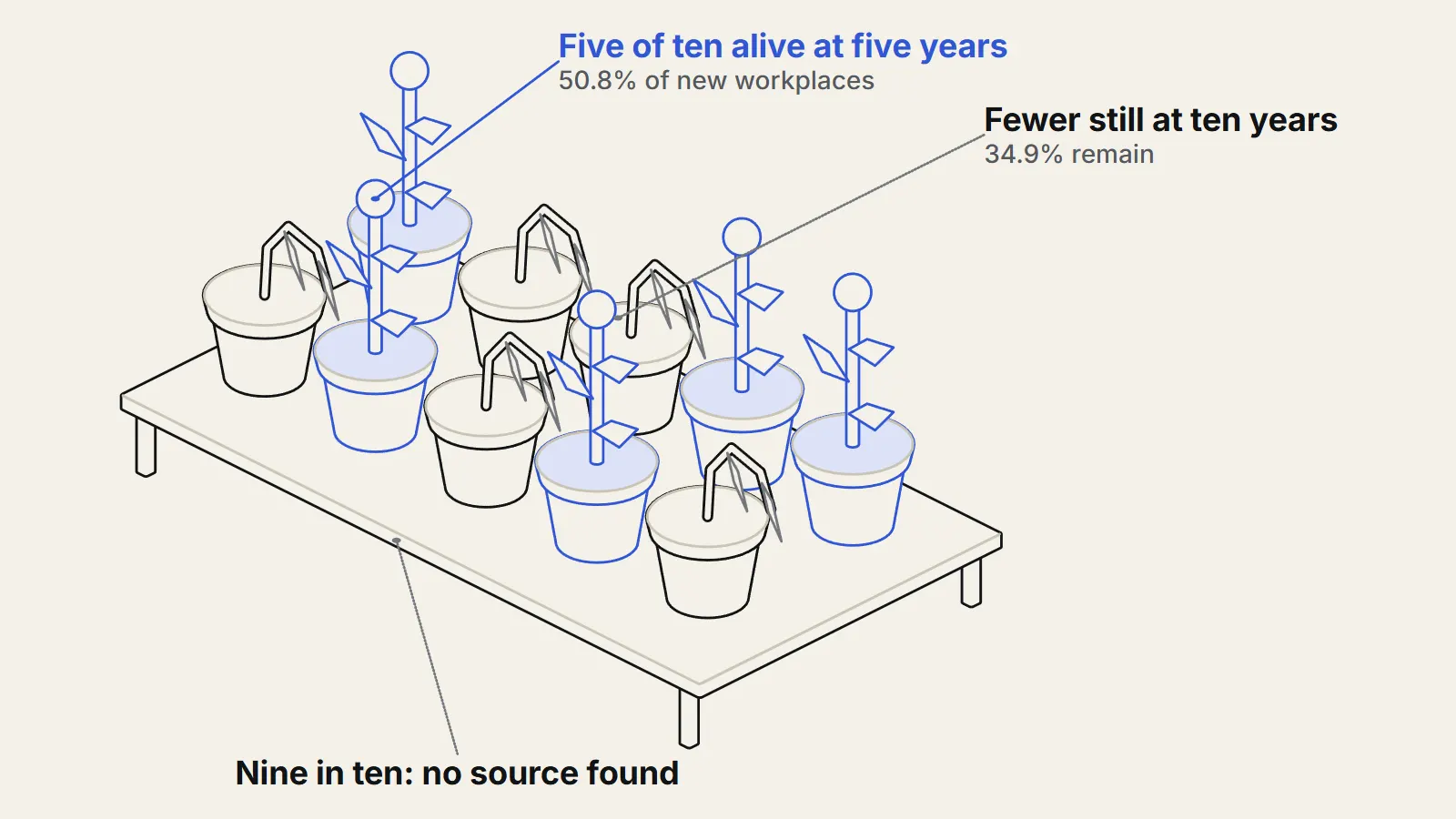
No one number answers this, because “startup” and “fail” can each mean several things. Start with every new business. The Bureau of Labor Statistics (BLS) tracks private-sector establishments, meaning individual workplaces, by the year they open. For those opening in the year to March 2014, 50.8 percent were still operating after five years and 34.9 percent after ten1.1 That is a high rate of closure, but closer to one in two at five years than nine in ten. See the BLS survival table (https://www.bls.gov/bdm/us_age_naics_00_table7.txt).
Two cautions apply to that table. An establishment is a workplace, so a new branch of an old company counts alongside a new firm. And BLS counts a closing by employment records: an establishment closes when it reports no employment, a rule that does not say whether the owner failed, sold up or moved on.2 Neither point makes the closure rate smaller, but both stop it being read as a count of bankruptcies.
Now take venture-backed startups, the kind that the phrase usually has in mind. In 2017 Fortune reported analysis by the investment firm Cambridge Associates of 27,259 venture-backed startups between 1990 and 20103, counting as failures those that returned 1X or less to investors. The share has not risen above 60 percent since 20013, and it peaked at 79 percent in the dotcom bust.3 Fortune’s own conclusion was that the nine in ten claim is not true. That is one firm’s data, not every startup, and because “1X or less” is the test, a company that only returns the money invested counts as a failure. See the Fortune column (https://fortune.com/2017/06/27/startup-advice-data-failure).
Where does 90 percent come from? In the pages we opened, we found no source or measurement for it: the 2011 post above states it as a plain assertion, and Fortune calls it conventional wisdom and says it is not true. What is not known is the original source of the figure, and whether any dataset has ever measured “startups”, “failure” and “nine in ten” together.
The better question
Of businesses like this one, with the same funding and industry, what share survive five years, and how is survival defined?
Sources
- 1Table 7. Survival of private sector establishments by opening year (opens the source in a new tab) · BLS Business Employment Dynamics, 2025 · Dataset · https://www.bls.gov/bdm/us_age_naics_00_table7.txt
- 2Business Employment Dynamics: frequently asked questions (opens the source in a new tab) · BLS, 2025 · Primary source · https://www.bls.gov/bdm/bdmfaq.htm
- 3Conventional Wisdom Says 90% of Startups Fail. Data Says Otherwise. (opens the source in a new tab) · Fortune, 2017 · Reporting · https://fortune.com/2017/06/27/startup-advice-data-failure