The Smoot-Hawley tariff (https://therealigned.com/story/who-pays-a-tariff) of 1930 raised United States duties on imported goods to near-record levels just as the economy was sliding into the Great Depression (https://therealigned.com/story/what-caused-the-great-depression), and it is often blamed for causing it. Most economic historians do not accept that. The economist Douglas Irwin (https://www.nber.org/system/files/chapters/c13858/c13858.pdf), who has studied the episode closely, concludes that it played a relatively small role in making the Depression worse or better, while still damaging trade relations between countries.1 This piece sets out what the law did, what happened to trade, and where historians still disagree.
What was the Smoot-Hawley tariff and how did it start?
The law began as a farm measure. In the 1928 election both parties promised to help struggling farmers, and Republicans stressed protection for them against foreign competition.1 Congress turned to a tariff revision after President Coolidge vetoed price-support bills. As the bill moved through Congress, other industries asked for protection too, and it grew into a bill that raised duties across many products. The Office of the Historian (https://history.state.gov/milestones/1921-1936/protectionism) describes how a measure meant to relieve farmers became a way to raise tariffs in every sector.2 Irwin makes the same point about origins: it did not start with pressure from manufacturers but with politicians trying to reach farm voters, and then other businesses took advantage once the door was open.1
Most farmers gained little. The United States was a net exporter of most farm goods, and many agricultural imports were things such as coffee and tea that it did not grow at all, so a tariff could not lift prices.1 President Herbert Hoover signed the bill on June 17, 19301, and it took effect the next day.1
How big was the tariff increase?
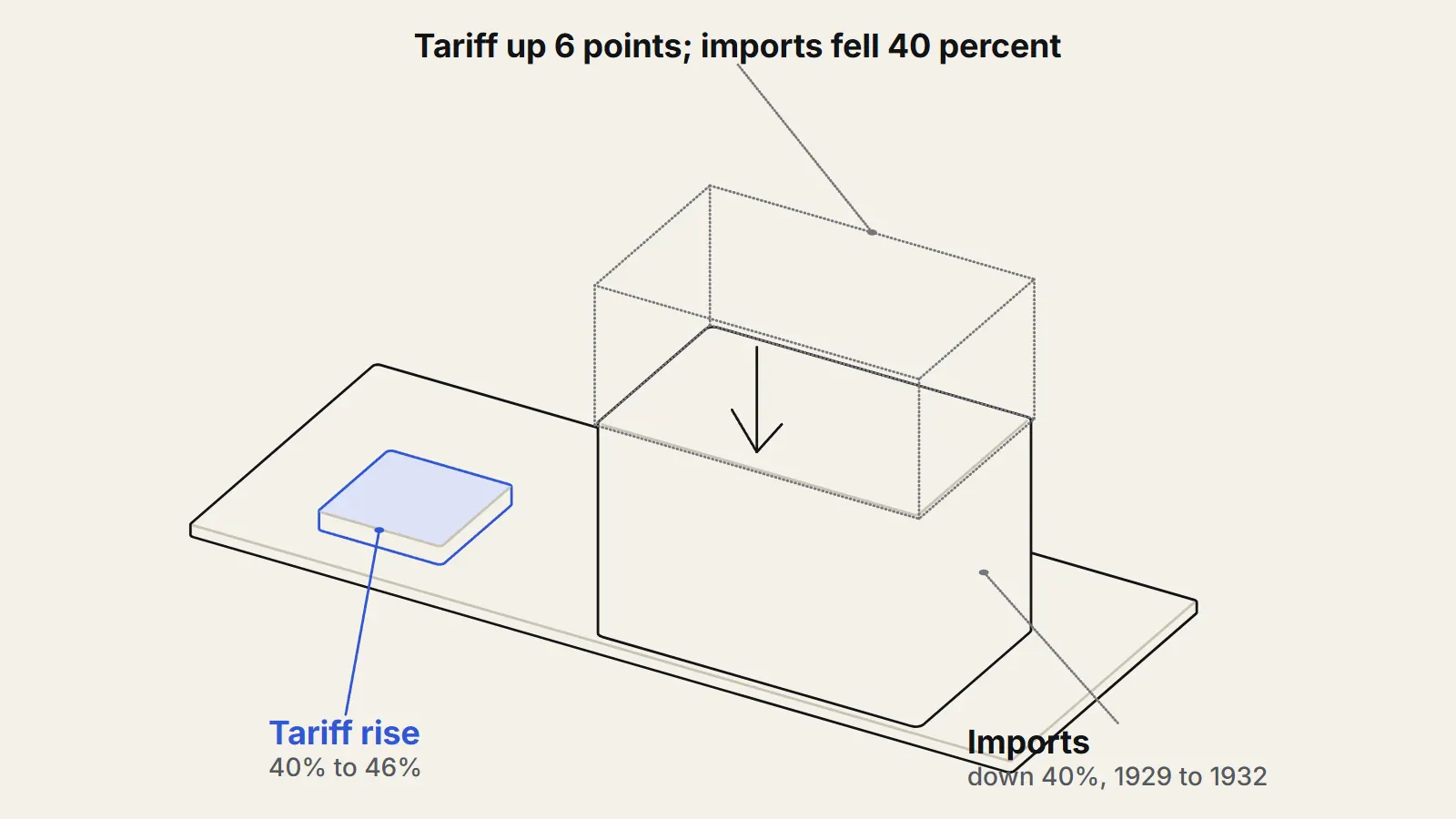
Large in headlines, modest in arithmetic. Irwin estimates that the act raised the average tariff on goods that were subject to duty by about six percentage points, or 15 percent, taking it from about 40 percent to 46 percent.1 A good that cost one dollar abroad would sell for $1.40 with duty before and $1.46 after, a rise of about 4 percent in the price paid. Only about a third of imports paid any duty at all, since the rest, such as silk, coffee and rubber, came in free.1
Falling prices then did more of the work than the law. Irwin calculates that the combined effect of the new rates and deflation lifted the average tariff on dutiable imports from 40 percent in 1929 to 59 percent in 19321, and that about one-third of that rise came from the law and two-thirds from deflation.1
Did the tariff cause the collapse in trade?
Trade did collapse. Between 1929 and 1932 the volume of US imports fell 40 percent and exports fell 49 percent, while real GDP fell 25 percent.1 But the tariff covered a small part of that fall. In 1929, dutiable imports made up just 1.4 percent of GDP1, and Irwin argues it is hard to see a rise from 40 to 46 percent on those goods producing a collapse on the scale of the Depression.1 The fall in incomes and prices did more to cut imports than the law did.
What the tariff did do, he writes, was worsen the climate for trade. Countries reacted. Canada was the most significant case: it took nearly 20 percent of US exports in 1929, and after the US law passed it imposed countervailing duties on sixteen American products that made up nearly a third of US exports to Canada.1 A 1932 League of Nations report quoted by Irwin called the American law the signal for an outburst of tariff-making elsewhere, partly by way of reprisals, naming Canada, Cuba, Mexico, France, Italy and Spain among those that raised duties soon after.1 The Office of the Historian likewise calls it a symbol of the beggar-thy-neighbor policies of the 1930s.2
What do historians still dispute?
Irwin answers that farm prices began to fall a year before the tariff took effect and their trend seemed unaffected by it, and that farm bank troubles stemmed more from bad management than lost exports.1 He also reports a simulation by Crucini and Kahn in which the higher tariff could have caused a 2 percent decline in GDP, which he calls significant but still far from the observed 25 percent fall.1 The Office of the Historian says scholars disagree about how much protection the tariff provided and about whether it provoked retaliation that deepened the Depression.2 So the retaliation question is open, even though most economists rank the tariff well below other causes.
The usual explanation from historians points elsewhere. Irwin says the consensus is that monetary and financial factors dominated, citing the banking panic of October 1930 and a fall in the money supply described by Friedman and Schwartz.1 On that reading the tariff was a bad policy that arrived at a bad time, not the engine of the downturn.
What is not known?
Nobody can run the period twice. Estimates of how much the tariff reduced imports, how much retaliation cut exports and how far foreign discrimination against US goods hurt later trade all rest on models and assumptions, and they give different answers. Irwin's own view, summarised by his publisher, is that the tariff was hardly responsible for the Great Depression but did contribute to a decline in world trade and to discrimination against US exports that lasted for decades.3 The long-run effects on how countries organised trade after 1930 are easier to describe than to measure.
Key takeaways
- The law began as a farm bill and grew into an across-the-board increase in duties, signed on June 17, 1930.
- It raised the average duty on dutiable imports by about 15 percent, but dutiable imports were only 1.4 percent of GDP in 1929.
- Falling prices raised the effective tariff more than the law did, and most economists rank monetary and financial causes far above the tariff in the Depression.
- The tariff did contribute to retaliation and a poorer trading climate; how large that effect was is still debated.
Sources
- 1The Hawley-Smoot Tariff and the Great Depression, 1928-1932 (chapter in Clashing over Commerce: A History of U.S. Trade Policy) (opens the source in a new tab) · University of Chicago Press / NBER, 2017 · Book · https://www.nber.org/system/files/chapters/c13858/c13858.pdf
- 2Protectionism in the Interwar Period (opens the source in a new tab) · Office of the Historian, US Department of State, 2026 · Primary source · https://history.state.gov/milestones/1921-1936/protectionism
- 3Peddling Protectionism: Smoot-Hawley and the Great Depression (publisher page) (opens the source in a new tab) · Princeton University Press, 2017 · Other · https://press.princeton.edu/books/paperback/9780691178066/peddling-protectionism