- Place
- Iceland
- Years
- 2003–2017
- Policy
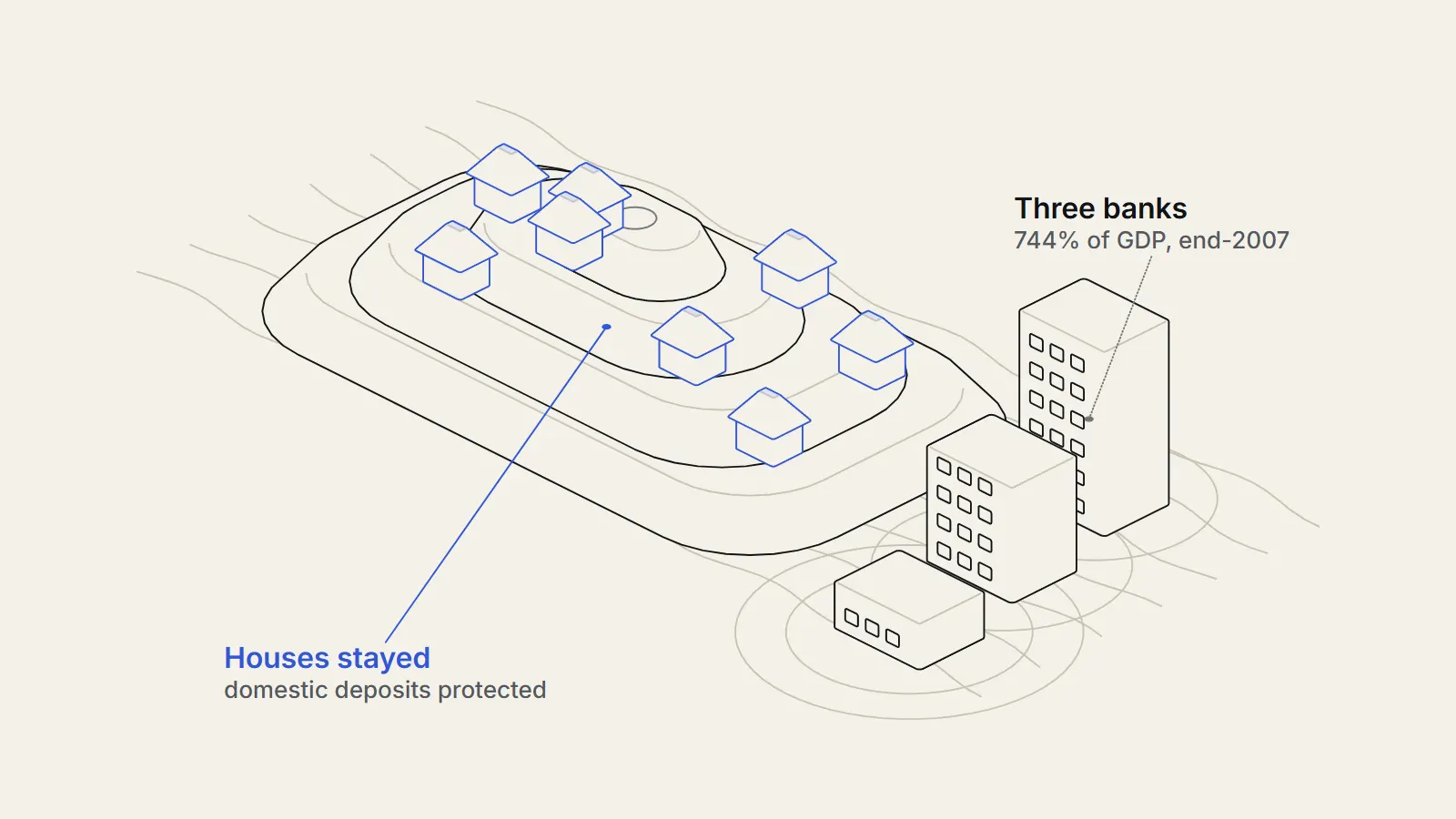
- Iceland let its three largest banks fail in October 2008, guaranteed domestic deposits, took a US$2.1 billion IMF loan and imposed capital controls that lasted until 2017.
- Outcome
- GDP fell about 10 percent in 2009 to 2010 and unemployment reached 8.1 percent; by 2016 growth was 7.2 percent, unemployment 3.0 percent and gross public debt 54 percent of GDP.
The Iceland 2008 banking crisis ended with the state letting its three biggest banks fail in October 2008 instead of rescuing them. The banks had grown to about ten times the size of the economy, which left the government and central bank (https://therealigned.com/story/what-a-central-bank-does) unable to save them, so Iceland protected domestic deposits, put other creditors in a queue behind depositors, borrowed from the IMF and restricted capital movements.3 Output fell about 10 percent over 2009 and 2010, and by 2016 growth was back at 7.2 percent.4
Before
How three banks became ten times the economy
Iceland privatised its banks from 1998, and by the end of 2003 the system was dominated by three large banks: Glitnir, Kaupthing and Landsbanki.3 Benediktsdottir, Danielsson and Zoega (https://elischolar.library.yale.edu/ypfs-documents2/875) report that the banking system's assets went from 174 percent of GDP at the end of 2003 to 744 percent at the end of 20071, in a country of about 300 thousand people, while real GDP grew 5.5 percent a year.1
By the time of the collapse the combined balance sheets were about ten times GDP, and the three banks held over 80 percent of the financial system.3 The Special Investigation Commission (https://www.rna.is/media/myndir/KynningEnsku.pdf), a parliamentary inquiry, named rapid growth as the main cause of failure and found that the big three banks had grown 20-fold in seven years.5
Funding that could leave quickly
Growth was financed abroad. In 2005 alone the three banks issued around 14 billion euros of foreign debt, a little more than Iceland's GDP that year, and most of that funding matured in three to five years.5 Two banks also gathered deposits from foreign savers. Landsbanki began offering Icesave accounts in the United Kingdom in October 2006 and in the Netherlands in May 2008, and Kaupthing also opened Edge online deposit accounts abroad.3 When Landsbanki entered receivership, its British and Dutch deposits came to 6.7 billion euros, and the IMF notes that all Icesave deposits were about 60 percent of GDP in 2008.32
The inquiry also found weaknesses inside the banks. The three had lent against their own shares, financing 300 billion krona of them by mid-2008, which was more than 25 percent of a combined capital base of 1,186 billion krona. The commission said owners had unusually easy access to loans from their own banks.5
Too big to save
A bank with foreign-currency funding needs a lender of last resort that can supply foreign currency. The Central Bank of Iceland could not: its reserves and credit lines were no match for the banks' needs, and a state bailout was ruled out because the size of the problem dwarfed the state's resources and risked a sovereign default.3 The commission put numbers on the gap: the economy's short-term liabilities had grown to 16 times the foreign currency reserve, and foreign currency deposits to eight times it.5
The risk was not treated as urgent in advance. The IMF's own evaluation says that the Fund did not highlight the exceptionally large banking sector as a key vulnerability that needed to be addressed urgently.2 The inquiry also described the supervisor, the Financial Supervisory Authority, as generally understaffed and lacking in experience, and said the deposit insurance fund was underfunded, which reduced the credibility of the whole system.5 Benediktsdottir and co-authors argue that Icelandic authorities encouraged the creation of an international banking centre as a matter of policy, while the supervisor was seriously understaffed.1
The decision
October 2008: protect depositors, split the banks
The sequence began in late September. Glitnir asked the central bank for emergency liquidity on 25 September; the central bank proposed instead that the government buy 75 percent of the bank for 600 million euros.3 On 6 October the run on the three banks intensified, and Kaupthing received 500 million euros of emergency liquidity.3 The same day the government announced a blanket guarantee for deposits in domestic banks and branches, regardless of size or holder, and in the early hours of 7 October Parliament passed the Emergency Act.3 The IMF summarises the outcome simply: the three largest banks collapsed within a week.2
Emergency liquidity had already proved inadequate. One bank received foreign-currency support and defaulted anyway, because the banks were in practice insolvent and the authorities did not know the true quality of their assets or whether they were merely short of cash.3 The Emergency Act did three things. It let the finance ministry provide funds to set up new banks, it let the supervisor take control of failing banks, and it moved customer deposits ahead of general unsecured claims in a bankruptcy, as the Bank for International Settlements (https://www.bis.org/fsi/fsicms1.pdf) describes.3 The failed banks were then split. Domestic operations went into new banks, while non-depositor creditors were left with claims on the assets of the old banks, behind depositors.2 Domestic deposits moved to the new banks overnight and were available the next business day.3 The BIS authors say the priority for deposits and the blanket guarantee together ended the bank runs (https://therealigned.com/story/bank-runs-explained).3
The legal basis of the Emergency Act was tested. Depositor priority was challenged in court on property-right grounds, and the BIS authors report that the Supreme Court gave the legislator considerable discretion given the extreme and unprecedented problem and the clear objective of the legislature.3
This is why the phrase "letting the banks fail" needs care. Shareholders, bondholders and other creditors of the old banks took losses. Domestic depositors did not.
The loan and the controls
On 19 November 2008 the IMF board approved a two-year arrangement of 1.4 billion special drawing rights, about US$2.1 billion, which was 1,190 percent of Iceland's quota6 and covered about 42 percent of the financing gap for 2008 to 2010.6 The krona had by then fallen more than 70 percent in offshore markets, and the policy rate averaged 14.9 percent in 2008.6
Capital controls came with it. In mid-October the central bank had imposed tight controls and rationed foreign exchange through daily auctions.2 Baldursson, Portes and Thorlaksson say the controls were meant to prevent massive capital flight, including a large stock of carry-trade money, after the krona had already fallen 25 percent in the week before the banks collapsed.7 The IMF staff called this a deviation from orthodoxy.2 The programme left the controls in place for the near term, and the IMF then expected them to be lifted within the programme, which ended in August 2011.67
- Autumn 1998Privatisation of the banks beginsSource 3 (opens the source in a new tab)
- Oct 2006Landsbanki launches Icesave in the United KingdomSource 3 (opens the source in a new tab)
- 25 Sep 2008Glitnir requests emergency liquidity; the central bank proposes a 75 percent state stake insteadSource 3 (opens the source in a new tab)
- 6 Oct 2008The run on the three banks intensifies; Kaupthing gets 500 million euros of emergency liquiditySource 3 (opens the source in a new tab)
- 6 Oct 2008Blanket guarantee for domestic deposits announcedSource 3 (opens the source in a new tab)
- 7 Oct 2008Parliament passes the Emergency ActSource 3 (opens the source in a new tab)
- Mid-Oct 2008Central bank imposes tight foreign exchange controlsSource 2 (opens the source in a new tab)
- 19 Nov 2008IMF board approves the stand-by arrangementSource 6 (opens the source in a new tab)
- 12 Apr 2010Special Investigation Commission presents its findingsSource 5 (opens the source in a new tab)
- Aug 2011IMF programme endsSource 7 (opens the source in a new tab)
- Jan 2013EFTA Court clears Iceland of Icesave claimsSource 3 (opens the source in a new tab)
- Mar 2017Capital controls removed for the most partSource 7 (opens the source in a new tab)
The strongest case against the policy
the imposition of capital controls was both unnecessary and unjustified...causing significant short-term and long-term economic damage
— Danielsson and Arnason (2011), quoted in Baldursson, Portes and Thorlaksson (2017), footnote 4
Part of that case rests on facts that are not in dispute. The IMF expected the controls to come off within the programme, and they lasted more than eight years.7 The IMF evaluation itself warns that keeping controls too long could prolong distortions, while lifting them too fast could drain reserves and destabilise the currency.2
The Icesave dispute shows the cost of the other choice. Iceland's private deposit insurance fund could not reimburse depositors in Landsbanki's foreign branches, so Britain and the Netherlands paid their own depositors and then sought repayment from Iceland.2 Two Icesave repayment bills passed through Parliament and were rejected by voters in referendums, in March 2010 and April 2011.3 The disputes delayed some programme reviews, because Nordic lenders tied their financing to progress on Icesave.2
There is also a challenge to the legality of the depositor priority. The Supreme Court of Iceland confirmed the constitutionality of the Emergency Act in 2011, and the EFTA Surveillance Authority had concluded that the priority for deposits was not unlawful discrimination under the EEA Agreement.73 The Supreme Court and the EFTA Surveillance Authority therefore both found the priority lawful. The rulings address legality, not whether the outcome was fair to foreign creditors.
What happened
What happened after the Iceland 2008 banking crisis
The real economy took a hard hit. The IMF counts a cumulative fall of 10 percent in real GDP2 and 23 percent in domestic demand over 2009 and 2010.2 Measured from the fourth quarter of 2007 to the first quarter of 2010, Baldursson and co-authors put the fall at 12 percent.7 In 2009 gross fixed investment fell 51.6 percent and private consumption 14.9 percent, while the IMF table shows real wages down 10.3 percent.2
Prices and the currency moved sharply. The nominal effective exchange rate fell 40.4 percent in 2008, and consumer price inflation was 12.4 percent in 2008 and 12.0 percent in 2009.2 Unemployment, which was 1.6 percent in 2008, averaged 8.0 percent in 2009 and 8.1 percent in 2010; registered unemployment peaked at 9.3 percent in February and March 2010.23
Who paid for the failed banks
The BIS authors report how much each class of creditor eventually recovered from the old banks. Depositors were repaid in full, because the Emergency Act gave them priority. The largest class, general claims, recovered 29 percent on average, owners of equity and subordinated debt recovered nothing, and the aggregate recovery was slightly over 58 percent3.3 Benediktsdottir and co-authors put the total loss to creditors at around 47 billion euros.1
| Claim | Recovery |
|---|---|
| Depositors (priority under the Emergency Act) | Fully satisfied |
| General unsecured claims (the largest class) | 29% on average |
| Equity and subordinated debt | Nothing |
| All claims together | Slightly over 58% |
The Icesave claims ended better than feared. The EFTA Court ruled in January 2013 that Iceland was cleared of the claims against it, leaving the British and Dutch governments with a priority claim on the Landsbanki estate, and the estate paid its last priority instalment in January 2016.3
Households, the budget and the debt
About 70 percent of domestic loan portfolios were in arrears when the new banks were set up. The loans were transferred to the new banks at an average discount of around 50 percent, which gave the banks a reason to restructure them.3 Household and corporate debt that had reached 350 percent of GDP in 2008 had more than halved by the end of 2017, helped by writedowns, court decisions, government debt relief, higher savings and rising GDP.3
The budget moved from a surplus of 5.4 percent of GDP in 2007 to a deficit of 8.6 percent in 2009, and the IMF's primary balance, which excludes interest, improved from minus 6.5 percent in 2009 to minus 1.1 percent in 2011.2 Gross public debt in the same table was 99.2 percent of GDP in 2011.2
The recovery and the exit
The IMF recorded GDP growth of 3.1 percent in 2011 and, in its 2017 Article IV release, growth of 4.4, 1.9, 4.1 and 7.2 percent for 2013 to 2016, with unemployment of 3.0 percent and gross public debt of 54.0 percent of GDP in 2016.24 The IMF board concluded in 2012 that the programme had achieved its objectives, and Iceland repaid its remaining IMF obligations ahead of schedule in 2015.89
This early repayment by Iceland marks a successful end to an intensive engagement with the Fund.
— Christine Lagarde, IMF Managing Director, 2015
The capital controls came off last. The offshore krona stock, which was 40 percent of GDP in 2008, had fallen to about 14 percent by the end of 2015, and most controls were removed in March 2017, though not by statute and with measures on inflows remaining.7 The IMF noted that capital flows were then essentially free for businesses, households and pension funds, with a special reserve requirement still applying to bond inflows.10 The route there ran through the old banks. In June 2015 the government announced a 39 percent stability levy on the estates' assets, to apply from 2016 unless a composition agreement meeting the central bank's conditions was reached by the end of 2015, and composition agreements with creditors followed in November 2015.3 An earlier attempt to clear the offshore krona holdings by auction failed and led to a dispute with international investors, according to Baldursson and co-authors; in March 2017 the central bank offered to buy remaining offshore krona assets at a 15 percent haircut.73
What economists still disagree on
Is the Iceland 2008 banking crisis a model or a special case?
The IMF staff reached a favourable verdict. Their evaluation says the programme struck a balance between short and medium-term aims, that creditors bearing part of the initial costs helped limit the absorption of private losses by the public sector, and that capital controls can be used on a temporary basis, after all other options are exhausted.2 Baldursson and co-authors argue that the controls were hard to remove because of the carry-trade overhang and the risk of outflows by the foreign creditors of the failed banks.7 They also note that Iceland's real GDP growth averaged about 3.5 percent in 2010 to 2015.7
Two cautions apply to that verdict. The IMF evaluation is by the institution that designed the programme, and the first author of the working paper led Iceland's team in its dealings with the IMF in October 2008, a fact the paper itself discloses.27 Neither is a neutral referee, which is why we place the Danielsson and Arnason criticism next to them.
The causes of the collapse are also viewed differently. The Special Investigation Commission stresses the banks' growth, their owners and the weak supervision.5 Benediktsdottir, Danielsson and Zoega add a wider incentive story: as the potential cost of a collapse shifted to foreign creditors and depositors, the incentive of domestic authorities to regulate efficiently fell. They call this explanation purely speculative.1
Even the size of the contraction depends on the measure. The IMF reports a cumulative fall of 10 percent over 2009 and 2010, the BIS paper says GDP contracted by 10 percent between 2008 and 2009, and Baldursson and co-authors give 12 percent from peak to trough.237 These are different time windows, not a contradiction, but they show how a single headline number can mislead.
The composition of the adjustment matters too. In 2009 imports fell 24.0 percent and net exports contributed 11.7 percentage points to growth, according to the IMF table.2 That is what a large currency fall and a collapse in domestic demand look like in the national accounts, and it is one reason the case may not travel to a country that cannot let its currency move.
- Agreed in the sources: the banks were about ten times GDP, foreign-currency funding could not be backstopped, depositors were protected, and other creditors took heavy losses.
- Disputed: whether capital controls were necessary and how long they needed to last.
- Disputed: how far the outcome reflects policy and how far Iceland's own currency and small size.
- Not known: what a full bailout of all creditors would have cost the state and whether it could have been financed.
How much of Iceland's recovery came from the choices described here, and how much from having its own currency to let fall, and could a country without that option follow the same path?
Lessons
Key takeaways
- Size relative to the state decides the options. Banks at about ten times GDP, funded in foreign currency, could not be rescued by their own central bank or treasury.
- The order of claims is a policy choice. Putting depositors first protected households and ended the runs, and left other creditors to absorb the losses.
- The costs were large and uneven. Output fell about 10 percent, unemployment reached 8.1 percent and the budget went into deficit, while capital controls stayed for more than eight years.
- The verdict depends on who is asked. The IMF calls the programme a success, critics call the controls unnecessary, and the data cannot say what a different policy would have produced.
What carries over is the method: decide early who is protected, set the order of claims by law, and plan the exit from any emergency control. The BIS authors add that establishing depositor preference in normal times can reduce uncertainty and the risk of runs.3 What may not carry over is Iceland's own floating currency, its small population of about 300 thousand, and the fact that so much of the loss fell on foreign creditors.
Sources
- 1Lessons from a collapse of a financial system (opens the source in a new tab) · Economic Policy, vol. 26, issue 66 (Yale EliScholar copy), 2011 · Paper · https://elischolar.library.yale.edu/ypfs-documents2/875
- 2Iceland: Ex Post Evaluation of Exceptional Access Under the 2008 Stand-by Arrangement (IMF Country Report No. 12/91) (opens the source in a new tab) · International Monetary Fund, 2012 · Primary source · https://www.imf.org/external/pubs/ft/scr/2012/cr1291.pdf
- 3The banking crisis in Iceland (FSI Crisis Management Series No 1) (opens the source in a new tab) · Bank for International Settlements, Financial Stability Institute, 2020 · Report · https://www.bis.org/fsi/fsicms1.pdf
- 4IMF Executive Board Concludes 2017 Article IV Consultation with Iceland (Press Release 17/240) (opens the source in a new tab) · IMF, 2017 · Primary source · https://www.imf.org/en/News/Articles/2017/06/22/pr17240-imf-executive-board-concludes-2017-article-iv-consultation-with-iceland
- 5Special Investigation Commission Press Conference, 12 April 2010 (slides) (opens the source in a new tab) · Althingi Special Investigation Commission, 2010 · Primary source · https://www.rna.is/media/myndir/KynningEnsku.pdf
- 6IMF Executive Board Approves US$2.1 Billion Stand-By Arrangement for Iceland (Press Release 08/296) (opens the source in a new tab) · IMF, 2008 · Primary source · https://www.imf.org/en/news/articles/2015/09/14/01/49/pr08296
- 7Iceland's Capital Controls and the Resolution of its Problematic Bank Legacy (opens the source in a new tab) · Working paper, Central Bank of Iceland seminar copy, 2017 · Paper · https://sedlabanki.is/library/frettir-og-utgefid-efni/kynningar-og-erindi/malstofur/Resolving_Icelands_Failed_Banks_3July2017_Baldursson_Portes_.pdf
- 8Public Information Notice No. 12/34: IMF Executive Board Concludes 2012 Article IV Consultation with Iceland (opens the source in a new tab) · IMF, 2012 · Primary source · https://www.imf.org/external/np/sec/pn/2012/pn1234.htm
- 9Iceland Repays All of Its Remaining Obligations to the IMF Ahead of Schedule (Press Release 15/469) (opens the source in a new tab) · IMF, 2015 · Primary source · https://www.imf.org/external/np/sec/pr/2015/pr15469.htm
- 10IMF and Iceland: Candid Discussions (IMF News) (opens the source in a new tab) · IMF, 2017 · Primary source · https://www.imf.org/en/news/articles/2017/04/21/na050317-imf-and-iceland-candid-discussions