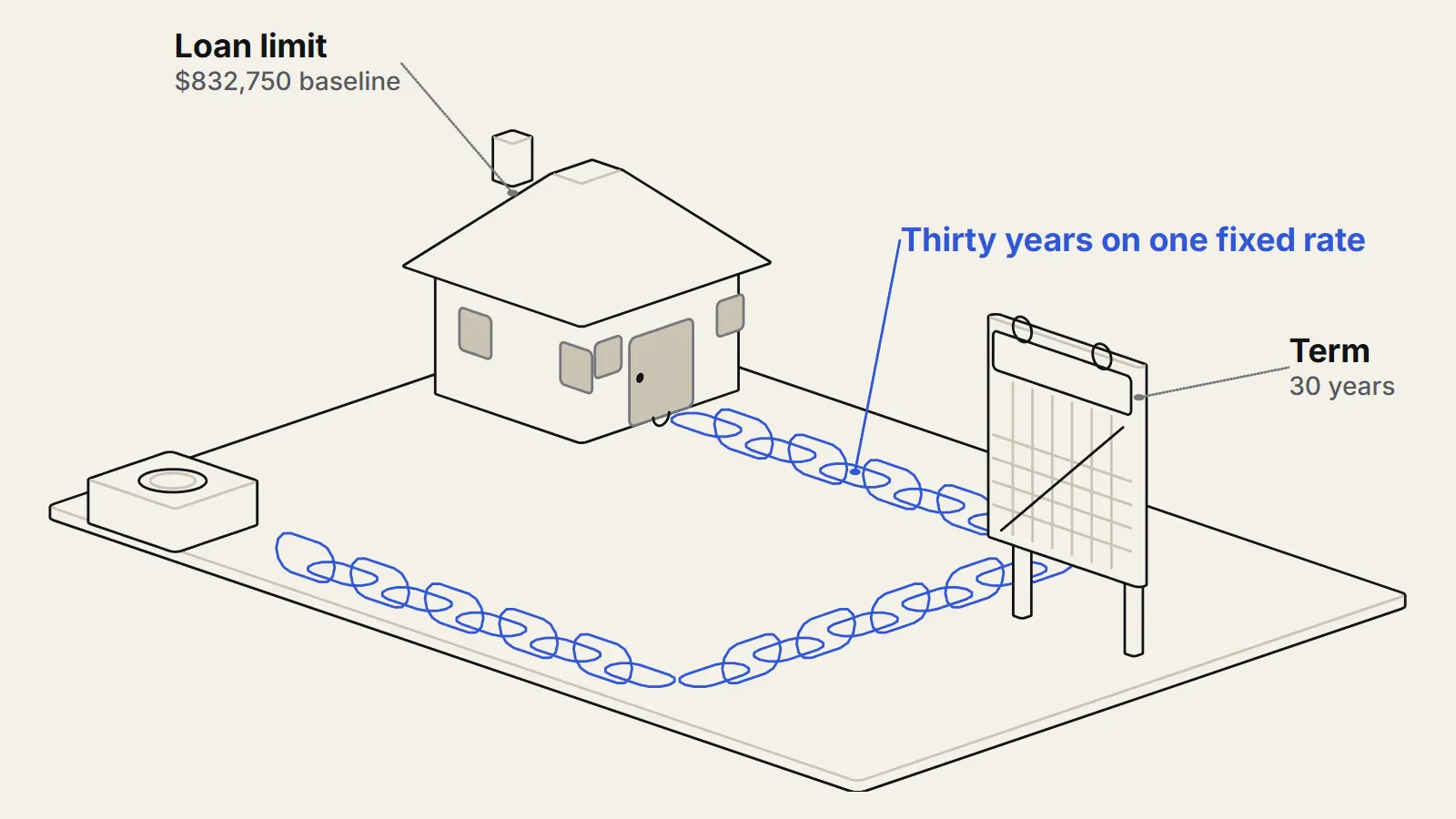
The US 30-year fixed mortgage is unusual because it combines three things that few lenders anywhere will offer together: a very long term, an interest rate that never changes, and the right to repay early without a penalty. Someone has to carry the risk that market rates move in the meantime. In the United States that someone is mostly investors in mortgage bonds, supported by government-backed institutions. A 2018 New York Fed study found that Denmark is, as far as its authors knew, the only other country where such loans are widely available.1
How did the 30-year fixed mortgage become the American standard?
It was not always normal. Before the Great Depression (https://therealigned.com/story/what-caused-the-great-depression), home loans were mostly short and renewable, with down payments of roughly half the purchase price and terms of ten years or less2, ending in a large lump sum called a balloon payment that the borrower had to pay or refinance.2
The federal response to the 1930s housing crisis changed the product. The Home Owners' Loan Corporation, created in June 1933, refinanced distressed loans into self-amortising, fixed-rate mortgages, meaning each payment covered interest plus a slice of the principal so that the debt reached zero by the end of the term. The Federal Housing Administration, created in 1934, insured lenders against losses on such loans and expanded the use of long-term fixed-rate lending. In 1938 Congress set up Fannie Mae to buy FHA-insured loans from lenders, giving them cash to lend again.2 The sequence is set out in an FHFA inspector general history (https://www.fhfaoig.gov/Content/Files/History%20of%20the%20Government%20Sponsored%20Enterprises.pdf).
Who carries the interest-rate risk on a long fixed loan?
Take a bank funded by savers' deposits, which can be withdrawn at short notice. If it lends for 30 years at a fixed rate and market rates then rise, it must pay more to keep its deposits while still earning the old, lower rate. If rates fall, borrowers refinance and the bank loses the high-rate loan. The New York Fed authors describe these loans as embedding significant interest-rate and prepayment risk, which is not a natural match for short-term deposit funding.1 The answer is to move the loan into the bond market, where investors with long horizons can hold it.
That is the job of the secondary mortgage market. Congress created Freddie Mac in 1970 to help savings institutions manage interest-rate risk, and in 1971 it issued the first mortgage-backed security made of conventional loans, meaning pools of loans sold on to investors.2 Fannie Mae and Freddie Mac buy loans that meet their rules and package them into securities. For 2026 the Federal Housing Finance Agency set the baseline size limit for a one-unit home at $832,750, the ceiling on loans the two companies will acquire in most of the country.3 Both companies were placed into federal conservatorship, a form of government control, in 2008.2
How do other countries lend for housing?
Most countries lean on banks that fund loans from deposits, so they offer shorter fixed periods or variable rates. A Dallas Fed review sorted countries by the dominant product in late 2021. The United States and France were mostly long-term fixed; Australia, the United Kingdom and other European countries were mostly variable or short-term fixed; and Canada, dominated by five-year fixed loans, sat between the two.4 The Dallas Fed adds that Fannie Mae and Freddie Mac lower the cost of long fixed loans in the US, while banks elsewhere keep loans on their own books.
Canada shows how a long repayment schedule can coexist with a short rate. A 2010 report from the Congressional Research Service (the research arm of the US Congress) found that Canadian payments are set so the loan takes 25 to 30 years to repay, but the rate is typically fixed for only four to five years, after which the balance rolls into a new term. Closed Canadian mortgages also carry a penalty for early repayment, even when the owner moves.5 The figures are old and will have changed.
Denmark is the close cousin. Its lenders fund each mortgage by issuing a matching bond, so the interest-rate and prepayment risk sit with bond investors. Danish borrowers can repay at par, or buy back their loan at the market price of the bond if rates have risen. In the words of the New York Fed authors, Denmark is the only country aside from the US where long-term prepayable fixed-rate mortgages are widely available1, to their knowledge, as set out in their staff report (https://www.newyorkfed.org/medialibrary/media/research/staff_reports/sr848.pdf).1
What does a fixed rate do when interest rates change?
It slows the effect of central bank (https://therealigned.com/story/what-a-central-bank-does) rate changes on households. The Dallas Fed found that from late 2021 to September 2023 the average rate on all outstanding US mortgages rose only about 0.2 to 0.3 percentage points, while the rate on newly issued mortgages rose about 4 points. In Australia and Finland, where variable and short fixed loans are common, outstanding rates rose almost 3 points.4 The same review found that consumption and core inflation did not weaken more in the faster pass-through countries, and concluded that US monetary policy effects are probably constrained rather than delayed. See the Dallas Fed analysis (https://www.dallasfed.org/research/economics/2024/0116).
The other side of the lock is that a borrower with a low fixed rate has a reason not to move. A Federal Housing Finance Agency working paper estimated that each percentage point by which market rates exceed a borrower's existing rate cuts the chance of a sale in a quarter by 18.1 percent, and that this lock-in prevented 1.72 million home sales between the second quarter of 2022 and the second quarter of 20246.6 The authors also estimate that the shortage of homes for sale raised prices by 7.0 percent, partly offset by a 5.6 percent fall from higher rates themselves. This is one model-based estimate from agency staff, circulated for comment and not an official FHFA position; see FHFA working paper 24-03 (https://www.fhfa.gov/document/wp2403.pdf).
What is the case for and against the system?
The case against has three strands. First, the backing places risk with the public: the two main institutions were rescued into government conservatorship in 2008.2 Second, the fixed rate and the no-penalty exit together create lock-in, as the FHFA estimate suggests.6 Third, the Danish example shows a design in which a borrower can buy back a loan at market value, which softens lock-in while keeping a long fixed rate.1 Whether a US version would work is not answered here.
What is still not known?
The sources read here do not separate how much of American borrowers' taste for fixed rates comes from habit and how much from the supply of such loans that government-backed institutions make possible. The lock-in estimate depends on a statistical model and on assumptions about what sales would have occurred otherwise. And the cross-country comparison rests on late-2021 and 2010 snapshots; products and market shares move.
Key takeaways
- The US 30-year fixed mortgage bundles a long term, a fixed rate and penalty-free early repayment, which puts rate risk on someone other than the borrower.
- It grew out of 1930s federal programmes and was extended by Freddie Mac and mortgage-backed securities from 1970.
- Denmark is the only other country where long, prepayable fixed loans are widely available; many others use shorter fixed periods or variable rates.
- A fixed rate slows the pass-through of central bank rate changes, but it also creates lock-in for owners with old, low rates.
- Fannie Mae and Freddie Mac entered conservatorship in 2008, so who bears the credit risk remains a live policy question.
Sources
- 1Peas in a Pod? Comparing the U.S. and Danish Mortgage Finance Systems (opens the source in a new tab) · Federal Reserve Bank of New York, 2018 · Paper · https://www.newyorkfed.org/medialibrary/media/research/staff_reports/sr848.pdf
- 2A Brief History of the Housing Government-Sponsored Enterprises (opens the source in a new tab) · FHFA Office of Inspector General, 2011 · Report · https://www.fhfaoig.gov/Content/Files/History%20of%20the%20Government%20Sponsored%20Enterprises.pdf
- 3FHFA Announces Conforming Loan Limit Values for 2026 (opens the source in a new tab) · Federal Housing Finance Agency, 2025 · Primary source · https://www.fhfa.gov/news/news-release/fhfa-announces-conforming-loan-limit-values-for-2026
- 4U.S. 30-year mortgage predominance doesn't seem to delay impact of Fed rate hikes (opens the source in a new tab) · Federal Reserve Bank of Dallas, 2024 · Report · https://www.dallasfed.org/research/economics/2024/0116
- 5Mortgage Markets in Selected Developed Countries (CRS R41432) (opens the source in a new tab) · Congressional Research Service, 2010 · Report · https://www.everycrsreport.com/reports/R41432.html
- 6The Lock-In Effect of Rising Mortgage Rates (opens the source in a new tab) · Federal Housing Finance Agency, 2024 · Paper · https://www.fhfa.gov/document/wp2403.pdf