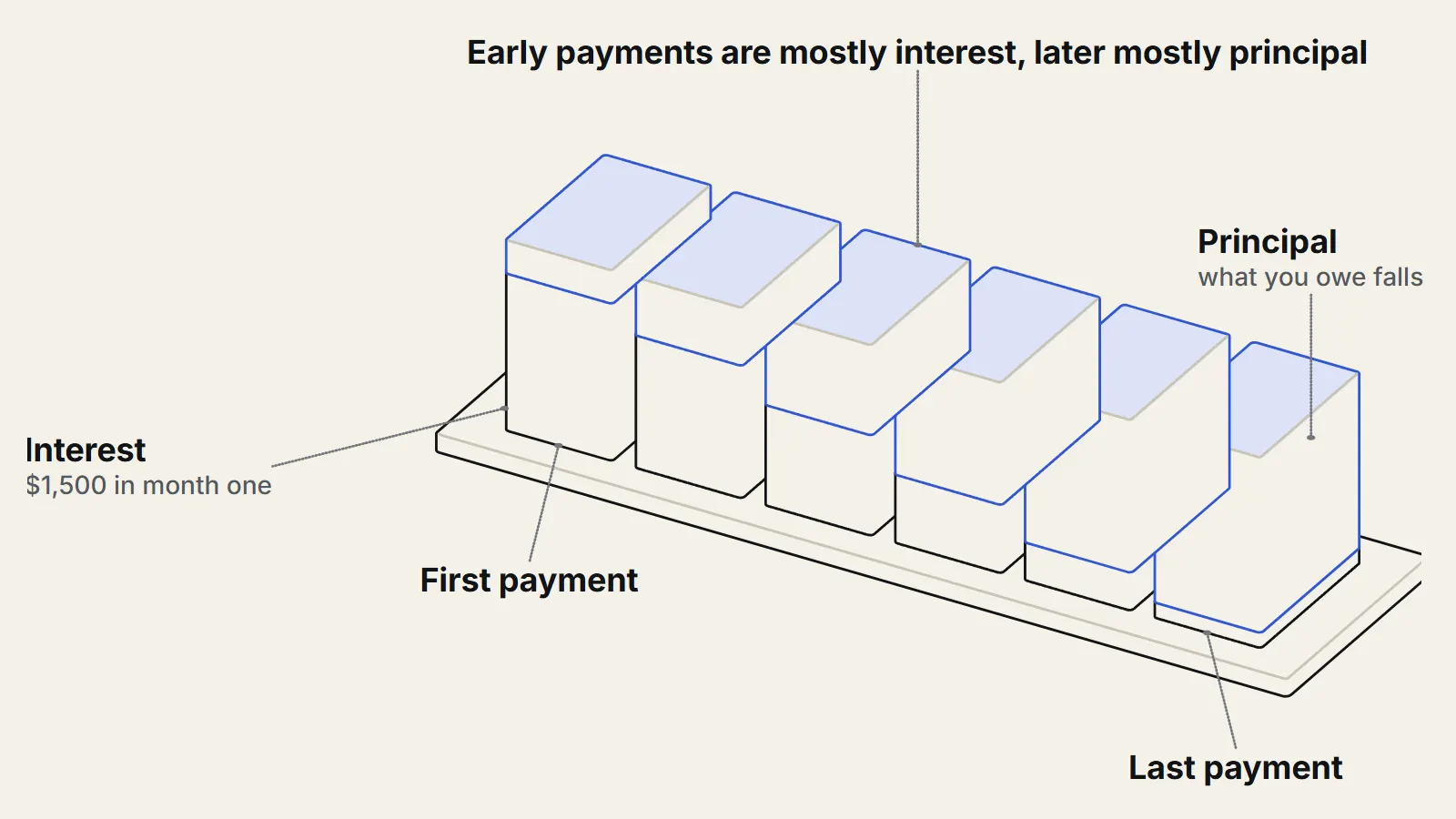
A mortgage is a loan secured by a home, repaid in equal monthly instalments over a fixed term. Because interest is charged on the balance still owed, most of each payment in the early years goes to interest, and only a small slice reduces the debt1.1 The split shifts slowly until, near the end, nearly everything goes to principal. That pattern is called amortisation, and understanding it explains why paying extra early saves so much and why selling after a few years leaves little equity from repayment alone.
How does a mortgage payment get split between interest and principal?
Principal is the amount borrowed that is still unpaid. Each month the lender works out interest on the remaining balance, which is the annual rate divided by twelve times that balance. The scheduled payment is set so that, after interest is taken, what is left reduces principal, and the final payment brings the balance to zero. The US consumer finance regulator describes how the part of the payment going to principal reduces what you owe and builds equity, while on a standard fixed-rate loan the total payment stays the same and only the split changes.1 Its plain-language explanation of amortisation (https://www.consumerfinance.gov/ask-cfpb/what-is-an-amortization-schedule-en-1943/) covers the idea; the numbers below are an illustration calculated for this article using the standard loan formula, not figures from that page.
Assume a $300,000 loan at a fixed 6 percent a year over 30 years, ignoring taxes and insurance. The monthly payment of principal and interest is about $1,798.65. In month one, interest is 0.5 percent of $300,000, which is $1,500, so only about $298.65 reduces the debt. By the end of year ten the balance has fallen only to about $251,057. Interest keeps shrinking as the balance falls, so by month 240 the interest share is about $815 and the principal share about $984.
| Month | Interest | Principal | Balance after |
|---|---|---|---|
| 1 | $1,500.00 | $298.65 | $299,701.35 |
| 120 | $1,257.99 | $540.66 | $251,057.17 |
| 240 | $814.97 | $983.68 | $162,010.76 |
| 360 | $8.95 | $1,789.70 | $0.00 |
Over the whole 30 years the example borrower pays about $347,515 in interest on a $300,000 loan, because the money is borrowed for a long time. In the first ten years about $166,895 of the payments is interest and about $48,943 is principal.
What do extra payments do to the schedule?
An extra payment aimed at principal cuts the balance now, so every later month charges interest on a smaller amount. The consumer finance regulator says that you may be allowed to make extra payments (https://www.consumerfinance.gov/consumer-tools/mortgages/your-mortgage-servicer-must-comply-with-federal-rules/) on principal, that you should check whether your loan permits them and that the money is applied to principal, and that even $100 more a month may shorten the term by several years2.2 In the example, adding $100 a month from the start repays the loan after about 313 months instead of 360, and cuts total interest by roughly $53,000. The saving is larger the earlier the extra money arrives, since early dollars reduce the balance that interest is charged on for the longest time.
One limit matters: extra payments are not always free of conditions, because some loans carry a prepayment penalty, a fee for repaying early. Under the federal ability-to-repay rule, a covered mortgage may not have one unless the loan has a rate that cannot rise and meets other tests, and any penalty must not apply after the first three years, and may not exceed 2 percent of the balance prepaid in the first two years or 1 percent in the third3.3 The lender must also offer a version without a penalty. Loans outside the rule can differ, so the loan documents decide.
What else is in the monthly bill?
The principal-and-interest figure is often not the whole payment. Many lenders collect property taxes and homeowners insurance monthly through an escrow account, a pot managed by the servicer that pays those bills when they fall due. Because taxes and premiums change from year to year, the total monthly payment can change even on a fixed-rate loan.4 The regulator also notes that a fixed rate makes payments more stable, while an adjustable rate can start cheaper but may rise a lot.5 Those costs are outside the example above, which is why a real quote will be higher than the formula figure.
Does a shorter term or paying down early always make sense?
Shorter terms save interest: the regulator says shorter loan terms generally save money overall but carry higher monthly payments.5 In the example, a 15-year loan at the same 6 percent would cost about $2,532 a month but total interest of about $155,683, against $347,515 for 30 years. Real 15-year loans often carry a lower rate as well, which widens the gap.
What remains uncertain?
The example uses a single fixed rate, but real borrowers may refinance, sell, or hold adjustable loans, all of which change the path of the balance. The penalty rules described do not fit every loan. And the figures above depend on the assumptions stated; a different rate or term gives a different split. For a specific loan, the Loan Estimate and closing documents show the actual schedule.
Key takeaways
- A standard mortgage payment stays level, but the share going to interest is largest at the start because interest is charged on the full balance.
- In a $300,000, 6 percent, 30-year example, 83 percent of the first payment is interest, and the balance is still about $251,000 after ten years.
- Extra principal payments shorten the loan and cut interest, most strongly when made early; $100 a month in the example saves roughly $53,000.
- Some loans have prepayment penalties, and federal rules limit them to three years on covered mortgages.
- Escrow for taxes and insurance, and an adjustable rate, can change the total monthly bill beyond the principal-and-interest figure.
Sources
- 1What is an amortization schedule? (opens the source in a new tab) · Consumer Financial Protection Bureau, 2024 · Primary source · https://www.consumerfinance.gov/ask-cfpb/what-is-an-amortization-schedule-en-1943/
- 2Your mortgage servicer must comply with federal rules (opens the source in a new tab) · Consumer Financial Protection Bureau, 2024 · Primary source · https://www.consumerfinance.gov/consumer-tools/mortgages/your-mortgage-servicer-must-comply-with-federal-rules/
- 312 CFR 1026.43 Minimum standards for transactions secured by a dwelling (Regulation Z), paragraph (g) (opens the source in a new tab) · Consumer Financial Protection Bureau, 2014 · Law · https://www.consumerfinance.gov/rules-policy/regulations/1026/43/
- 4What is an escrow or impound account? (opens the source in a new tab) · Consumer Financial Protection Bureau, 2024 · Primary source · https://www.consumerfinance.gov/ask-cfpb/what-is-an-escrow-or-impound-account-en-140/
- 5Loan options (Owning a Home) (opens the source in a new tab) · Consumer Financial Protection Bureau, 2024 · Primary source · https://www.consumerfinance.gov/owning-a-home/loan-options/