Where you’ve heard it
“Renting is throwing money away.” Bernadette Joy, Bankrate expert contributor, July 1, 2025, in an article on building wealth while renting. Read the article (https://www.bankrate.com/investing/how-to-build-wealth-while-renting-home/)
“Renting is throwing your money away.” Liberty Vittert Capito, opinion column in The Hill, June 5, 2026 (AOL copy). Read the column (https://www.aol.com/articles/opinion-don-t-buy-hype-110000366.html)
“you’re just throwing away money on rent” Erica Gellerman, CPA, Credit Karma guide to renting versus buying, updated August 11, 2026. Read the guide (https://www.creditkarma.com/home-loans/i/rent-vs-buy)
Renting is throwing money away.
Renting is throwing your money away.
you’re just throwing away money on rent
Why people believe it
What the evidence shows
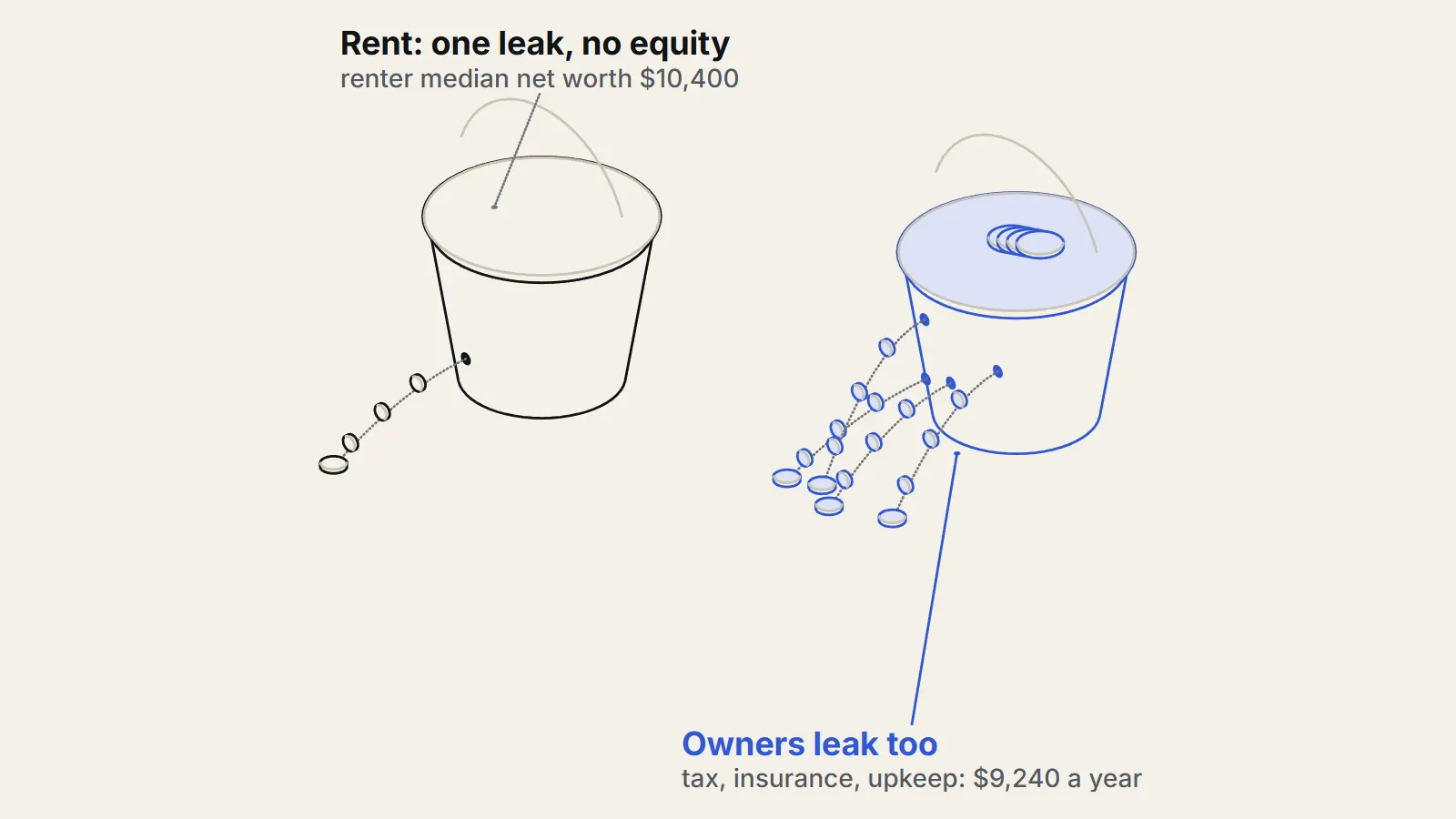
The wealth gap is real. In the Federal Reserve’s 2022 survey, the median homeowner family had a net worth of $396,2001, against $10,400 for the median renter or other non-owner.1 But the same report says income is considerably higher for homeowners than for non-homeowners, and family income is positively correlated with net worth.1 So the gap compares two different kinds of households. It does not show how much of it was caused by owning.
The second point is cost. The claim treats every renter’s dollar as lost and every owner’s dollar as saved. Owners pay for much more than the loan. The National Association of Home Builders analysed the Census Bureau’s 2019 American Housing Survey and found that owners of single-family detached homes spent about $9,240 a year2 to operate and maintain their homes, not counting mortgage payments.2
| Cost | Average per year |
|---|---|
| Property taxes | just under $3,700 |
| Fuels (electricity, gas, oil) | about $2,500 |
| Home insurance | about $1,250 |
| Maintenance | about $950 |
| Water and trash | about $850 |
Some of that, such as fuel and water, is a cost renters pay in some form. Property taxes, insurance and repairs do not build ownership. As a share of the home’s value, operating costs averaged close to 5 percent2, and above 6 percent for homes built before 1960.2 About two-thirds of owner families also carried debt secured on their home in 2022, with a median of $155,600 for those with a mortgage, so interest on that debt is a further cost that these figures do not measure.1
Equity still counts. Owners gain when home prices rise, and the 2019 to 2022 jump in net housing wealth was large.1 But the Federal Reserve report ties that rise to home values increasing sharply, and says rising prices also mean declining affordability for would-be buyers.1 A gain from a price boom is not guaranteed for the next buyer.
Not measured here: the costs of buying and selling a home, mortgage interest, and rent levels in any particular market. Those decide the answer for a given household. This is an explanation of evidence, not advice.
The better question
For this household, in this place and over the years it expects to stay, which costs less once every cost of renting and of owning is counted?
Sources
- 1Changes in U.S. Family Finances from 2019 to 2022: Evidence from the Survey of Consumer Finances (opens the source in a new tab) · Federal Reserve Board, 2023 · Report · https://www.federalreserve.gov/publications/files/scf23.pdf
- 2Operating Costs of Owning a Home (opens the source in a new tab) · National Association of Home Builders (Economics and Housing Policy), 2021 · Report · https://www.nahb.org/-/media/04F57989FBC74C82BEF51C382C654E54.ashx