Summary
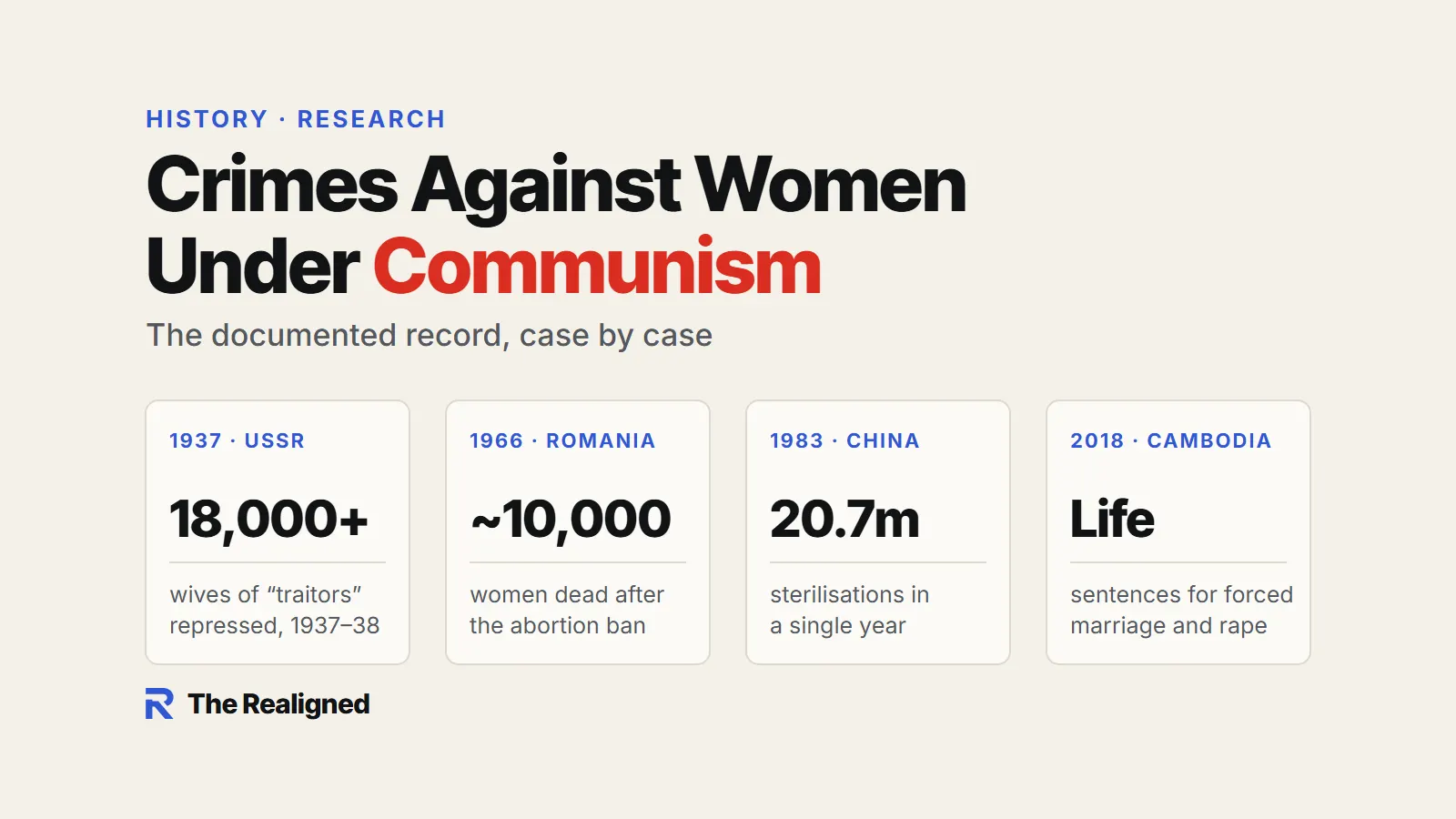
What does the record show about crimes against women under communism? We reviewed court judgments, UN inquiries, state archives, official statistics and peer-reviewed studies on about 20 communist states and movements and three Indian states with elected Left governments. Three patterns recur. Armies under communist command committed mass rape, worst in 1944-45, when the most-cited estimate for Germany alone is 1.9 million victims1, a figure historians dispute. States used women's bodies as policy, through Romania's abortion ban, which killed almost ten thousand women2, and China's birth quotas.
Detention systems from Soviet Ukraine to North Korea exposed women to rape with near-total impunity, and in Tibet, Cambodia and Colombia the control of women's sexual lives was itself an instrument of rule. In West Bengal, records tie ruling-party supporters to rapes.
The question
What are we asking about crimes against women under communism?
The question is simple to state and hard to answer well: what crimes against women were committed, ordered, enabled or covered up by governments and movements that called themselves communist, in the years of revolution and in the decades after, and how strong is the evidence for each? By crimes against women we mean rape and other sexual violence, forced marriage, forced abortion and sterilisation, the punishment of women for the acts of their husbands, abduction, trafficking, and the deaths of women caused by state policy on reproduction.
The question matters because the record is fought over. Some people treat any figure that reflects badly on communist states as Cold War propaganda. Others repeat large numbers that turn out, when traced, to rest on a single guess. Both habits do harm to the women concerned, whose experiences deserve to be counted carefully or not at all. This post tries to do the first: to set out what is established, what is estimated and what is only alleged, and to say which is which.
Which states and movements are included?
We include every state ruled by a communist party for a sustained period where we could find documented evidence: the Soviet Union and the armies under its command, the European people's republics, China (including Tibet and Xinjiang), Mongolia, North Korea, Vietnam, Laos, Cambodia under the Khmer Rouge, Cuba, Ethiopia under the Derg, Afghanistan under the People's Democratic Party, Mozambique, Angola and Nicaragua. We also include Nepal, where a Maoist party fought a ten-year insurgency and later led governments, and three Indian states where communist parties won elections: West Bengal, Tripura and Kerala.
These are very different cases. A one-party state that runs labour camps and an elected state government inside a federal democracy cannot be judged by the same test. We keep them apart throughout. For the revolutionary states the main question is what the state and its forces did. For the Indian states, where police and courts answer to a national constitution, the question is whether crimes against women were different under Left governments than under the parties that came before and after them.
How do we sort the evidence?
We sort every finding into one of four kinds:
- Acts by state forces or party members: soldiers, police, guards, cadres.
- State policies that harmed women by design: abortion bans, birth quotas, sterilisation incentives, the punishment of wives and families.
- Crimes by others that the state tolerated, failed to stop or covered up.
- General crime recorded in a society while a communist party governed it, which may or may not have anything to do with the party.
The fourth kind is the weakest. A rise in recorded rape under a given government can mean more rape, more reporting, a new legal definition or a change in how police record cases. We treat such numbers with the most caution.
We also grade sources. A court judgment or a UN commission of inquiry, which hears witnesses and weighs evidence, carries more weight than a newspaper report. State archives published by historians carry weight because the regime itself produced them. Survey data carry weight when the sample is large and representative. Testimony gathered by human rights groups is often the only evidence available from closed states, and we use it, but we say when a finding rests on it alone.
What did we expect to find?
We set down two working claims before writing, and a test for each. The first claim: that communist governments produced patterns of crimes against women that were directed by the state, not merely tolerated. We would call it supported if, in several unrelated states, a court, a UN body or the regime's own records showed a policy or order that caused the harm. We would call it unsupported if the documented cases were mostly individual crimes without a policy behind them.
The second claim, for India: that elected Left governments in West Bengal, Tripura and Kerala presided over more crimes against women than the parties that governed those states before or after them. We would call it supported if recorded crimes and survey measures were consistently worse under the Left than under its successors in the same state, after allowing for national trends. We would call it unsupported if the differences ran in both directions or could be explained by reporting.
What have earlier studies found?
Most research looks at one country at a time. Historians of the Second World War have argued for decades about how many German women Soviet soldiers raped; the German parliament's research service reviewed the estimates in 2021 and concluded that no definitive number is possible because almost no statistics exist.1 Demographers studying China and India have estimated how many women are missing from those populations because of sex selection and excess female mortality.3
The Extraordinary Chambers in the Courts of Cambodia convicted the surviving Khmer Rouge leaders of forced marriage and rape within forced marriage as crimes against humanity.4 The UN Commission of Inquiry on North Korea found forced abortion, infanticide and rape in detention to be crimes against humanity.5
What is missing is a single account that sets these findings side by side, states the strength of each, and compares them with what armies and governments of other kinds did. That is what this post attempts. It does not attempt a single global count, which the evidence cannot support.
Data
Which records did we use?
No single dataset covers this subject, so we assembled one from six kinds of record, opened and checked one by one. The table lists them with an example of each and what each can and cannot tell us.
| Kind of record | Examples | What it can show | What it cannot show |
|---|---|---|---|
| Court judgments | ECCC Case 002/02 (Cambodia); Calcutta High Court on Nandigram; US federal courts on Ethiopia's Red Terror | Facts found to a criminal or civil standard after hearing both sides | How common a crime was beyond the cases tried |
| UN and regional inquiries | UN Commission of Inquiry on North Korea; OHCHR assessment of Xinjiang; OHCHR Nepal Conflict Report; Inter-American Commission on Cuba and Nicaragua | Patterns found credible after many interviews, often across a whole system | Exact numbers; most inquiries could not enter the country |
| The regime's own records | NKVD orders and reports to Stalin; Soviet Gulag statistics; Chinese health statistics on abortion and sterilisation; Guangxi Party archives | What the state counted and ordered, in its own words | Crimes the state chose not to record |
| Official statistics in democracies | India's National Crime Records Bureau; National Family Health Surveys; census sex ratios | Trends over decades, comparisons between states and parties | Whether a change in recorded crime is a change in crime or in reporting |
| Peer-reviewed research | Demographic estimates of missing women; studies of Romania's abortion ban; archival histories | Estimates built with stated methods | Certainty where data are thin |
| Human rights and press reports | Amnesty International, Human Rights Watch, AP, BBC | Testimony from closed states, often the only evidence | Representative samples |
For the Soviet Union and Eastern Europe the main sources are Soviet orders and reports published from the archives after 1991, Soviet Gulag statistics compiled by the historian Viktor Zemskov,8 Pavel Polian's archival study of forced migrations,10 a 2021 review of rape estimates by the German Bundestag's research service,1 a Czech ombudsman's 2005 investigation of sterilisations,11 and a 1993 reproductive health survey of Romania (https://stacks.cdc.gov/view/cdc/8248) run with the US Centers for Disease Control.2
For China the main sources are official family planning statistics reported in peer-reviewed work,1213 demographic estimates of missing women,3 the UN human rights office's 2022 assessment of Xinjiang (https://www.ohchr.org/sites/default/files/documents/countries/2022-08-31/22-08-31-final-assesment.pdf),14 the Chinese government's own white paper in reply,15 and archival research on the Mao era. For North Korea the main source is the 2014 report of the UN Commission of Inquiry (https://www.michaelkirby.com.au/images/stories/pdf/COI_DPRK_REPORT.pdf), which drew on public hearings and confidential interviews with escapees,5 with later UN and Human Rights Watch reports.1617
For Cambodia the main source is the Case 002/02 judgment of the Extraordinary Chambers (https://www.eccc.gov.kh/sites/default/files/documents/courtdoc/%5Bdate-in-tz%5D/20181217%20Summary%20of%20Judgement%20Case%20002-02%20ENG_FINAL%20FOR%20PUBLICATION.pdf), supported by survey work among survivors.18 For the other states we relied mainly on UN, Inter-American and court records, and on Amnesty International and Human Rights Watch where nothing else exists.
For India we used the National Crime Records Bureau's annual Crime in India reports, the bureau's district-level table of crimes against women for 2001 to 2012,6 and three rounds of the National Family Health Survey, a household survey that asks women directly about violence.1920
How complete is the record?
Very uneven. For some subjects the evidence is strong because a court or the regime itself counted: the Khmer Rouge marriage policy, Romania's abortion deaths, China's sterilisation totals, the number of wives Stalin's police arrested. For others the best figures are extrapolations from a few hospital records or a small survey, and we say so. For some countries we found almost nothing that meets our standard, notably Bulgaria, Mongolia, South Yemen, Benin and the Republic of the Congo, and we do not fill the gap with guesses.
Indian data are fuller but bring their own problems. NCRB counts are counts of cases registered by police. Most violence against women in India is never reported to the police at all: in the 2005-06 health survey, only 0.56% of women who had experienced physical or sexual violence reported it to the police21. So a state with more registered crime may have more crime, or may simply have police stations that write more of it down.
Method
How did we decide what counts?
Step one: for each country we listed every specific harm to women that appeared in at least one source we could open: a law, an order, a court finding, a statistic or a documented case. We discarded any claim that we could trace only to an unsourced web page, a social-media post or a single advocacy pamphlet.
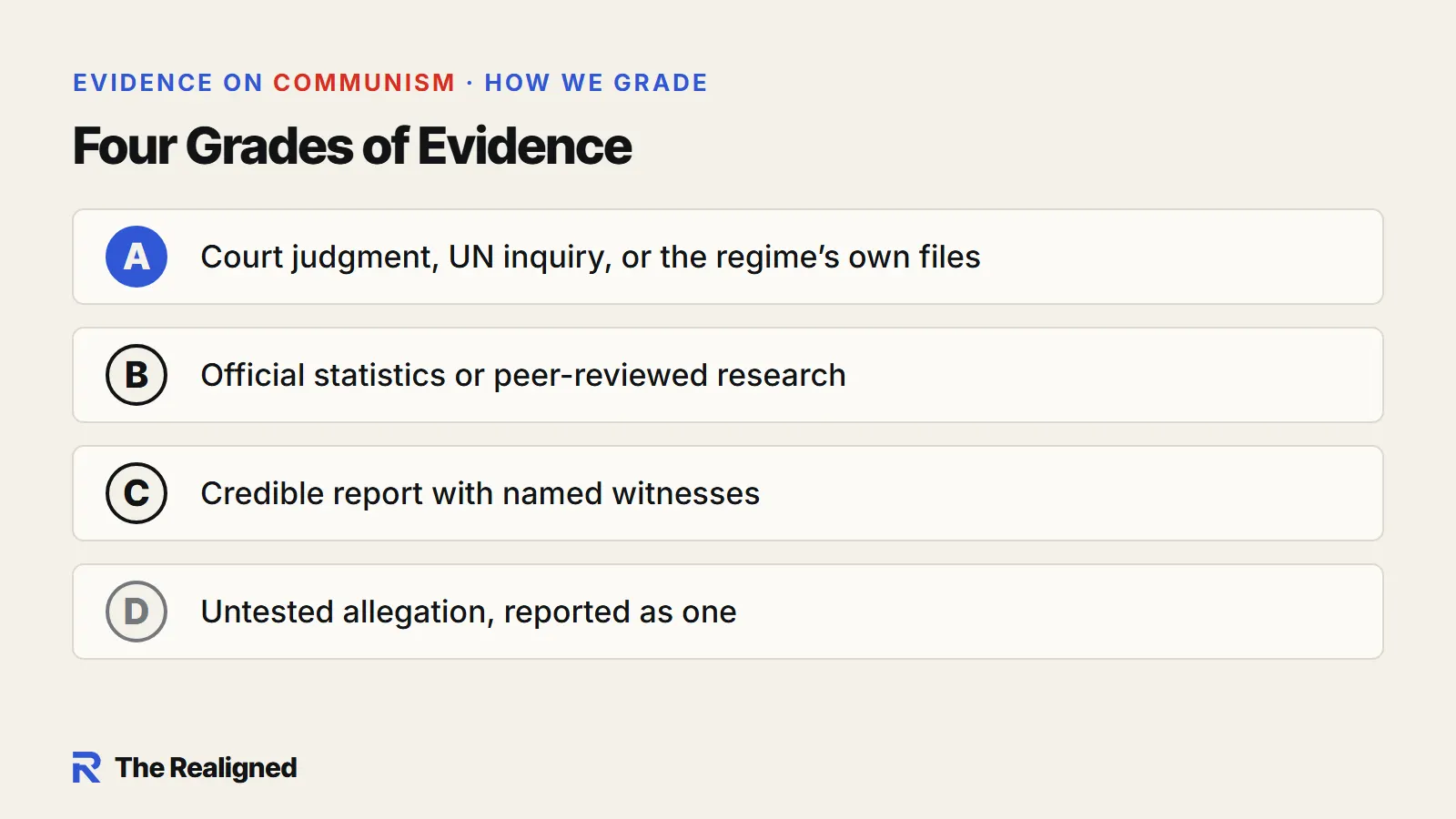
Step two: we graded each item by the strongest source supporting it. Grade A means a court finding, a UN or regional commission finding, or the regime's own document. Grade B means official statistics or peer-reviewed research. Grade C means a credible human rights report or press investigation with named witnesses. Grade D means an allegation that has never been tested and that we report only to say it exists. We state the grade in the synthesis table at the end of the findings.
Step three: for every number that is disputed we looked for at least two independent estimates and report the range, the method behind each, and who made it. Where only one estimate exists we say so.
Step four: we classified each harm by who did it and why, using the four kinds set out above: acts by state forces, harm by state policy, crimes the state tolerated, and general crime.
Step five: we looked for comparisons. A finding that the Red Army raped on a mass scale means more when set beside what other armies did in the same war. A finding that China has millions of missing women means more beside India, which has a similar problem without a communist government. Each comparison is sourced.
How did we handle the Indian data?
India's crime statistics changed in two ways that matter. Until 2011 the bureau published rates per 100,000 people; from 2012 it published rates per 100,000 women, which roughly doubles the number for the same count. And in 2013 Parliament broadened the legal definition of rape and created new offences of sexual harassment, stalking and voyeurism22, so counts before and after 2013 are not like for like.
We therefore compare states with India in the same year, never with themselves across a definition change, and we report counts for the Left years (2001 to 2011 in West Bengal) as counts, not rates. For 2001 to 2012 the bureau's district table gives seven offence heads under the Indian Penal Code: rape, kidnapping and abduction of women, dowry deaths, assault and insult to modesty, cruelty by husband or relatives, and importation of girls. We add those seven. The sum is lower than the bureau's full total, which also includes offences under special laws.
To check recorded crime against something less sensitive to police behaviour, we use the National Family Health Survey, which asks a sample of women in every state whether their husbands have hit them or forced sex on them. Survey answers have their own biases, but they do not depend on a woman walking into a police station.
How did we handle disputed numbers?
Three rules. We never quote the largest number on its own. We say how each estimate was built. And where an estimate is an extrapolation from a small base, such as hospital records multiplied up to a whole country, we say that too.
Take the rapes in Germany in 1945 as an example. The most-quoted figure, 1.9 million, comes from Gerhard Reichling and was published by Helke Sander and Barbara Johr in 1992; the Bundestag's researchers note it has been repeated many times without new calculation.1 The historian Miriam Gebhardt built a different estimate from records of children born to occupation soldiers and reached 860,000 victims of all occupying armies, Soviet and Western, between 1944 and 1955.1 Both rest on chains of assumptions. We report both and do not pick one.
Findings
What happened to women in the Russian revolution and civil war?
The first communist state was born in a civil war of extreme brutality, and sexual violence was part of it on every side. The most careful recent study, by the historian Thomas Chopard, examined the pogroms against Jews in Ukraine between 1917 and 1922. He found that the scale and systematic use of rape was greatest among the anti-Bolshevik forces, especially the White armies, but that Red Army soldiers raped too; in Uman, he records, they stripped men and women and raped them almost in the street.23
Chopard also deals with one of the most repeated stories of the period: a decree on the "socialisation of women", supposedly issued by local Bolsheviks, that made women common property. The decree is a recognised fake circulated by the Whites. Yet, he writes, the rumours did not come from nowhere: they were fed by reports of mass rapes by Red troops.23 At the same time, the new Soviet state put on paper some of the most advanced protections for women in the world. In November 1920 it made abortion legal and free in Soviet hospitals24.
How did Stalin's police punish women for their husbands?
The clearest case of a crime against women by deliberate order in the Soviet record is the treatment of the wives of men arrested as enemies of the people. On 15 August 1937 the head of the NKVD, Nikolai Yezhov, signed Operational Order No. 00486. It instructed police across the country to begin repressing the wives of "traitors to the motherland"25 and to send them to camps for at least five to eight years. The women had committed no offence: the order punished them for their marriages. The order also dealt with their children.
Nursing infants were to go to the camps with their mothers and then to children's homes. Children aged three to fifteen were to be placed in orphanages, and children over fifteen judged "socially dangerous" were to be sent before the NKVD's Special Board.25 Fourteen months later, Yezhov and his successor Lavrentiy Beria reported to Stalin on the result. On incomplete data, more than 18,000 wives had been repressed26, more than 3,000 of them in Moscow and about 1,500 in Leningrad. Stalin wrote one word on the report: "Correct".26
Stalin wrote one word on the report: "Correct".
How many women passed through the Gulag?
Women were always a minority in Soviet camps, but a large one at times, and their share rose sharply during the Second World War. The historian Viktor Zemskov, using the Gulag administration's own statistics, found that women were 5.9% of camp prisoners at the start of 1934, 7.6% in 1941 and 24% at the start of 1945, when 168,634 women were held in the camps8. In the labour colonies, where shorter sentences were served, women made up 38% of prisoners in 1945. On 1 April 1954, a year after Stalin's death, 177,544 women were still held.8
Some of those women were pregnant or gave birth in captivity. Zemskov's tables show 6,779 pregnant women and 14,630 children under their mothers' care in the camps and colonies at the start of 1947, rising to 35,505 children by 1953. The death rate in the camps' homes for prisoners' infants was 409 per 1,000 children in 19478; it fell year by year to 46 per 1,000 in 1953.8
The statistics do not say how many of the pregnancies resulted from rape by guards or other prisoners, or how many were consensual; the published figures do not record it.
| Year | Women in camps | Share of camp prisoners | Women in colonies | Share of colony prisoners |
|---|---|---|---|---|
| 1934 | 30,108 | 5.9% | ||
| 1938 | 68,749 | 6.9% | ||
| 1941 | 110,835 | 7.6% | ||
| 1943 | 125,184 | 13.1% | 131,928 | 28.1% |
| 1944 | 121,981 | 18.8% | 171,627 | 37.7% |
| 1945 | 168,634 | 24.0% | 246,996 | 38.0% |
| 1946 | 85,198 | 14.5% | 126,748 | 27.0% |
| 1947 | 127,224 | 16.0% | ||
| 1948 | 208,324 | 19.0% |
What did the 1936 abortion ban do?
In June 1936, as part of a drive to raise the birth rate, the Soviet government reversed its 1920 decree and banned abortion. Doctors who performed one faced one to two years in prison; women who had one faced public censure and then a fine for a repeat offence.27 The historian Lewis Siegelbaum reports that registered abortions fell from about 1.9 million in 1935 to 570,000 in 1937 and then rose again to 755,000 in 1939, with the true number probably much higher as women turned to illegal operations.
Infant mortality, according to the health commissar, rose from 146 to 162 per 1,000 between 1935 and 1938.27 We found no verified count of women who died from illegal abortions in the USSR between 1936 and 1955, when abortion was legalised again. That is a gap in the record, not evidence that there were none. The comparison with Romania after 1966, where the deaths were counted, suggests the toll could have been substantial.
What does the Beria case show?
Lavrentiy Beria, head of the secret police from 1938 and one of the most powerful men in the Soviet Union, was arrested by his colleagues after Stalin's death in 1953. At the Central Committee plenum that July, a party official read out the testimony of Sarkisov, the head of Beria's bodyguard. Sarkisov said that a schoolgirl and other women had become pregnant by Beria, that two had been given abortions, and that he had kept a list of the women on Beria's orders, of which one copy survived with 25 to 27 names.28
The hall, the stenogram records, laughed. The record supports sexual exploitation of women by one of the most powerful officials in the state, with the state's security apparatus arranging it. It does not support the much larger numbers, in the hundreds, that later writers have attached to Beria; we found no document giving them.28 Beria's prosecution was also a political act by rivals, which is a reason for some caution about the detail.
What did the Red Army do in Yugoslavia, Romania and Hungary?
As the Red Army fought its way west in 1944 and 1945, its soldiers committed rape on a mass scale, and the first protests came from communist allies. Milovan Djilas, a leader of Tito's partisans, recorded that the Yugoslav authorities collected complaints of 121 rapes, a number of them with murder, and 1,204 cases of looting with assault29, even though the Red Army crossed only the north-eastern corner of the country.29 Tito's biographer Vladimir Dedijer gave a figure of 1,219 rapes.30 Djilas raised the matter with Soviet commanders and was rebuffed. Later, at a dinner in the Kremlin, Stalin answered him directly.
Can't he understand it if a soldier who has crossed thousands of kilometres through blood and fire and death has fun with a woman or takes some trifle?
— Stalin to Milovan Djilas, as recorded in Djilas, Conversations with Stalin (1962)
In Romania, then changing sides, local authorities recorded 231 rapes in Arad county in three weeks of September and October 1944 and 213 in Iasi county in ten days.30 For Hungary, where the siege of Budapest lasted into February 1945, estimates range widely: the historian Andrea Peto estimated 50,000 to 200,000 rapes from medical and abortion records; Krisztian Ungvary has written that in many towns 10-15% of women were raped; Attila Horvath has put the figure as high as about 800,000.30 The historian Vojin Majstorovic, who collected these estimates, himself argues that the Red Army showed relative restraint in Yugoslavia compared with enemy territory.30
How many women were raped in Germany, Austria and Poland in 1945?
Nobody knows precisely. The German Bundestag's research service, reviewing the literature in 2021, concluded that no definitive answer is possible because almost no statistical material exists, and that all the figures are rough extrapolations resting on assumptions.1 For Berlin the estimates are relatively consistent. Helke Sander and Barbara Johr, working from the records of the Charite hospital, estimated 94,450 to 131,000 victims, with a mean of about 110,000. Gerhard Reichling put the Berlin figure at at least 100,000.1
The historian Antony Beevor, citing the city's two main hospitals, gives 95,000 to 130,000, and reports one doctor's estimate that about 10,000 of the roughly 100,000 Berlin victims died, mostly by suicide.31 For Germany as a whole, Reichling's estimate of 1.9 million, of whom 1.4 million were in the eastern territories and during the flight west and 500,000 in the later Soviet zone, is the most quoted; Beevor writes of at least two million.131
Miriam Gebhardt's lower estimate of 860,000 covers all occupying armies from 1944 to 1955, and her own breakdown attributes a substantial share to Western soldiers; she calls that breakdown speculative.1
| Place | Estimate | Who estimated | Basis |
|---|---|---|---|
| Berlin | 94,450-131,000 (mean 110,000) | Sander and Johr | Hospital records and births, extrapolated |
| Berlin | 95,000-130,000 | Berlin's two main hospitals, cited by Beevor | Hospital estimates |
| Germany (eastern territories and flight) | 1.4 million | Reichling | Extrapolation |
| Germany (later Soviet zone) | 500,000 | Reichling | Extrapolation |
| Germany, all occupiers, 1944-1955 | 860,000 | Gebhardt | Births to occupation soldiers, extrapolated |
| Vienna and Lower Austria | about 240,000 | Stelzl-Marx | Approximation |
| Hungary | 50,000-200,000; up to about 800,000 | Peto; Horvath | Medical and abortion records; extrapolation |
| Poland | possibly near 100,000; called conjecture by the authors | Ostrowska and Zaremba | Local records |
| Yugoslavia | 121-1,219 reported cases | Djilas; Dedijer | Complaints collected by Yugoslav authorities |
In Austria, the historian Barbara Stelzl-Marx estimates about 240,000 rapes in Vienna and Lower Austria combined, about 20,000 in Burgenland and about 10,000 in Styria.32 In Poland, which the Red Army was liberating from German occupation, the historians Joanna Ostrowska and Marcin Zaremba found 268 rapes recorded in the village of Debska Kuznia alone by the end of June 1945, and a March 1945 report from Olsztyn stating that almost no woman had been spared. Whether the Polish total approached 100,000 they leave, in their words, to conjecture.33
Soviet soldiers also raped women of their own side. Beevor cites the war correspondent Vasily Grossman's notes that Soviet women freed from German forced labour complained of being raped by their liberators.31 And in Manchuria in 1945, where the Red Army invaded in August, leaders of one group of Japanese settlers, the Kurokawa group, handed 15 unmarried young women to Soviet soldiers in exchange for food and protection; the survivors spoke publicly only from 2013.34 We found no reliable estimate of how many women Soviet soldiers raped in Manchuria or northern Korea.
Was the rape ordered?
We found no document ordering Soviet soldiers to rape, and historians who have worked in the archives do not claim one exists. What the record shows is tolerance from the top. Djilas's complaint was dismissed by the Soviet general he raised it with as an insult to the Red Army, and Stalin's reply was an excuse.29 This matters for the first of our working claims. Mass rape by the Red Army is established beyond reasonable doubt, and the leadership's response encouraged it.
But it falls into our third category, crimes the state tolerated, more than the first. It also has to be set beside what other armies did. The Bundestag review notes that sexual violence by German troops in the occupied Soviet Union was "no exception", although no estimate of its scale exists.1 Gebhardt's work suggests Western soldiers raped many more German women than was long assumed.1 The evidence shows mass rape by Soviet soldiers on a very large scale; it does not show that such crimes were unique to them.
Why were ethnic German women deported to the USSR?
Alongside the rapes came a less well known crime aimed partly at women by design. On 16 December 1944 the Soviet State Defence Committee ordered the mobilisation for labour in the USSR of all able-bodied ethnic Germans in Romania, Yugoslavia, Hungary, Bulgaria and Czechoslovakia: men aged 17 to 45 and women aged 18 to 3010. The upper age for women was lower than for men, so the order swept up young women in particular. Soviet records show that 112,480 people were interned, of whom 51,105 were women10.
In Yugoslavia women were about two-thirds of those taken. Mortality among the deportees was 19.2%.10 A study of the deportations from Romania found that mothers of infants were supposed to be exempt but that the rule was not respected, and estimated that 10,000 to 20,000 of the deportees from Romania died.35
| Country | People interned | Of whom women | Women's share |
|---|---|---|---|
| Romania | 69,332 | 32,742 | 47% |
| Hungary | 31,923 | 10,934 | 34% |
| Yugoslavia | 10,935 | 7,243 | 66% |
| Czechoslovakia | 215 | 166 | 77% |
| Bulgaria | 75 | 20 | 27% |
| Total | 112,480 | 51,105 | 45% |
The deportations did not stop with the war. In March 1949, in Operation Priboi, the Soviet authorities deported 94,779 people from the Baltic republics, of whom 41,987 were women and 27,084 children; in July the same year they deported 35,796 people from Moldova, 14,033 of them women.10 These were whole families, deported because of their class or their politics, and women and children were the majority.
Do Soviet population figures show "missing women"?
No, and it is worth saying so plainly because the claim circulates. The 1959 Soviet census showed 18.43 million more women than men among people born between 1889 and 1928, and only 641 men for every 1,000 women aged 30 to 69.36 Those are missing men, killed overwhelmingly in the war. The Soviet population data cannot be used as evidence of crimes against women.
What did Romania's abortion ban cost women?
Of all the state policies in this review, Romania's Decree 770 has the clearest and best-counted toll. Issued by Nicolae Ceausescu's government on 1 October 1966, its first article was blunt: termination of pregnancy is prohibited37. Abortion was allowed only to save the woman's life, for hereditary disease or serious disability, for women over 45, for women who had already borne and were raising four children, and after rape or incest. Every other abortion was a crime.37 Women did not stop having abortions. They had them illegally, often in dangerous conditions, and many died.
A national reproductive health survey carried out with the US Centers for Disease Control after the regime fell found that almost ten thousand women died during the period 1966-19892 as a result. In the 1980s Romania's maternal mortality averaged 150 deaths per 100,000 live births, and 80-85% of those deaths were due to illegal abortion. The abortion-related death rate was eight times its level before 1966.2 A study in the American Journal of Public Health called it the highest maternal mortality rate in Europe.38
The state enforced the ban through women's bodies. Gynaecologists examined women at their workplaces, every four months in factories, and recorded pregnancies; hospitals had to report women admitted after botched abortions, and some doctors were jailed.39 After the ban was lifted in December 1989, maternal mortality fell to 60 per 100,000 by 1992.2 The children born under the policy bore part of the cost. Romania's institute for investigating communist crimes has found that more than 300,000 children were placed in state institutions between 1954 and 1989 and that more than 15,000 died in them.40
Human Rights Watch counted more than 100,000 children in institutions in 1990, in a system built to cope with the results of the coercive birth policy.41
Did other Eastern Bloc states police pregnancy?
Hungary did, for a shorter time. Under the government of Matyas Rakosi, a 1953 decision made it compulsory to report and register every pregnancy so the state could track its outcome. Convictions for procuring abortion rose from 447 in 1950 to 1,538 in 1953, and 123 people were sentenced to five to ten years. Trials were often staged to humiliate pregnant women in public, many of them mothers of several children. Hungary liberalised abortion in June 1956.42
What were East Germany's closed venereal wards?
From the 1960s until 1989, the German Democratic Republic ran closed wards for venereal disease in about ten cities, including Berlin, Halle, Leipzig, Dresden and Rostock. Girls and women could be committed there by the police or youth authorities, often not because they were ill but because they were labelled "vagrants".4344 The numbers are recorded. In 1968 alone, 2,763 girls and women aged 12 to 72 were committed, and 72% of them were completely healthy43.
They were held for up to 12 weeks and examined gynaecologically every day; according to the medical historian Florian Steger, they were released only after thirty negative smears.43 In the Leipzig-Thonberg ward, a study of 1,474 patient files from 1961 to 1990 found that only 29% of those committed actually had a venereal disease; 52% had been committed for "vagrancy", more than half of them minors, and the average age was 19.5.44 Committals for "vagrancy" had no legal basis, and since 2016 German courts have ruled committals to the Halle and Leipzig wards unlawful.44
In March 2026 the German parliament's commissioner for victims of the communist regime held a hearing on the wards. It heard that tens of thousands of girls and young women had been committed, about 5,000 in Halle alone, and heard one former inmate, committed at 15, testify that inmates had been raped one after another.45 That is a single witness's account and has not yet been corroborated in the published record; we report it as testimony. East Germany also held women political prisoners.
Hoheneck castle in Saxony was the state's central women's prison from 1950 to 1989; about 24,000 women were held there, about 8,000 of them for political reasons46, in overcrowded cells averaging about 14 degrees, with forced labour and Stasi informants among staff and inmates.46 A federally funded study published in 2026 found that about 11% of some 95,000 adoptions in the GDR involved excessive harshness by youth welfare authorities, but no systematic political programme of forced adoption.47 We note it because the claim of mass forced adoption is often made; the evidence does not support it in that form.
Were Roma women sterilised in Czechoslovakia?
Yes, and in this case the democratic successor states have investigated, apologised and, in the Czech Republic, paid compensation. In 1973 Czechoslovakia introduced a one-off cash benefit for women who agreed to be sterilised, and a 1988 decree raised it to up to 10,000 crowns plus goods. Regional reports from the 1970s, found by the Czech ombudsman in the archives, spoke openly of curbing the birth rate to avoid what one called the undesirable growth of Gypsy families.11
The ombudsman, Otakar Motejl, examined 87 complaints and concluded in 2005 that free and informed consent was missing in every case he examined. Before 1990, Romani women were persuaded, with a tacit approval and support from the management11 of hospitals and social services, and the cash benefit was the main motivation in a number of cases.11 He found no official instruction to reduce the Roma population, but held the state responsible for tolerating and encouraging the practice. The practice did not end with communism.
In 2021 the Czech parliament passed a law paying 300,000 crowns to people unlawfully sterilised between 1966 and 2012; by February 2025 more than 2,300 people had applied and 1,581 claims had been decided, 581 of them rejected.48 In Slovakia, a 2003 study interviewed more than 230 Romani women and found more than 140 who had been coercively or forcibly sterilised, about 30 of them under the communist-era incentive scheme and the rest after 1989.49
In 2021 the Slovak government apologised, naming 1966 to 1989 as the main period and linking it to state policy on the size of the Roma population.50
What happened to women in Albania and Czechoslovakia's show trials?
Albania under Enver Hoxha interned the families of political opponents, so that women, children and old people were punished for the acts of their relatives, as Stalin's wives order had done. At the Tepelena camp, which operated from 1949 to 1954, about 1,500 families were held; Albania's state security archive records the number of children in the camp falling from 460 in January 1950 to 164 in December 1950, during a typhus epidemic.51 Women were also among the victims of the political trials of the late 1940s and 1950s.
In Czechoslovakia, the politician Milada Horakova was hanged on 27 June 1950 after a show trial prepared with Soviet advisers; the verdict was annulled in 1968 and she was fully rehabilitated after 1989.52
- 1918-1922Rape by Red Army soldiers during the civil war, alongside larger-scale rape by White forcesSource 23 (opens the source in a new tab)
- 1920Soviet Russia legalises abortionSource 24 (opens the source in a new tab)
- 1936USSR bans abortionSource 27 (opens the source in a new tab)
- 1937NKVD Order 00486 orders the repression of wives of "traitors"Source 25 (opens the source in a new tab)
- 1938Yezhov and Beria report more than 18,000 wives repressedSource 26 (opens the source in a new tab)
- 1944-1945Mass rape by Soviet soldiers in Yugoslavia, Romania, Hungary, Poland, Austria and GermanySource 1 (opens the source in a new tab)
- December 1944Order to deport ethnic German women aged 18-30 and men aged 17-45 for labourSource 10 (opens the source in a new tab)
- 1945Women reach 24% of Gulag camp prisoners and 38% of colony prisonersSource 8 (opens the source in a new tab)
- 1949Baltic deportation: 41,987 of 94,779 deportees are womenSource 10 (opens the source in a new tab)
- 1950Milada Horakova executed in PragueSource 52 (opens the source in a new tab)
- 1953Hungary makes pregnancy registration compulsory; abortion convictions peakSource 42 (opens the source in a new tab)
- 1955USSR legalises abortion againSource 27 (opens the source in a new tab)
- 1966Romania's Decree 770 bans abortionSource 37 (opens the source in a new tab)
- 19682,763 girls and women committed to East Germany's closed venereal wardsSource 43 (opens the source in a new tab)
- 1973Czechoslovakia introduces cash payments for sterilisationSource 11 (opens the source in a new tab)
- 1989Romania lifts the abortion ban after almost ten thousand deathsSource 2 (opens the source in a new tab)
What did the Chinese revolution change for women?
Any account of China has to begin with what the revolution promised women, because the promise was real. The Marriage Law of 1 May 1950, one of the new state's first major laws, abolished the feudal marriage system and prohibited bigamy, concubinage, child betrothal and interference with the remarriage of widows53. It set minimum marriage ages of 20 for men and 18 for women and allowed divorce at the request of either party.53 In 1951 alone, about 410,000 divorce cases were filed.54
The economist Amartya Sen, in the same 1990 essay in which he first counted China's missing women, credited pre-reform China with considerable attention to reducing inequality between men and women, with female life expectancy overtaking male.55 Women's participation in paid work stayed among the highest in the world: the World Bank's modelled estimate is 73.1% in 1990, falling to 59.7% by 2020.9 The transition was also violent. An official estimate from the early 1950s put deaths linked to marital disputes at 70,000 to 80,000 a year in the two years after the Marriage Law.54
Those deaths were mostly not caused by the state; they are a reminder that the harms women suffered in this period came from families and villages as well as from cadres.
What happened to women in the Great Leap Forward and the Cultural Revolution?
In the famine of 1958 to 1962, which the historian Frank Dikotter estimates killed at least 45 million people, local cadres held power of life and death over food. Dikotter's archival research, as summarised by the historian Roderick MacFarquhar, found that women were raped by cadres, that in some factories women were made to work naked, and that teams hauled back hundreds of women a month from Inner Mongolia.56 These findings come from Party archives Dikotter consulted; we have checked them through the review rather than the book's pages.
The Cultural Revolution brought mass killing in parts of the countryside, and sexual violence with it. The historian Song Yongyi studied secret archives compiled by the Guangxi Party committee in the 1980s to investigate the massacres there in 1967 and 1968. They contain 225 fully documented cases of rape, gang rape and sexual abuse57; Song estimates there were more than a thousand female victims. Of the tens of thousands of killers, only ten were formally executed, three of them for rape and murder.57
In Daoxian county in Hunan in 1967, the journalist Tan Hecheng documented the mass killing of people classed as class enemies. Women survivors, he found, were forced to marry the men who had killed their husbands and children, and gang rapes took place during the killings.58
What happened to the sent-down girls?
From 1968 the state sent millions of urban young people to the countryside to "learn from the peasants". Many were teenage girls, sent far from their families and placed under the authority of village cadres. The historian Michel Bonnin, whose history of the movement is the standard account, found that the young people were defenceless against mistreatment by local cadres, including the widespread rape of female youth.59 The problem reached Mao himself in 1973 through a letter from Li Qinglin, and the leadership launched a campaign against the persecution of sent-down youth.5960
Local records give a sense of scale. Provincial gazetteers compiled by Chinese historians record 2,528 cases of persecution of sent-down youth in Anhui between 1974 and 1978, of which 2,408 involved young women60; offenders included 593 basic-level cadres and 385 state officials. Zhejiang recorded 2,557 cases involving young women from 1973, with 669 cadres among the offenders.60 Not every case was rape: the historians Emily Honig and Xiaojian Zhao have argued that the 1973 campaign also recast consensual relationships between young women and rural men as crimes.60
A national figure of more than 23,000 cases by 1973, about 70% of them sexual, circulates widely; we could not check it against its original source and leave it out of our tables.
How coercive was China's birth planning?
China's birth control campaigns involved hundreds of millions of procedures on women's bodies. They began not with the one-child policy of 1980 but in the early 1970s. Official statistics show IUD insertions rising from 6.17 million in 1971 to 13.95 million in 1973, female sterilisations from 1.74 million to 2.95 million, and abortions from 3.91 million to 5.11 million.12 The peak came in 1983, in a national campaign that Li Mei and Quanbao Jiang describe as combining reward, persuasion and coercion.13
The sociologists Martin Whyte, Wang Feng and Yong Cai, who reject several common myths about the policy, call 1983 a particularly dreadful year: 14.4 million abortions, 20.7 million sterilisations and 17.8 million IUD insertions12, in a year with about 21 million births. Wang, Cai and Gu Baochang add that the sterilisations were predominantly of women and that a large proportion of these procedures were involuntary61.
A large proportion of these procedures were involuntary.
Over four decades the totals are very large. Health ministry data reported in 2013 counted 336 million abortions and 196 million sterilisations since 1971.62 Not all were coerced; many women chose them. But the system set quotas, fined families that exceeded them and rewarded officials who met them, and its own officials admitted abuses when they became public.
In 2005, after the blind activist Chen Guangcheng collected testimony from women in Linyi, Shandong, who had been forced into late abortions and sterilisations, a national family planning spokesman said local officials had violated the law; Chen himself was seized by police in Beijing.63 In 2012, Feng Jianmei, about seven months pregnant, was forced to abort in Shaanxi when her family could not pay a 40,000-yuan fine; officials apologised and three were suspended.64 In 2014 the UN committee on discrimination against women said it was concerned that forced abortion and sterilisation persisted.65
How many women are missing in China?
In 1990 Amartya Sen estimated that about 50 million women were missing from China's population, compared with what normal ratios of women to men would predict.55 Later work refined the figure. The demographers John Bongaarts and Christophe Guilmoto estimate that missing females in China rose from 27.2 million in 1970 to 62.3 million in 2010, 9.5% of the female population3, through higher death rates among girls and, from the 1980s, sex-selective abortion.3
The sex ratio at birth tells the same story. Normal populations have 103 to 107 boys born for every 100 girls. China's ratio was 108.5 in 1982, peaked at about 121 and was 111.3 at the 2020 census.66 Li Mei and Quanbao Jiang estimate that about 30 million female foetuses were aborted for sex selection between 1980 and 2020.13 Missing women are not a communist phenomenon as such. Bongaarts and Guilmoto find that China and India together account for 84% of the world's missing women, and India has never had a communist national government.3
Son preference long predates 1949. What China's birth limits did, according to the UN committee, was combine with son preference to produce sex-selective abortion, forced abortion and the infanticide of girls on a large scale.65
Are women abducted and trafficked in China?
Yes, and the state has acknowledged it, while also suppressing information about it. The trade in women sold as brides is driven partly by the shortage of women that birth limits and sex selection produced. In one 2009 campaign, the Ministry of Public Security reported rescuing 3,851 abducted women and 2,169 children in eight months.67 The most notorious recent case came to light in 2022, when a video showed a woman chained by the neck in a shed in Fengxian county, Jiangsu. Local officials first denied she had been trafficked.
A provincial investigation then found she had been sold three times in 1998, and 17 officials were punished, including the county Party secretary.68 Brides are also trafficked into China from neighbouring countries. Human Rights Watch interviewed 37 women and girls from Myanmar's Kachin state who had been sold to Chinese families for US$3,000 to 13,000, locked up and raped to make them pregnant; some who escaped to Chinese police were jailed for immigration offences.69
The US State Department reports that brokers arrange forced or fraudulent marriages of women from across Asia and Africa for fees of up to US$30,000, links the demand to the legacy of the one-child policy, and notes that China's Ministry of Public Security has not published its anti-trafficking figures for seven years.70
What happened to women in China's labour camps?
Until 2013 China ran a system of re-education through labour, in which police could detain people for up to several years without trial. The UN's special rapporteur on torture, Manfred Nowak, visited in 2005. Of the torture allegations his office had sent to China since 2000, covering more than 1,160 people, 66% concerned Falun Gong practitioners and 8% sex workers; former detainees of Beijing's women's labour camp called its intensive training section the "Intensive Torture Section".71
Amnesty International's interviews with women held at the Masanjia women's camp in Liaoning described beatings with electric batons and sleep deprivation. Amnesty also recorded the case of Tang Hui, a mother sent to a labour camp in 2012 for demanding harsher punishment of the men who had abducted, raped and prostituted her 11-year-old daughter.72 Her case shows a pattern that recurs across this review: a woman punished by the state for seeking justice for a crime against a girl.
What happened to women in Tibet?
The International Commission of Jurists, in a 1997 study, found that Tibetan women, and especially nuns detained for political protest, suffered gender-specific torture, including rape using electric cattle-prods73. Birth limits in Tibet were enforced through fines, abortions and sterilisations; by 1990 about 3% of the Tibet Autonomous Region's 600,000 women of childbearing age had been sterilised.73 The same report cites field research by anthropologists who found no coercion among nomads but clear coercion in the Lhasa area, a reminder that enforcement varied.73
What has happened to Uyghur women in Xinjiang?
The evidence on Xinjiang is recent, contested by the Chinese government, and in parts strong. Three findings stand out. First, birth rates. Chinese official statistics, accepted by the UN human rights office, show that Xinjiang's birth rate fell from 15.88 per 1,000 people in 2017 to 8.14 in 2019, below the national rate of 10.48; in the mainly Uyghur prefectures of Hotan and Kashgar it fell by more than half in two years.14
The Australian Strategic Policy Institute, working county by county, found the fall was steepest where the population was most indigenous, and called it proportionally the steepest two-year fall anywhere in UN data since 1950.74
| Area | Earlier year | Rate | Later year | Rate | Change |
|---|---|---|---|---|---|
| Xinjiang | 2017 | 15.88 | 2019 | 8.14 | -48.7% |
| Hotan prefecture | 2016 | 20.94 | 2018 | 8.58 | -59.0% |
| Kashgar prefecture | 2016 | 18.19 | 2018 | 7.94 | -56.3% |
| China | 2019 | 10.48 |
Second, sterilisation. In 2018 Xinjiang recorded 243 sterilisations per 100,000 people, against 32.1 nationally14, a reversal from 2010-15, when the region's rate had been far below the national one.75 Budget documents analysed by the researcher Adrian Zenz show plans for 2019 to sterilise 14% and 34% of married women of childbearing age in two Uyghur areas.75 The UN human rights office found credible indications of violations of reproductive rights through the coercive enforcement of family planning policies since 201714.
An AP investigation found that in a leaked list of detainees from Karakax county, 149 of 484 were held for having too many children.76 Third, sexual violence in detention. The UN office interviewed 40 people, 26 of whom had been held in or worked in the camps. It found allegations of sexual and gender-based violence, including rape mainly affecting women, credible, though it could not judge how widespread they were.14
The BBC published the account of Tursunay Ziawudun, who said she had been gang-raped three times in a camp; the BBC checked her documents but said her account could not be verified completely.77 A non-governmental tribunal chaired by the British lawyer Geoffrey Nice concluded in 2021 that rape and sexual violence in the penal system were widespread and that measures to prevent births amounted to genocide, a finding it said it would have preferred not to make.78
Some figures used against China are also overstated. Zenz's claim that 80% of China's new IUDs in 2018 were fitted in Xinjiang uses net placements, after removals; on the gross count, Xinjiang's 328,475 placements were 8.7% of the national total, as Chinese state media pointed out.7975 The fall in births and the rise in sterilisations, however, come from China's own statistics, and the UN office treated them as reliable.14
What has North Korea done to women?
North Korea is the hardest case to document, because it admits no independent observers, and the clearest in what has been found. In 2014 a UN Commission of Inquiry, chaired by the Australian judge Michael Kirby, concluded that the North Korean state had committed crimes against humanity, including rape, forced abortions and other sexual violence5 and persecution on grounds of gender. North Korea rejected the inquiry outright.5 The commission's findings on women fall into four groups. The first concerns women sent back from China.
Many North Koreans, most of them women, cross the border to find food or work; when Chinese police catch them they are returned. The commission found that repatriated women who are pregnant are regularly subjected to forced abortions, and babies born to repatriated women are often killed5, motivated by racist attitudes towards children who may have Chinese fathers.5
A later UN report, based on interviews with more than 100 women forcibly returned and detained between 2009 and 2019, found that all had been body-searched by state security staff, and recorded rape by guards, beatings intended to cause abortion, and the killing of a newborn in a holding centre in 2012.16 The second concerns the prison camps. In the political prison camps, the commission found, rape is common, and pregnant victims face forced abortion or execution; in ordinary prisons guards rape prisoners with impunity.5
The third concerns ordinary life. Human Rights Watch interviewed 106 North Koreans, most of them women, and found that sexual violence by police, prison guards and market officials is so common that it has come to be accepted as part of ordinary life17, with near-total impunity. North Korea told the UN it recorded nine rape convictions in 2008, seven in 2011 and five in 2015.17 The fourth concerns trafficking.
The commission found that a large percentage of women who cross into China alone are trafficked into forced marriage, concubinage or prostitution, usually sold at least twice, and that about 20,000 children born to North Korean women live in China.5 A study by the Korea Future Initiative of 45 survivors estimated that about 60% of North Korean women and girls in China had been trafficked into the sex trade, sold for as little as about US$4 for sex and US$146 as a wife; this is a single organisation's estimate.80
The share of women among North Koreans who eventually reach South Korea reflects this flight. Women were 12% of arrivals before 1999 and 72.3% of all arrivals since records began, rising to 89% in 2024 and 2025.81
Did North Korea kidnap foreign women?
Yes, and here the evidence is unusually firm, because the North Korean state admitted part of it. In 2002 North Korea's leader acknowledged to Japan's prime minister that North Korean agents had abducted Japanese citizens. Japan now recognises 17 of its nationals as abducted in 12 incidents; five returned in October 2002. At least nine of the 17 are women, among them Megumi Yokota, taken in 1977. North Korea says she died, but DNA tests on remains it handed over matched someone else.82
The UN commission found that women abducted from Europe, the Middle East and Asia were subjected to forced marriages: four Lebanese women were lured to North Korea in 1978, and two were given as wives to American army deserters; a Thai woman, Anocha Panjoy, was abducted from Macao in 1978; and a Romanian woman, Doina Bumbea, was lured to Pyongyang and given as a wife to another deserter.5
This is state abduction of foreign women for forced marriage, documented by a UN inquiry, and there is no comparable case among the other states in this review.
What about Mongolia?
We found little documentation of crimes against women by the Mongolian People's Republic beyond its reproductive policy. Socialist Mongolia restricted abortion for decades; it was legalised on request only in 1989, after the regime collapsed.83 We found no study that examines what happened to women in the purges of 1937 to 1939.
What did the Khmer Rouge do to women?
In Cambodia between 1975 and 1979 the Khmer Rouge emptied the cities and caused the deaths of about 1.9 million people84. When Phnom Penh was evacuated in April 1975, at least two million people were driven out, including the sick from hospitals, pregnant women and women who had just given birth.85 The regime's treatment of women had a distinctive feature that a court has examined in detail: forced marriage.
In 2018 the Trial Chamber of the Extraordinary Chambers in the Courts of Cambodia found a nationwide policy, carried out by cadres at every level, under which the Party replaced parents in choosing spouses, forced couples to marry and to have sex4, with militiamen watching to make sure the marriages were consummated. People who refused were re-educated or threatened with punishment or death.
The court convicted the two surviving senior leaders, Nuon Chea and Khieu Samphan, of the crime against humanity of other inhumane acts through forced marriage and through rape within forced marriage, and sentenced them to life.4 The convictions were upheld on appeal in 2022.86 The trial judgment found that husbands who reported their wives for refusing to consummate the marriage exposed them to punishment by cadres, including rape, and that the evidence showed women assaulted by husbands, not the reverse.86 How many people were forced to marry is not known.
A 2014 study of 106 survivors found that 70.2% had refused at least once, yet 97.2% were eventually married and 97% said the marriage was not their choice; the penalties for refusing included threats, beatings, rape, sexual slavery and death.18 The same study notes that prevalence has never been measured, and cites one rough extrapolation of up to 210,000 women forced to marry.18 We report that figure as an extrapolation, not a count.
Rape outside marriage was a different matter in law. The court's closing order held that official Khmer Rouge policy was to prevent rape and punish rapists, so senior leaders were not charged with rape outside forced marriage.87 The legal scholar Theresa de Langis has argued that the regime's moral code, which punished all sex outside state-approved marriage, in practice punished victims as harshly as perpetrators or more so, and that perpetrators were rarely punished, which silenced women.87
Research by the Cambodian Defenders Project found that all perpetrators reported to it were Khmer Rouge cadres, that gang rape and mass rape occurred especially before executions, and that ethnic Vietnamese women were targeted more often.88 A 1993 survey of 993 adults in border camps found that 17% reported rape or sexual abuse during the Khmer Rouge years.89 A comparison with the death toll puts this in context. The demographer Patrick Heuveline estimates that two-thirds of the Khmer Rouge regime's excess deaths, and more than 80% of its violent deaths, were men.84 Women were less likely to be killed. What they suffered was gendered in a different way: through marriage, sex and pregnancy.
What happened to women in Vietnam and Laos?
After the communist victory in 1975, Vietnam held people associated with the former southern government in re-education camps without charge or trial. Officials told Amnesty International in December 1979 that 40,000 had passed through the camps, of whom 26,000 were still held.90 Amnesty's report contains no findings on sexual violence against women detainees, and we found no primary source that documents it. That absence of evidence is not evidence of absence, but we do not fill it. The best-known sexual violence associated with Vietnam in this period was not committed by the Vietnamese state.
Women fleeing by boat were attacked at sea by Thai fishermen acting as pirates. Citing the UN refugee agency, TIME reported in 1981 that women had been raped on 81% of the refugee boats reaching Thailand in the first nine months of the year.91 We include it as context for why women fled, not as a crime of the regime. Vietnam's state did detain women for sex work.
From 1993, many of the country's drug detention centres doubled as centres for detaining sex workers, who were held and made to work; about 309,000 people passed through the centres between 2000 and 2010. In 2003 the Party secretary of Ho Chi Minh City set a goal of putting all the city's sex workers into centres by 2004.92 Today trafficking is the main documented harm.
Vietnam identified 500 trafficking victims in 2024, 310 of them female; traffickers lure women and girls, particularly from the Hmong minority, to China for forced marriages that often involve sex trafficking or forced labour.93 Vietnam also has missing girls: its 2019 census recorded 111.5 boys born for every 100 girls, implying about 45,900 missing female births a year.94
In Laos, Amnesty International reported in 2007 that young Hmong women captured in the jungle had been separated from their families and subjected to slavery-like treatment, including repeated rapes by police; one woman described being held for about a year at a police post in sexual servitude. Amnesty said the evidence was not enough to establish a pattern and knew of no investigation.95
Laos identified 168 trafficking victims in 2023, of whom 145 were girls trafficked for sex, and the US State Department, which downgraded Laos to its lowest tier in 2025, cites endemic corruption and official complicity.96
What has Cuba done to women?
Cuba's revolution brought real gains for women in education. Illiteracy among Cubans over ten fell from 23.6% in 1959 to 3.9% in 1961 after the literacy campaign, according to a UNESCO report.97 Cuba's record on women's rights in custody is harder to establish, because the government does not admit the Inter-American Commission on Human Rights or UN rapporteurs, so most of the evidence comes from Cuban human rights groups and is relayed, not tested, by international bodies. With that caveat, the pattern the groups record is consistent.
The Ladies in White, a movement of wives and mothers of political prisoners, have been detained again and again. The Inter-American Commission, relaying their figures, recorded more than 1,600 summary arbitrary detentions of Ladies in White in January to October 201698, with mothers held together with their children for up to 24 hours, and reports of beatings. Another monitoring group counted 7,995 politically motivated detentions in the first nine months of 2016, most of them of women.98
In 2025 the commission, again relaying civil society figures, reported 122 women held for political reasons in August and at least 77 women arbitrarily detained in the first half of the year; women reported mistreatment, harassment and violence, including sexual violence, and forced labour.99 The NGO Prisoners Defenders counted 1,197 political prisoners at the end of 2025, of whom 128 were women.100 Cuba has also detained women for prostitution.
In 1999 Human Rights Watch reported a new 300-place facility next to Valle Grande prison apparently used to hold the increasing numbers of women accused of prostitution, under laws that allowed detention for "dangerousness" without any crime.101 The third issue is Cuba's export of doctors and nurses. In 2019 two UN special rapporteurs wrote to the Cuban government setting out allegations that women doctors on overseas missions had suffered sexual harassment and that conditions could amount to forced labour; these were allegations, not findings.102
The US State Department, which ranks Cuba in its lowest tier, finds a government policy or pattern of forced labour in the missions, with about 26,000 medical workers abroad in early 2025 and the state keeping 75-95% of their pay.103 That assessment comes from a government in long conflict with Cuba's, and readers should weigh it accordingly.
What happened to women in Ethiopia's Red Terror?
Ethiopia's military government, the Derg, declared itself Marxist-Leninist in the 1970s and in 1977-78 waged a campaign against its opponents known as the Red Terror. Africa Watch called it one of the most systematic uses of mass murder by the state ever seen in Africa, with deaths well in excess of 10,000, and Amnesty International estimated 30,000 political detainees in the capital by the end of 1977.104 Two court records establish sexual abuse of women detainees.
In the United States, three Ethiopian women sued Kelbessa Negewo, a former district official, for what they had suffered in his custody; the courts found that they had been questioned, beaten, threatened and ordered to undress, and awarded each $500,000 in damages, a judgment upheld on appeal in 1996.105 In Ethiopia, the special prosecutor's charges against 55 senior officials of the regime, including the former leader Mengistu Haile Mariam, included rape among other crimes; the Federal High Court convicted all but one in 2006.106
Mengistu, tried in his absence, was sentenced to death on appeal in 2008 and lives in Zimbabwe.107 The same Africa Watch report documents rape and abduction of women by Derg soldiers in Eritrea, Tigray and the Ogaden during the regime's wars, and rapes by insurgents too.104
What happened in Afghanistan under the communist government?
The People's Democratic Party of Afghanistan seized power in 1978, and the Soviet Union invaded in 1979 to support it. A UN mapping report on crimes in Afghanistan from 1978 to 2001, drafted around 2005 and published only in 2024, found that women arrested by KhAD, the government's secret police, were tortured like men and sometimes subjected to rape and sexual abuse, though this did not appear to be common or systematic108.
It cites the UN special rapporteur, who in 1985 listed rape among KhAD's methods of torture and recorded a witness who saw a woman eight months pregnant raped in front of her husband at the Interior Ministry in March 1980.108 The same report found that rape by Soviet soldiers occurred but was not systematic. It also records that after the communist government fell in 1992, mujahideen factions committed mass rape.108 In the UN report, the most widespread sexual violence in Afghanistan came after the communist government fell, not under it.
What happened in Mozambique and Angola?
After independence in 1975, Mozambique's ruling Frelimo party, which adopted Marxism-Leninism, sent people it considered undesirable to re-education camps. The historian Benedito Machava estimates that about 100,000 people passed through the camps by 1992, about half of them in the 1983-88 Operation Production. He notes the unchecked sexual life of the camps, particularly for female detainees, and that pregnancy was in some cases a death sentence.109
In Angola, after a failed coup attempt in May 1977, the ruling MPLA's political police carried out executions without trial that ran into 1978; Amnesty International reported that those killed included members of the women's detachment, and could not estimate the total.110
Did Nepal's Maoists commit sexual violence?
Nepal's Communist Party (Maoist) fought an insurgency from 1996 to 2006 and then led several governments. The UN human rights office's 2012 report on the conflict catalogued more than a hundred cases of sexual violence. Of these, 12 list Maoist personnel as alleged perpetrators111; the rest were attributed to the state's security forces, then under the monarchy and the parliamentary government. More than a third of victims were girls. The report found Maoist sexual violence more opportunistic and committed by individuals.111
Human Rights Watch documented seven cases of sexual violence by Maoists, including rape within the movement's own ranks and the rape of a woman abducted in 2004.112 In Nepal, then, the communist movement committed sexual violence, but the state forces fighting it committed far more. Nepal also has a large trafficking problem: its human rights commission estimated up to 35,000 people trafficked in 2018-19, 15,000 of them women.113 We found no evidence linking that to Maoist rule rather than to poverty and migration, and do not attribute it.
What has Daniel Ortega's government done to women in Nicaragua?
Nicaragua's Sandinista front governed as a revolutionary party in the 1980s and returned to power under Daniel Ortega in 2007. Since the protests of April 2018, a UN group of experts has found that the police, the prison service and pro-government armed groups have systematically committed acts amounting to torture, including rape and other forms of sexual violence114, including threats of rape, forced nudity and electric shocks to the genitals. It documented 14 long-term enforced disappearances, two of them of women.114 The most serious allegation against Ortega himself has never been tested.
In 1998 his stepdaughter, Zoilamerica Narvaez, filed criminal charges accusing him of sexual abuse, rape and sexual harassment; he was protected by parliamentary immunity, and the Inter-American Commission declared her petition admissible without judging the merits. She later withdrew it and the case was closed.115 We record the allegation and that it was never adjudicated.
What happened to women in India's Left-ruled states?
India is the one country in this review where communist parties have won power repeatedly in free elections and then lost it. The Left Front led by the Communist Party of India (Marxist) governed West Bengal for 34 years, from 1977 to 2011. A Left Front governed Tripura from 1978 to 1988 and again from 1993 to 2018. In Kerala, where a communist government was first elected in 1957, the Left Democratic Front has alternated in power with the Congress-led United Democratic Front, and governed from 2016.
These governments ran the police and the state administration, but not the courts, the criminal law or the national statistics office. So the question here is not whether a party state committed crimes, but whether Left governments presided over more crimes against women, or protected the perpetrators more, than the parties before and after them. We look at three kinds of evidence: recorded crime, survey data, and specific cases established in court or by credible inquiry.
Did recorded crimes against women rise under the Left Front in West Bengal?
Yes, very fast. Using the crime bureau's district table, the seven main offences against women recorded in West Bengal rose from 6,533 in 2001 to 26,014 in 2010 and 28,919 in 20116, the year the Left Front lost power, a rise of 4.4 times in a decade. Most of the increase was in one offence, cruelty by a husband or his relatives under section 498A of the Penal Code, which rose from 3,859 to 19,772 and made up about two-thirds of the total.6
Two things argue against reading this as a simple rise in violence under the Left. The first is that the pattern continued under the Trinamool Congress, which took over in 2011. In 2020 West Bengal recorded cruelty by husbands or relatives at 41.7 cases per 100,000 women, against 17.0 for India7, and its overall rate of recorded crimes against women stayed between about 64 and 76 per 100,000 women from 2017 to 2024.116
The state's high count of domestic cruelty cases looks like a feature of how cases are registered in West Bengal, persisting across governments. The second is that recorded rape in West Bengal was below the national rate in the years we can compare: 2.4 per 100,000 women in 2020 against 4.3 for India.7 A state where women report domestic cruelty more and rape less than elsewhere is telling us at least as much about reporting as about crime.
Was Tripura's record worse under the Left?
On recorded crime, at one point, yes. In 2011, under the Left Front, Tripura had the highest rate of recorded crimes against women of any Indian state: 37 per 100,000 people, against a national 18.9117. Its rate fell after the BJP took power in 2018, from 54.5 per 100,000 women in 2019 to 34.8 in 2024.116 The data cannot tell us whether that fall reflects less crime, less reporting or different recording. The household survey points the same way as the crime data for the Left years.
In the 2005-06 National Family Health Survey, 19% of ever-married women in both West Bengal and Tripura reported sexual violence by their husbands, against 8% in India20, and 40% of women in Tripura reported physical violence, against 31% nationally.20 Both states were then governed by the Left Front. By the 2015-16 survey, sexual violence had fallen to 9% in both.20
In the 2019-20 survey, the share of women reporting any physical or sexual violence by a husband was 27.0% in West Bengal (then under the Trinamool Congress) and 20.7% in Tripura (then under the BJP), down from 33.1% and 28.1% in 2015-16, and 9.9% in Kerala.19 The national figure was about 29%.118
Which rapes are linked to the Left parties in West Bengal?
The statistics above describe whole populations. The cases below are different: in each, members or supporters of the CPI(M), or police under the Left Front government, are found by a court, named in an official record or a credible inquiry, or credibly alleged to have committed sexual violence, or the party responded by disputing the women's accounts. We do not name survivors; Indian law forbids it. The table sets out each case with the basis for the party link and what became of it.
| Year | Place | What happened | Basis for the party link | Outcome |
|---|---|---|---|---|
| 1979 | Marichjhapi | Police firing killed 36 refugees during a government blockade; rape of refugee women by police alleged | Police acting under the Left Front government; rapes alleged in scholarship and survivor testimony | No charges against any official |
| 1990 | Bantala | Three women health officials attacked and sexually assaulted; one died, and their driver died | Attackers described as party men in later accounts; police and government said the women were suspected child-lifters | Six accused reported sentenced to life; court record not located |
| 1990 | Birati | Women living in railway-side hutments raped | The CPI(M) women's wing's published statement questioned the victims' character | Perpetrators described as anti-socials |
| 2003 | Dhantala | Six women raped in an attack on two wedding buses; a driver killed | Chief Minister told the Assembly 7 of 22 arrested were CPI(M) supporters | 2009: four convicted, one of rape; local CPI(M) leaders acquitted |
| 2006 | Singur | A young woman protester raped, according to the CBI charge sheet, and murdered | CBI charged the local CPI(M) zonal secretary with arranging the assailants | 2008: life sentences for murder and conspiracy; bail pending appeal |
| 2007 | Nandigram | At least 20 women sexually assaulted by armed ruling-party supporters; three women identified as raped on 14 March; five rape cases registered by November | Petition before the High Court, CBI raid findings, Amnesty International, a citizens' tribunal | High Court ordered compensation for identified rape victims; no conviction found |
- 1979Police firing at Marichjhapi kills 36 refugees during a government blockadeSource 120 (opens the source in a new tab)
- 1990Bantala: three women health officials attacked; police and government call them child-liftersSource 121 (opens the source in a new tab)
- 1990Birati: the CPI(M) women's wing publicly questions the victims' characterSource 122 (opens the source in a new tab)
- February 2003Dhantala: six women raped; seven of 22 men arrested are CPI(M) supportersSource 123 (opens the source in a new tab)
- December 2006Singur: CBI charges the local CPI(M) secretary with arranging the assailantsSource 124 (opens the source in a new tab)
- March 2007Nandigram: High Court records rapes; compensation orderedSource 119 (opens the source in a new tab)
- 13 November 2007Chief Minister says the people who suffered at Nandigram were paid back in their own coinSource 125 (opens the source in a new tab)
- 4 December 2007He says he should not have said soSource 126 (opens the source in a new tab)
- 2008Singur: life sentences for murder and conspiracySource 127 (opens the source in a new tab)
- 2009Dhantala: four convicted, local CPI(M) leaders acquittedSource 128 (opens the source in a new tab)
- 2012New government withdraws the appeal against Nandigram compensationSource 129 (opens the source in a new tab)
Nandigram, 2007
In early 2007 villagers in Nandigram barricaded their land against acquisition, and the area became a battleground between them and armed supporters of the ruling party. On 14 March the police went in. The petition before the Calcutta High Court, summarised in its judgment, stated that the police were accompanied by at least 300 CPI(M) cadres and that three women were raped that evening; when the CBI raided a brickfield nearby it recovered arms, CPI(M) receipts and red flags, and all ten men found there were said to belong to the CPI(M).119
The court found that criminal acts of violence including arson, rape and murder were rampant119, held the police firing wholly unconstitutional, and ordered the state to pay 200,000 rupees to each rape victim identified in the pleadings.119 The Left Front government appealed against the order to the Supreme Court; it was the next government that withdrew the appeal in 2012 and agreed to pay.129
Amnesty International, which sent a delegation after the ruling party retook the area in November 2007, reported that in January and March at least 20 women were sexually assaulted by armed supporters of the ruling CPI-M130. Officials and villagers named groups of armed CPI-M supporters as the perpetrators of the November attacks; police had registered five rape cases, naming the accused, and at the time of Amnesty's visit none of the named men had been arrested. One woman told Amnesty's researchers: "They raped my daughters in front of me and then they raped me."130
| FIR | Date | Sections charged |
|---|---|---|
| 30 of 2007 | 4 March 2007 | 448, 376(2): house trespass, aggravated rape |
| 47 of 2007 | 19 March 2007 | 147, 148, 149, 448, 323, 326, 376, 511: rioting, trespass, hurt, rape, attempt |
| 192 of 2007 | 11 November 2007 | 376: rape |
| 260 of 2007 | 17 November 2007 | 376(2), 506: aggravated rape, criminal intimidation |
| 316 of 2007 | 22 November 2007 | 448, 363, 361, 380, 325, 354, 506: trespass, kidnapping, theft, grievous hurt, outraging modesty, intimidation |
The police figures were inconsistent. The CRPF's deputy inspector general gave Amnesty the five FIRs above, three of them filed after the November violence, while the Nandigram police station said only two complaints had been filed. None of the men named in the FIRs had been arrested at the time.130
In one case reported to Amnesty, a woman said she and her two daughters, aged 16 and 14, were raped at Satengabari in the first days of November 2007. The daughters were still missing when Amnesty visited. The police officer in charge told its delegation there was news that they had joined a circus at Howrah, and Amnesty recorded no verification of it.130 A citizens' team found women in several villages threatened with attack at night, with men telling them: We'll come back at night - light your lamps and wait for us with open doors131.131
An NGO platform's inquiry, released in September 2007 by a former state Land Reforms Secretary, counted among the women at Nandigram on 14 March 274 physically tortured, 46 whose modesty had been violated, 17 sexually tortured and 11 raped132.132 That is an NGO's count, not a court or official finding.
A citizens' tribunal chaired by a former chief justice of Sikkim found a disturbingly large number of incidents of sexual violence by both police and armed ruling-party cadres.133 The state's women's commission, by contrast, visited one survivor in hospital and declared there was no evidence of rape, one member remarking that the woman had borne several children, although the local police chief and the hospital superintendent had confirmed evidence of rape.134 We found no conviction in any of the Nandigram rape cases.
The tribunal also recorded that two women who said they had been raped were not examined for rape for 72 to 80 hours, and that a mother and daughter named CPI(M) cadres.133 A women's-group team reported in 2015 that only 3 of 16 rape survivors it traced had received the Rs 2 lakh compensation the High Court ordered; that is an NGO's claim, not an official count.135 The cases have not closed. In January 2026 the CBI arrested a witness in a 2007 Nandigram gang-rape case after 19 years; Bengali outlets disagreed over how many of the accused are alive, and the Trinamool Congress and the BJP traded accusations over the arrest.136137 A Bengali retrospective of 2026 records that protesters alleged CPI(M) cadres entered the villages in disguise alongside the police on 14 March 2007, and that rape allegations were made against them.138 We could not find the accused in these cases named, or their 2007 party, in any source.
The ruling party's reaction came from the top. On 13 November 2007, after the CPI(M)'s cadres had retaken the villages, Chief Minister Buddhadeb Bhattacharjee told reporters in Kolkata that the people who suffered were paid back in their own coin125. He asked whether they had been peaceful people, and said they had for months attacked, harassed and evicted CPI(M) supporters.125
the people who suffered were paid back in their own coin
Human Rights Watch, which reports the phrase as paid back in the same coin, says the remark helped fuel the violence of that November.139 On 4 December, at a press conference in New Delhi, the Chief Minister said of it: I should have not said so. The statement has drawn so much criticism.126 The remark was about the recapture of Nandigram as a whole; none of the reports we found shows him speaking about the rape allegations. The same weeks produced part of the sexual violence on record: according to the CRPF officer who spoke to Amnesty, three of the five rape cases registered at Nandigram were filed after the November violence.130 It was not about the Singur case below.
The party's formal line was denial. A Central Committee statement of 3 April 2007 spoke of allegations and charges fabricated and purveyed about sexual assaults on women in Nandigram, and said a woman from a CPI(M) sympathiser's family had been gang-raped on 3 March by its opponents.140 A commentary in Mainstream reported the state hospital's superintendent as saying a medical board found the woman in a separate rape case of 18 April 2008 had not been raped, while its author argued that rape is a legal conclusion and not a medical one.141
Singur, 2006
At Singur, where land was being acquired for a car factory, the burnt body of a young woman active in the farmers' protest was found in December 2006 inside the fenced factory site. The CBI's charge sheet stated that Suhrid Dutta, the CPI(M)'s zonal secretary for Singur, had arranged four assailants to carry out the killing, and that the assailants raped and murdered her124.
In 2008 a fast-track court sentenced Dutta and a co-accused to life imprisonment for murder and conspiracy; the court called it a personal vendetta rather than a political murder, and the reports of the verdict do not mention a finding of rape.127 The High Court granted both men bail in 2009 pending appeal.142
The case was contested from the first day. The Asian Human Rights Commission reported on 18 December 2006 that the young woman's undergarments had been removed and that it was believed she had been raped and then set on fire to cover up the crime. It alleged that the police at first refused her father's written complaint.143 The CBI took over, and in 2007 it arrested the CPI(M) supporter Debu Malik, who was reported to have confessed in a Delhi court after a narco-analysis test, and then the party's Singur secretary.144 The party's state secretary, Biman Bose, called the case fabricated, and the party described Debu Malik as a supporter and not a member.145
The party defended its secretary. On 28 June 2007, after Suhrid Dutta's arrest, Jyoti Basu said the party would defend him and that CBI officials are also human beings who may be under pressure.146 Dutta died in November 2023, and we found no appeal outcome.147 Tapasi Malik's father, Manoranjan Malik, said in 2024, in Bengali, that the CPI(M) had killed his daughter; that is a father's statement, not a finding.148
Other Singur women accused the police, not the party. After the police action of 2 December 2006, in which villagers including women were arrested, a national human rights confederation said that female arrestees at Chandannagar police station had been manhandled, beaten, molested and sexually abused by male policemen, and a citizens' committee of historians and lawyers reported that women protesters were beaten by male policemen who used filthy language.149 Medha Patkar, who was arrested that day, said the same to the magistrate and in a report published in February 2007.150 These are statements by rights groups, not court or official findings, and we found no FIR, chargesheet or verdict for any of them.
We looked for more, and the record is thin. We found one individually documented rape case at Singur, that of Tapasi Malik, and no second case with a complaint, chargesheet or court finding. We found no count of rapes at Singur, and no report by the National Commission for Women, the state women's commission or the NHRC on sexual violence there. We also found no report of women missing from Singur. A figure that circulates, of eleven women raped, belongs to Nandigram: it comes from an NGO platform's report of September 2007 on 14 March at Nandigram, and has sometimes been wrongly attributed to Singur.132 Bengali-language press, which we could not search in depth, may hold more.
Dhantala, 2003
On the night of 5 to 6 February 2003, two buses carrying wedding parties were stopped in Nadia district; passengers were robbed, a driver was killed and six women were raped. The Chief Minister, Buddhadeb Bhattacharjee, told the state Assembly that of 22 men arrested, seven were CPI(M) supporters123, six were Trinamool Congress supporters and one a Congress supporter.123 In Parliament, the opposition leader Mamata Banerjee said the women had been gang-raped by ruling-party cadres and that the police had registered a complaint only after 18 days.151
In 2009 a fast-track court convicted four men of dacoity with murder, one of them also of rape, and acquitted 17 others, among them a former CPI(M) zonal committee member and a former village council head.128
Bantala, 1990
On 30 May 1990, three women officials of the state health department, returning from an immunisation inspection, were stopped at Bantala on the edge of Calcutta and sexually assaulted; one of them died, and so did their driver. The police and the state government at first put out the story that the women were suspected child-lifters.121
Later accounts describe the attackers as party men and Bantala as a party stronghold, and report that six accused were eventually sentenced to life imprisonment; we could not locate the court record to confirm the sentences or any party membership.121152 A remark widely attributed to the Chief Minister, Jyoti Basu, that such things happen, circulates in several wordings that we could not trace to a contemporary record, so we do not quote it.
Birati, 1990
In July 1990 women living in railway-side huts at Birati, north of Calcutta, were raped. The response drew more attention than the crime. The CPI(M) weekly People's Democracy printed a statement by the general secretary of the party's West Bengal women's organisation saying that the victims lived in unauthorised hutments, that local women were involved in foul professions122, and that one was the mistress of a notorious anti-social.122 The historian Tanika Sarkar and others criticised the statement in the Economic and Political Weekly in 1991, and the CPI(M) leader Brinda Karat replied there.153
Marichjhapi, 1979
In the Left Front's second year in office, the government blockaded refugees from Bangladesh who had settled on Marichjhapi island in the Sundarbans and then evicted them by force. On 31 January 1979 the police opened fire and killed 36 people120; no official or politician was ever charged.120 The political scientist Ross Mallick, quoting a 1982 account, wrote that the police began to rape the helpless young women at random, and argued that the CPI(M) state committee and cabinet were morally and perhaps legally culpable for rape and mass murder.154
Survivors interviewed for the 2019 oral history Blood Island said women were afraid to go out for fear of being raped by police and that women were taken away.155 No inquiry has examined these accounts, and we report them as allegations.
Across these cases the official response followed a pattern. At Bantala the victims were called child-lifters; at Birati the party's own women's organisation questioned their morals; at Nandigram the women's commission found no evidence of rape where doctors had found it, and the government appealed to the Supreme Court against the High Court order that included compensation for the rape victims. In none of the cases above could we confirm from a court record that a party leader was convicted of rape.
At Bantala the victims were called child-lifters; at Birati the party's own women's organisation questioned their morals
What other cases were reported across West Bengal under the Left Front?
Beyond the cases above, the Bengali and national press and rights groups reported others. Most are weaker. The original Anandabazar Patrika and Telegraph reports are blocked to automated access and we could not read them, so several cases reach us through writers who cited them, and for most we found no court record. The table gives each case with its grade: B for credible reporting of charges, C for an allegation reported by one side or a secondary source.
| Year | Place | What is reported | Grade | Outcome |
|---|---|---|---|---|
| 2003 | Ghoksadanga, Cooch Behar | A housewife who was herself a member of the CPI(M)'s women's front alleged gang rape; police registered rape cases naming two CPI(M) members and four activists | B | A local blog reports ten-year sentences in 2005, upheld in 2007; no court record found |
| 2003 | Patulia, Khardah | A tribal woman alleged gang rape; locals and Trinamul said the two men arrested were CPI(M) members | C | The party denied it; no outcome found |
| 2003 | Nanoor, Birbhum | Two women filed rape complaints; one accused was said to be a CPI(M) worker | C | The party called it a Trinamul-police conspiracy; no outcome found |
| 2003 | Aranghata, Nadia | The son of a CPI(M) local committee member was arrested for alleged molestation of a 12-year-old girl | B | No outcome found |
| 2003 | Dangapara, Malda | Four CPI(M) workers were arrested for stripping and beating a woman who defied a panchayat court | B | Sexual humiliation, not rape; the zonal secretary said they had tarnished the party's image |
| 2000 | Alipore, Kolkata | A 19-year-old mute girl was reported raped by two constables in a police van | B | Amnesty gives no outcome |
| 1993 | Nadia | A deaf-mute girl was allegedly raped by a ruling-party worker; police would not register a complaint | C | No outcome found |
| 2008 | Nandigram | Two rapes were reported on 18 April and 5 May 2008; rights groups named CPI(M) cadres | C | Hospitals did not examine the women for days; no investigation reported |
| 2010 | Sonamukhi, near Jhargram | At least six women were allegedly raped when joint police and paramilitary forces raided the village; a later letter names a CPI(M) armed cadre | C | No FIR or medical result found |
The 2000 Alipore case comes from Amnesty,156 the 1993 Nadia case from a Mainstream commentary,157 and the 2008 Nandigram rapes from a report by the World Organisation Against Torture, which presumed the perpetrators were CPI(M) members or allied militias and found no police investigation.158 The Sonamukhi account is an activist report of July 2010 that blames the joint forces,159 and a later letter from a Maoist-aligned committee names a CPI(M) armed cadre and says the Chief Minister denied any rape in the Assembly.160
Ghoksadanga, 2003
The Ghoksadanga case is the best documented. On 22 February 2003 a woman in the village was allegedly gang-raped, and police registered cases under the sections for house trespass and gang rape against a number of men, among them, according to the writer Soma Marik citing Ananda Bazar Patrika, two CPI(M) members and four party activists.123 The woman was herself a member of the CPI(M)'s women's front. A left-critical report says six CPI(M) activists, including a local leader described as an asset for the party, were arrested after much delay.161
The party's reaction is part of the record. Marik reports that the party's state secretary, Anil Biswas, said the woman was of questionable character, that a minister said the principal accused had been falsely implicated, and that Chief Minister Buddhadeb Bhattacharjee said character could never be a precondition in a case of rape.123 A local blog reports that all six men were convicted on 22 March 2005 and sentenced to ten years, that a High Court bench upheld it in 2007, and that the Governor sanctioned Rs 50,000 relief; it cites no court record, so we treat those details as unconfirmed.162
Custody, the harmads and the party's handling
Amnesty International reported in 2001 that women in West Bengal were vulnerable to torture and ill-treatment including rape in police custody. It recorded the report of a 19-year-old mute girl raped by two constables in a police van in September 2000, and noted that the state human rights commission had received 95 complaints of rape, molestation and other indignity to women in 1998-99 without separating those against the police.156
In 2010 Open magazine quoted an unnamed senior police officer in West Midnapore saying that a number of the armed cadres known as harmads have serious charges like murder and rape pending against them; no case is named.163 An all-India fact-finding team in April 2009 found that police were present on several occasions when the harmads committed murders and that women were subjected to atrocities, though its report does not mention rape.164 The accounts of rape by harmads and joint forces in the Jhargram area in 2010 come from activist sources, and we found no police, court or commission record for them.159
Scholars have described the party's handling in similar terms. A footnote in a volume of Subaltern Studies says the Left Front government distinguished itself at the time of the Bantala and Birati rapes by very similar evasions165.165 The journalist Monobina Gupta writes that CPI(M) members, often district-level leaders, were involved in incidents of rape and murder, and that the party answered the allegations as part of a political conspiracy; at the Dhantala trial she reports that about 90% of 158 witnesses turned hostile.166
Not every case points one way. Several 2003 cases involve victims who belonged to the CPI(M) or its Left Front partners, and at Dangapara the party's own zonal secretary said its arrested workers had tarnished its image.123 We found no conviction of a CPI(M) leader for rape that we could confirm from a court record.
What about Tripura and Kerala under the Left?
In Tripura we found no rape case under Left Front rule with a court or official finding against party members. The best-documented case involves a CPI(M) legislator, Manoranjan Acharjee, who was expelled by the party after an internal inquiry, resigned his seat and was arrested in January 2016 on a charge of molesting a minor girl; he denied it, and we found no trial outcome.167 Kerala's Left governments have no record comparable to Nandigram, but several cases under the government of 2016 onward involve party members or failures by the state.
In 2017 two Dalit sisters, aged 13 and 9, were found hanged in Walayar, seven weeks apart. Two of the accused were members of the local CPI(M) unit, one of them a president of a unit of the party's youth wing.168 The accused were acquitted in 2019; the girls' mother accused the party of protecting them, which the party denied.169 In 2021 the Kerala High Court set the acquittals aside and ordered a retrial, calling the initial investigation utterly disgusting170 and saying the trials had been lowered to the level of mock trials.170
Other cases involve party office-holders. In Wadakkanchery, a CPI(M) municipal councillor accused of a 2014 gang rape was suspended in 2016, and the party's district secretary publicly named the survivor.171 In Vadakara in 2021, a CPI(M) branch secretary and a leader of the party's youth wing were arrested on a woman party worker's complaint of rape and expelled.172
In 2018 a woman youth-wing worker accused a CPI(M) legislator of sexual harassment; a party commission, not the police, examined the complaint, found only that he had spoken improperly on the phone, and suspended him for six months.173 In 2025 a special investigation team charged the CPI(M) legislator and actor M. Mukesh with a sexual assault in 2010; he denies it, and the party kept him in his seat.174 We found no conviction of a CPI(M) member for rape in Kerala.
In 2017 an actor was sexually assaulted, a crime for which six men were convicted in 2025.175 A committee under Justice K. Hema, set up by the state government, examined sexual harassment in the Malayalam film industry and reported on 31 December 2019. The government did not act on it; in 2024 a special bench of the High Court asked why the state government had been inactive or silent from 31.12.2019176, and ordered the full report handed to a special investigation team.176
In 2025 the state told the court that all 35 cases arising from the report had been dropped because no victim came forward.177 Recorded crimes against women in Kerala rose sharply under the Left government, from 55.1 per 100,000 women in 2020 to 86.1 in 2023, well above the national rate.116 Yet Kerala had the lowest rate of spousal violence of the three states in the 2019-20 survey, at 9.9%.19
Part of the explanation is likely that women in Kerala report crimes more readily and the police register them more often; research elsewhere in India has found that more women in local government raise recorded crime against women through greater reporting rather than greater incidence178. The latest survey, for 2023-24, as reported in the press, does show spousal violence in Kerala rising to 17.7% from 9.8%, while it fell nationally.118
Were things different after the Left lost power?
Not in any way the data can show. Under the Trinamool Congress, which governed West Bengal from 2011, the state saw some of India's most notorious crimes against women: the Park Street gang rape in Kolkata in 2012, for which three men were convicted in 2015;179 the rape and murder of a student at Kamduni in 2013;180 the allegations of rape and sexual exploitation by associates of a local Trinamool leader at Sandeshkhali, which the Calcutta High Court ordered the CBI to investigate in 2024;181 and the rape and murder of a trainee doctor at RG Kar Medical College in 2024.182
Sandeshkhali in particular resembles Nandigram: a ruling party's local strongmen accused of sexual violence, and a court turning to a national agency because it did not trust the state police. The data on missing and trafficked women also come mostly from after the Left. Between 2019 and 2021, 156,905 women and 36,606 girls were reported missing in West Bengal183, out of about 1.06 million women and 251,000 girls across India. In 2016 West Bengal recorded 3,579 of India's 8,132 human trafficking cases, about 44%.184
We found no comparable state-level figures for the Left Front years, so we cannot say whether these problems grew or shrank when government changed. One measure of missing girls does cover the Left years and favours the Left states. In the 2011 census, the child sex ratio, girls per 1,000 boys aged under seven, was 956 in West Bengal, 964 in Kerala and 957 in Tripura, all well above the national figure of 919.185 Whatever drove sex-selective abortion in India was weaker in these three states.
| Measure | West Bengal | Tripura | Kerala | India |
|---|---|---|---|---|
| Crimes against women, 2011, per lakh population | 37.0 | 18.9 | ||
| Spousal sexual violence, NFHS-3, 2005-06 | 19% | 19% | 5% | 8% |
| Cruelty by husband or relatives, 2020 | 41.7 | 17.9 | 14.7 | 17.0 |
| Rape, 2020 | 2.4 | 4.0 | 3.5 | 4.3 |
| Child sex ratio, girls per 1,000 boys, 2011 | 956 | 957 | 964 | 919 |
What does this mean for our second claim?
Our second working claim was that Left governments in these three states presided over more crimes against women than the parties before and after them. On the statistics, the answer is mixed. Some measures look worse under the Left: spousal sexual violence in West Bengal and Tripura in 2005-06 was more than twice the national rate, and Tripura had India's highest rate of recorded crime against women in 2011. Others look better: the child sex ratio, and recorded rape below the national average.
The parties that replaced the Left in West Bengal inherited the same patterns and produced grave cases of their own. The case record shows what statistics cannot. Over three decades in West Bengal, from Marichjhapi to Nandigram, women were raped in the course of the ruling party's political and land conflicts, by its supporters or by police acting for its government, and the party and state repeatedly responded by doubting the women, resisting compensation, or leaving the accused unconvicted.
What the Indian cases do show is a danger that is not confined to the Left: when local party workers act as enforcers, as at Nandigram under the Left and Sandeshkhali under its successor, women in villages that oppose them are exposed to sexual violence, and the courts have turned to a national agency because the state police were not trusted to investigate.
Was rape used as a political weapon under communism?
The earlier sections describe harms that came from laws, quotas and prisons. This one asks a narrower and darker question: where did sexual violence serve a political purpose, whether by order, by design, or because those in power let it happen and punished almost no one? The evidence below comes from the regimes' own files where they exist, from courts and UN inquiries, and from survivors where nothing else survives.
We sort every case into one of three kinds. Ordered or built into policy: a written instruction, a rule, or a system that required it. Tolerated: soldiers or cadres acted on their own, the leadership knew, and punishment was rare or absent. Custodial: the victims were in the hands of the state's guards and interrogators, who raped with impunity.
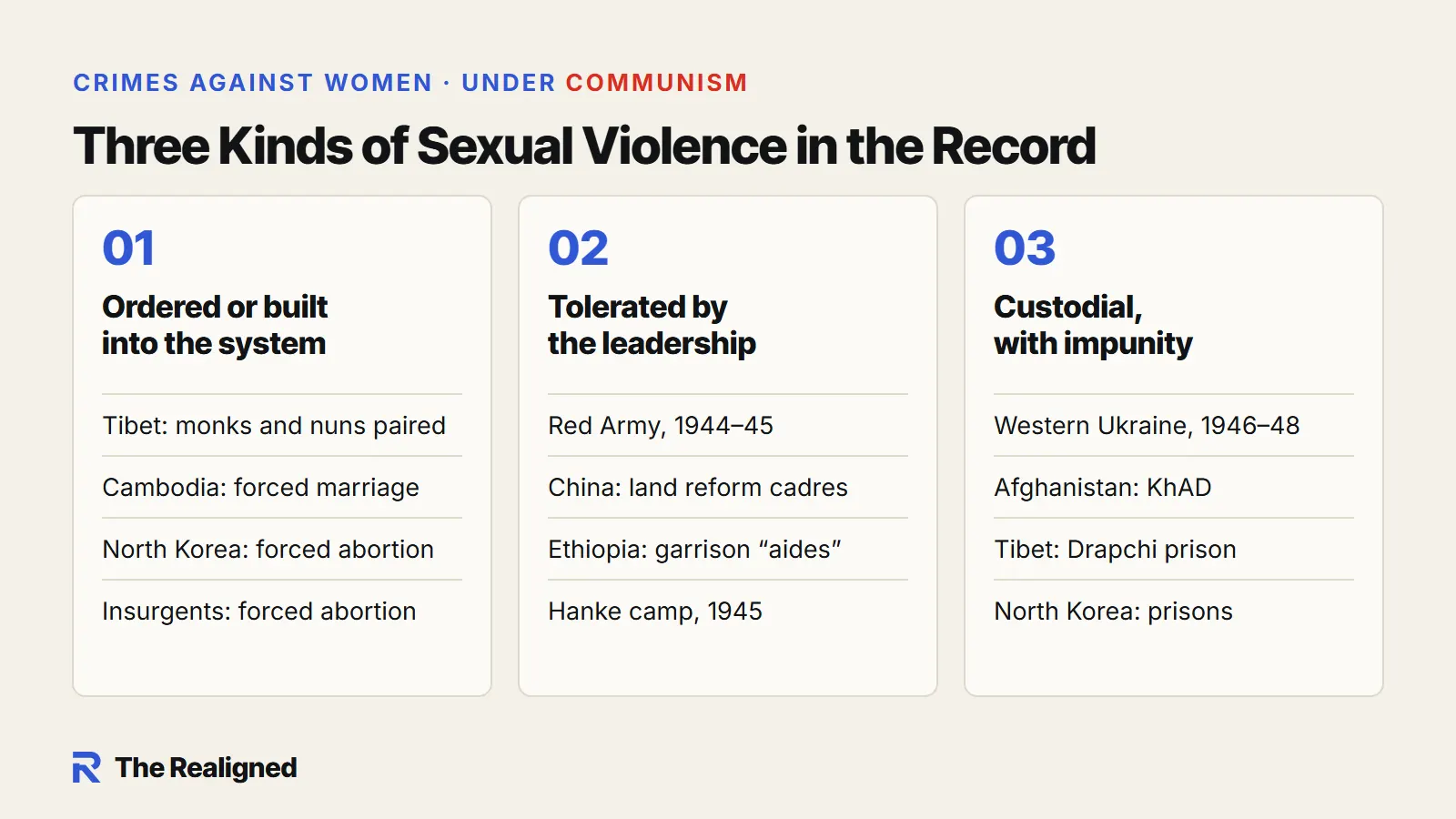
The question needs one caution, which the political scientist Elisabeth Wood puts plainly: many Marxist-Leninist armed groups commit heavy violence against civilians but rarely engage in sexual violence as such.186 The record bears that out in some places. It also shows how often, once communist power was established over a town, a village, a camp or a prison, women there were exposed to rape by the people holding it. The cases follow by region and period.
What do the Soviet files themselves say about the rapes of 1945?
Some of the best evidence comes from Soviet documents written at the time. On 17 March 1945 the NKVD's representative with the army group in East Prussia sent Beria a top-secret report. It said that Germans were claiming that every German woman left in the Red Army's rear had been raped187, and that suicides among Germans, especially women, were becoming more widespread.
It quoted a woman who said that on 3 February twelve soldiers had raped her one after another in a courtyard, and a witness who described soldiers raping all the women, underage girls and old women in a flat on the night of 12 February.187 Antony Beevor, who read the NKVD files, writes that reports of this kind went to Beria and Stalin with tick marks showing they had been read.188
How the leadership responded
The leadership's own response is on the record, and it came late and was narrow. Stavka Directive No. 11072 of 20 April 1945 ordered better treatment of the German population. The historian Vadim Birstein notes that it went only to the 1st Belorussian and 1st Ukrainian Fronts, the fronts advancing on Berlin; he says no similar order reached the fronts that had been fighting in East Prussia since January.189
The military prosecutor of the 1st Belorussian Front reported on 2 May that shootings and looting had fallen sharply after the directive, but that violence against women still occurs190. He named three rape cases from the last week of April that had gone to tribunal. Marshal Zhukov's handwritten resolution of 4 May ordered the removal of unfit commandants.190
The argument over the count
Russian historians who defend the army's record rely on the registered count. The prosecutor's follow-up report of 5 May 1945 recorded 124 crimes in seven armies of about 908,000 men between 22 April and 5 May, 72 of them rapes of German women191; the historian Elena Senyavskaya argues the rapes were excesses that were strictly suppressed, and says 4,148 officers were convicted by tribunals in early 1945 for outrages against civilians, though she gives no archival citation for that figure.191 A registered count measures what was reported and prosecuted.
Polish archives show how far the two can diverge: in Torun the prosecutor recorded about 500 rapes by Red Army soldiers between March and August 1945, while the provincial militia recorded only two in the district for February to May.192 The wartime tribunal files that would show how many soldiers were actually tried remain classified, and in 2019 the Russian embassy in Bucharest cited the registered figure to dismiss the estimate of two million.188193
Senyavskaya's own footnote concedes that the frequently quoted order of 19 January 1945 that rapists be shot appears in no published order collection and could not be found in the army archive, so we do not rely on it.191
- 17 March 1945NKVD plenipotentiary Tkachenko reports to Beria on rapes and suicides in East PrussiaSource 187 (opens the source in a new tab)
- 14 April 1945Pravda attacks Ehrenburg; the US ambassador reports it as authoritative Soviet policySource 194 (opens the source in a new tab)
- 20 April 1945Stavka Directive 11072 orders better treatment of Germans, sent to two frontsSource 189 (opens the source in a new tab)
- 2 May 1945Front prosecutor reports that violence against women still occursSource 190 (opens the source in a new tab)
- 4 May 1945Zhukov orders unfit commandants removedSource 190 (opens the source in a new tab)
- 5 May 1945Prosecutor's follow-up: 72 rapes registered across seven armies in 14 daysSource 191 (opens the source in a new tab)
The historian Norman Naimark, whose archival study of the Soviet zone of Germany is the standard work, concludes according to a scholarly review that Soviet occupation authorities and senior officials were unable or unwilling to stop the rapes, that there is evidence Stalin condoned the practice in general, and that the rapes destroyed any legitimacy the German Communist Party might have had.195 Beevor, for his part, found that the leaflet urging soldiers to break the racial pride of German women, long attributed to the writer Ilya Ehrenburg, was a Nazi invention.
He still faults the violence of Ehrenburg's wartime propaganda, and the state's own turn against Ehrenburg in April 1945, when Pravda attacked him in what the US ambassador called an authoritative expression of Soviet policy, shows the leadership changing its line in April 1945.196194
Other victims
The victims were not only Germans. The war correspondent Vasily Grossman recorded in his notebooks that liberated Soviet girls complained that their own soldiers raped them.31 Beevor reports a Soviet account that more than a hundred women and girls freed from Nazi camps at Bunzlau, held without guards, were raped at night by soldiers who entered the camp; one of the victims is quoted saying that now the Soviet soldiers treat us worse than the Germans did.188
What happened in Poland, Hungary and Czechoslovakia?
Poland
The rapes were not confined to enemy territory, and the satellite regimes that followed hid the evidence. In Pomerania, Remigiusz Lawniczak of Poland's Institute of National Remembrance reconstructed the record from archives. Besides the Torun figures, the militia counted 104 rapes in the Chojnice district between February and May 1945, and a welfare committee there reported 300 to 400 pregnant women whose pregnancies came from rape. The rapes fell away almost completely by October 1945, after the troops moved out. Rape was a forbidden subject under communist censorship until 1989.192
The Polish communist authorities' own handling of the victims shows what they valued. In May 1945 the Justice Minister authorised the Polish Red Cross to carry out abortions for rape victims, and a commission in Katowice handled 46 cases in seven weeks. By October the authorities had told doctors in a secret appeal to show considerable restraint, citing demographic needs.197
Hungary
In Hungary, where the siege of Budapest lasted into February 1945, the historian James Mark estimates that about 50,000 women were raped in the capital, the most of any Central or East European capital after Berlin, and Andrea Peto, working from medical records of venereal disease, puts the Budapest figure between 50,000 and 200,000.198199 On 14 February 1945 the Budapest National Committee allowed free legal abortion, and a woman's written statement that she had been raped automatically produced a permit.199 The subject was then suppressed under communism.198
Czechoslovakia
Czechoslovakia shows both the camps of 1945 and the invasion of 1968. At the Hanke internment camp in Moravska Ostrava, a parliamentary commission found in November 1947 that a Czech woman and possibly interned German women had been raped, and recommended prosecuting five guards. A report two days later stated that all but one were members of the Czechoslovak Communist Party; three were then quietly expelled from the party, and an amnesty law made prosecution unlikely.200
When Warsaw Pact troops invaded in August 1968, Czechoslovak police statistics recorded 13 rapes and 4 cases of sexual abuse by the occupiers by the end of the year, some at gunpoint, with the real figure very probably many times higher, since most reported victims were girls under twenty whose parents had reported the crime.201
What happened in the camps of Yugoslavia and in northern Korea and Manchuria?
After the Partisans took power in Yugoslavia in 1944, a decision of the local communist leadership placed ethnic Germans in camps, where about 50,000 died according to the expellee organisations' count. The evidence on sexual violence there is memoirs, not archives, and we state it as such: the memoirs of Danube Swabian women describe rape beginning with the Soviet arrival in the Banat in October 1944 and becoming a daily occurrence in camps run by the Partisans, used as punishment for women who left to find food.202 No count exists.
Soviet forces entered Manchuria in August 1945 and northern Korea the same month. Frank Dikotter's history of the Chinese revolution, citing a US historian, says Red Army troops in Shenyang were let loose for three days of rape and pillage.203 The leaders of one Japanese settler community, the Kurokawa group, handed fifteen unmarried young women to Soviet soldiers in exchange for food and safe passage, as described above.34 In northern Korea, Soviet commandants kept their own statistics of soldiers' immoral behaviour, including armed robbery and rape, but the published research gives no totals.204
One historian, citing Andrei Lankov's study of the Soviet occupation, writes that looting, theft, rape and murder by Soviet soldiers were common, especially early in the occupation; we could not open Lankov's book to check the page.205 Soviet archives on these regions have not been opened to the point where a count is possible.
Did the Soviet security services use rape as a method in Western Ukraine?
Here the evidence points beyond tolerance. The historian Jeffrey Burds, who worked in the Ukrainian and Russian party and security archives, found a Party Control report of August 1946 recording that the MVD chief of the Gliniany district in Lviv province had raped a detainee during interrogation in February 1946, and at least four other girls arrested without cause.206 In July 1948 an MGB special group, a unit of the secret police disguised as insurgents, abducted and gang-raped a young woman in Rivne province.
Burds reads such acts as deliberate, part of a policy of disorganising the insurgency, and writes that they were a tactical weapon that used women's bodies in a wider conflict.206
The best source on that case is a Soviet one. In February 1949 the military prosecutor of the MVD troops in Ukraine, Colonel Kosharsky, sent a top-secret memorandum to Nikita Khrushchev on grave violations of Soviet legality by the special groups. It describes the young woman beaten, hung upside down, sexually assaulted with a stick and then gang-raped by the group.
The prosecutor concluded that the groups' actions had a bandit, anti-Soviet character, and he added that most such incidents were never investigated and that some perpetrators were arrested only months later or were released by their superiors.207
Did the Chinese Communist Party tolerate rape in land reform?
During land reform from 1946 to 1953, peasants and party work teams seized landlords' property in public "struggle" sessions. The best eyewitness account is by William Hinton, an American who sympathised with the Party and lived in the village of Long Bow in Shanxi province. He recorded that a militiaman and party member raped a landlord's daughter, that militiamen took women who were "struggle objects" whether they were willing or not, and that seventeen cases of "rascal behavior" were charged against cadres in a single village, some of them out-and-out rape. The victims were almost invariably the wives and daughters-in-law of dispossessed landlords and rich peasants.208 Hinton quotes the rapist's justification:
Bastard landlords, they took our women, why shouldn't we take theirs?
— Reported by William Hinton, Fanshen (1966), ch. 23, quoting a militiaman and party member
The punishment in the village was apologies only; Hinton records that no form of restitution was possible.208 The historian Brian DeMare, in the most recent history of the land reform, found that the Party never explicitly endorsed attacks on landlord women but that for some newly empowered men they were another form of property to take from class enemies. A work-team cadre reported activists dividing not just landlords' fields but their wives and daughters; when he tried to stop it, he was himself struggled against and disarmed.209
DeMare believes the full scale is unknowable, and concludes that it seems sadly reasonable to assume that sexual assault was as common as the killing of class enemies, which he puts at up to two million deaths; this is an inference, not a count.209 Dikotter, quoting an internal investigation from about 1951, adds that in Yidu, Shandong, entire families were put under surveillance and some of their daughters were raped, with similar examples too numerous to be enumerated.203
How did the People's Liberation Army treat women in Tibet?
In 1960 the International Commission of Jurists published the findings of its Legal Inquiry Committee on Tibet, based on testimony from refugees in India. The Committee concluded that the right to life had been violated by acts of murder, rape and arbitrary imprisonment, and that marriage had been made non-voluntary by forcing monks and lamas to marry.210
Refugee testimony in the report includes a woman gang-raped at home in 1954 by three PLA soldiers and a civilian, and a woman of about 22 raped in 1956 by at least seven men of a ten-soldier group, held for about a year, and then forced to marry a Chinese civilian.210 The Committee also noted that most Tibetan witnesses had heard nothing of Tibetan women being raped by either side during the fighting.210
Coerced sex as policy
The more striking finding concerns policy. The Committee heard that monks were threatened with deportation unless they had sex with an assigned woman, that a girl was offered a sum for each monk she persuaded, that the monks of one monastery were ordered to live with girls under threat of death, and that an old lama who resisted was accused in public, made to kneel on stones and thorns and beaten, and died.
The Committee read the purpose as being to break the monks of their religious ties and to discredit them in the eyes of lay believers.210 In 1962 the Panchen Lama put the practice in writing to the Chinese leadership. During the "democratic reform" of monasteries, he wrote, work teams compelled monks to return to lay life, going so far as lining up monks on one side and nuns and secular women on the other and forcing each to choose a partner.211
lining up monks on one side and nuns and secular women on the other and forcing each to choose a partner
A petition from that source is not the testimony of an opponent; it is an internal document, and it describes coerced pairing of religious people as a work-team method.
In custody
Sexual violence against Tibetan women in custody continued. The Tibet Justice Center, relying on interviews with Tibetan monitors, reported about 295 women political prisoners in autumn 1998, about 250 of them in Drapchi prison and 88.4% of them nuns, and testimony of electric cattle prods inserted into the vagina and rectum.212 A Tibet Information Network study reported by the Baltimore Sun found that five Drapchi nuns had taken their own lives after beatings and cattle-prod shocks, with electric batons applied to tongues, ears and genitalia.213
How is sexual violence used as control in North Korea?
North Korea is the clearest modern case of sexual violence built into a custodial system. The Database Center for North Korean Human Rights, a Seoul organisation that records escapee testimony, had documented 586 cases of sexual violence against women as of December 2022; 270 of them, 46%, took place inside detention facilities214. The organisation calls it a structural sex crime. Officers trade sentence reductions for sex and threaten additional sentences if a woman refuses, and any resulting pregnancy is aborted to protect the perpetrator.214 The cases come from non-random interviews and are counts of documented cases, not a measure of prevalence.
The UN's special rapporteur on North Korea reported in 2023 that women detainees are subjected to sexual violence by state officials, invasive cavity searches and forced abortions, that guards are almost exclusively men, and that the criminal code sets the penalty for rape at up to five years while men in positions of authority act with total impunity.215
The Korea Institute for National Unification gives an example from a South Korean government study of escapee accounts: in 2019 a soldier who raped a civilian in Sonchon County received seven months in a labour-training camp, against a statutory minimum of five years, and when a superior rapes a female soldier it is the victim who is transferred or discharged.
The same study says women in construction "shock troops" are constantly raped, and quotes a woman sexually assaulted by a guard at a police holding centre in 2016 who was told it did not count as sexual assault because she was dead there and a dead person cannot say she is assaulted.216
In September 2025 the UN human rights office, in its ten-year update after the Commission of Inquiry, reported from more than 300 interviews that market women faced threats of detention, fines, bribes and sexual violence, that cavity searches of repatriated women continued, and that authorities demanded sexual favours in exchange for better food and less demanding jobs217.217 Among the documented violations by the Ministry of State Security and the Ministry of Social Security, the Seoul database counts 145 cases of sexual violence and 117 forced abortions.218
What happened in the Khmer Rouge's prisons and among minorities?
In Cambodia the courts have examined forced marriage in detail, as described earlier, and rape in custody only partly. At S-21, the Phnom Penh prison, the Trial Chamber found proven that an interrogator inserted a stick into a female detainee's vagina during interrogation; the prison's commandant, Duch, reassigned the man and took no other sanction.219 The court held a second alleged rape not proved to the required standard, and the judgement lists one proven instance of rape among the torture methods used at the prison.219
The most detailed survivor evidence concerns minorities. A 2014 study by the Cambodian Defenders Project interviewed 105 Cham, Vietnamese, Khmer Krom and other minority survivors with a questionnaire, not a random sample. About two-thirds had directly experienced sexual violence, mostly forced marriage; 67% were ordered to marry; and there were 56 witness reports of rape, nearly half of them mass rape, in which the victims were usually executed afterwards. All identified rapists were Khmer Rouge cadres except one civilian.220
What did Vietnam's re-education camps and Ethiopia's Derg do?
Between 200,000 and 250,000 people were sent to re-education camps in Vietnam after 1975. The historian Hoang Minh Vu, drawing on camp memoirs, notes many accounts of corruption and even sexual predation by guards, but most inmates were men and we found no source documenting rape of women detainees in Vietnamese camps.221 In Ethiopia the evidence is richer. Africa Watch, in its 1991 history of the Derg's wars, records rape as an instrument of the army's counterinsurgency in Eritrea and Tigray.
Eritrean relief figures, which the author says roughly match independent estimates, say that between January and June 1980 soldiers raped at least 110 women while detaining 1,475 rural people and executing 240; a 1987 Leeds team recorded 200 women raped by soldiers since the start of 1986.104
More striking is a system. In garrison towns the army practised what the report calls de facto conscription of women: at Tessenei in Eritrea several hundred women in 1978-84 were recruited as aides, whose main purpose was as sexual servants104; they were not volunteers. In the Ogaden in 1987, after a round-up of about 8,000 villagers, 23 young women were kept for the soldiers' sexual gratification; women dragged from resettlement trucks at Humera were raped; and refugees from the villagization of Harerghe described systematic rape of women by militia.104
A journalist's refugee testimony about the joint Ethiopian-Cuban advance on Jijiga in March 1978 says that at first the women were saved so that they could be raped, and then they were killed.104 Some of the figures come from the Eritrean liberation movement's relief wing, which was a party to the war.
What did Soviet and Afghan government forces do in Afghanistan?
The evidence for Afghanistan is held in UN and Helsinki Watch records of the 1980s. Women arrested by the communist government's secret police, KhAD, were raped as a method of torture. The UN's special rapporteur, Felix Ermacora, heard from a former security-police officer who listed raping women, introducing objects into the vagina, and electric shocks to women's breasts among the methods, and who named the torturers; he also recorded women raped in the presence of their families, including a man killed for trying to stop a soldier raping his daughter.222
A Kabul University student told Helsinki Watch that interrogators at the Sedarat centre in 1981 threatened to bring her sister and rape her, and that Soviet advisers organised the interrogations.223
In the countryside, Ermacora recorded that in reprisal operations in Laghman province in March 1985, in which about 1,000 civilians were allegedly killed in twelve villages, women were raped and some of them summarily executed.224 Helsinki Watch in 1985 received a number of reports of rapes by Soviet soldiers during searches and massacres, among them rapes during searches in Kunduz and Laghman provinces and tank crews who abducted girls in Kabul between 1981 and 1984, some found dead days later.
It called the evidence sketchy and judged that rape was generally not part of the systematic massacres but reflected an undisciplined and unrestrained occupation army.225 No count exists. The UN's mapping report, as noted above, rated rape by KhAD as neither common nor systematic, so we report the Afghan record as repeated rape in custody and during village sweeps, without a showing of order.108
Did communist insurgencies use sexual violence?
Insurgent communist movements show a different pattern: rules against rape on paper, and control over women's reproduction in practice.
Peru
In Peru, the national Truth and Reconciliation Commission attributed about 11% of rapes it registered to the subversive groups, mostly the Shining Path.
It found that the Shining Path was responsible for forced abortion, forced unions and sexual servitude, and it recorded a former recruit's testimony that the group permitted three rapes of a woman but on the fourth buried the rapist, and that rules against rape were for the rank and file, not for the commanders. Women in the Shining Path's "army" were forced to abort, one commander forcing a 13-year-old to abort up to four times. The Commission nonetheless concluded that the testimonies did not support calling subversive sexual violence a systematic or generalised practice.226
Among the Ashaninka people of the Peruvian jungle, specialists estimate that about 5,000 of 55,000 were held captive by the Shining Path and about 6,000 died; the Commission described its "popular committees" as a kind of concentration camp.227
Colombia
In Colombia, the national memory centre found that the FARC strictly regulated its fighters' sexual and reproductive lives and massively applied contraceptives to girls and women on entry; the FARC Secretariat confirmed in January 2016 that contraception was obligatory.228 The Truth Commission found that some FARC blocs imposed abortion on women combatants, that sexual violence was used to reward combatants, and that in some cases commanders planned it, took part or knew and did nothing, until it became an accepted practice. A former combatant quotes commanders saying an abortion is like removing a thorn.229
The recruitment of girls fed the system: of 16,238 children documented as recruited in Colombia between 1990 and 2017, 12,038 were recruited by the FARC, and girls under 15 made up 15.9% of recruits, with adolescent girls under 18 another 30.3%.230
The national memory centre counts guerrillas as responsible for 31.5% of 15,076 victims of sexual violence, without a separate FARC figure, and the special peace tribunal's case on sexual violence presumes the FARC responsible for 2,051 of 35,178 victims; it has also opened a subcase on sexual and reproductive violence inside the FARC's own ranks.228231
The Philippines and India
Smaller cases fill out the picture. The UN verified that the Philippines' New People's Army abducted two 15-year-old girls in 2022-23 and that one was raped in captivity by a member.232 Scholars of India's Maoist insurgency write that sexual and gender-based violence and discrimination within the movement undermine its commitment to gender justice.233
What does the record show when taken together?
| Kind | Cases | Strongest evidence |
|---|---|---|
| Ordered or built into the system | Coerced pairing in Tibet; Khmer Rouge forced marriage; forced abortion in North Korea; sex for reduced sentences in North Korean prisons; forced abortion in the Shining Path and FARC | ICJ 1960; Panchen Lama petition; ECCC judgment; UN inquiries; Peru and Colombia truth commissions |
| Tolerated by the leadership | Red Army 1944-45; Chinese land reform; Derg garrison towns; Hanke camp; Soviet and Afghan village sweeps; MGB special groups in Western Ukraine | NKVD and prosecutor reports; Hinton and DeMare; Africa Watch; Czechoslovak commission; Kosharsky memorandum |
| Custodial, with impunity | MVD interrogations in Ukraine; KhAD in Afghanistan; Drapchi prison; S-21; North Korean prisons | Party Control report; UN rapporteurs; Tibet Justice Center; ECCC; UN human rights office |
The cases fall into a pattern. Where communist power was consolidated, in a conquered town, a village undergoing land reform, a camp, a prison or a garrison, women under that power were exposed to sexual violence by its agents, and the system around them could rarely be made to answer for it. Often, as at Hanke or in Ukraine, party and security-service structures shielded the perpetrators.
At times, as in Tibet, Cambodia, North Korea and the insurgent movements of Peru and Colombia, the sexual control of women was itself an instrument of the movement's rule, written into rules or practised as policy. Where the regimes' own officials recorded the crimes, in the front prosecutor's reports in Germany, the Party Control report on a police chief and Kosharsky's memorandum in Ukraine, the crimes were known to the leadership and were not stopped.
What patterns run across the evidence?
Set side by side, the cases fall into five patterns. The table summarises the main findings, who was responsible, and how strong the evidence is, using the grades described in the method: A for a court, UN commission or the regime's own records, B for official statistics or peer-reviewed research, C for credible human rights or press reports, D for untested allegations.
| Country | Period | Harm | Who was responsible | Evidence grade |
|---|---|---|---|---|
| USSR | 1937-1938 | Arrest and camp sentences for over 18,000 wives of "traitors"; children sent to orphanages | State policy (NKVD order) | A |
| USSR | 1934-1954 | About 415,000 women in camps and colonies at the start of 1945; infant death rate of 409 per 1,000 in camp homes (1947) | State detention | A |
| USSR | 1936-1955 | Abortion banned; illegal abortions; deaths not counted | State policy | B |
| Red Army in Europe | 1944-1945 | Mass rape: hundreds of thousands to about two million victims in Germany; large numbers in Hungary, Austria, Poland | State forces, tolerated by the leadership | B (estimates) |
| USSR | 1944-1949 | Deportation of 51,105 ethnic German women for forced labour; Baltic and Moldovan deportations | State policy | A |
| Romania | 1966-1989 | Abortion ban; almost 10,000 women dead; workplace pregnancy checks | State policy | A and B |
| Hungary | 1953-1956 | Compulsory pregnancy registration; prosecution of women | State policy | B |
| East Germany | 1961-1989 | Committal of tens of thousands of girls and women to closed venereal wards, most healthy, with forced examinations | State policy | A and B |
| Czechoslovakia | 1966-1989 and after | Coerced sterilisation of Roma women with cash incentives | State policy, tolerated and encouraged | A |
| China | 1958-1962 | Rape and abuse of women by cadres in the famine | State agents | B |
| China | 1966-1978 | Mass rape in Cultural Revolution killings; abuse of sent-down girls by cadres | State agents | A and B |
| China | 1971-2015 | Forced abortion and sterilisation under birth quotas; tens of millions of missing women | State policy | A and B |
| China (Xinjiang) | 2017- | Coercive birth control; sexual violence in detention | State policy and state agents | A (credible) and C |
| North Korea | ongoing | Forced abortion and infanticide of repatriated women; rape in detention; trafficking; abduction of foreign women | State policy and state agents | A |
| Cambodia | 1975-1979 | Forced marriage and rape within forced marriage, nationwide | State policy | A (court) |
| Vietnam | 1993 to the 2010s | Administrative detention of sex workers with forced labour | State policy | C |
| Laos | 2005-2006 | Sexual servitude of captured Hmong women at a police post | State agents | C |
| Cuba | 2016- | Repeated detention of women dissidents; reports of sexual violence in custody | State agents | C |
| Ethiopia | 1977-1978 | Sexual abuse of women detainees in the Red Terror | State agents | A (courts) |
| Afghanistan | 1979-1989 | Rape as a torture method by the secret police, not systematic | State agents | A (UN) |
| Nepal | 1996-2006 | Sexual violence by Maoist insurgents, far less than by state forces | Insurgent movement | A (UN) |
| Nicaragua | 2018- | Rape and sexual torture of detainees | State agents | A (UN) |
| India (West Bengal) | 1979-2007 | Rapes linked to ruling-party supporters or police at Nandigram, Dhantala, Singur and Bantala; victims disparaged at Birati | Party supporters and police | A to C |
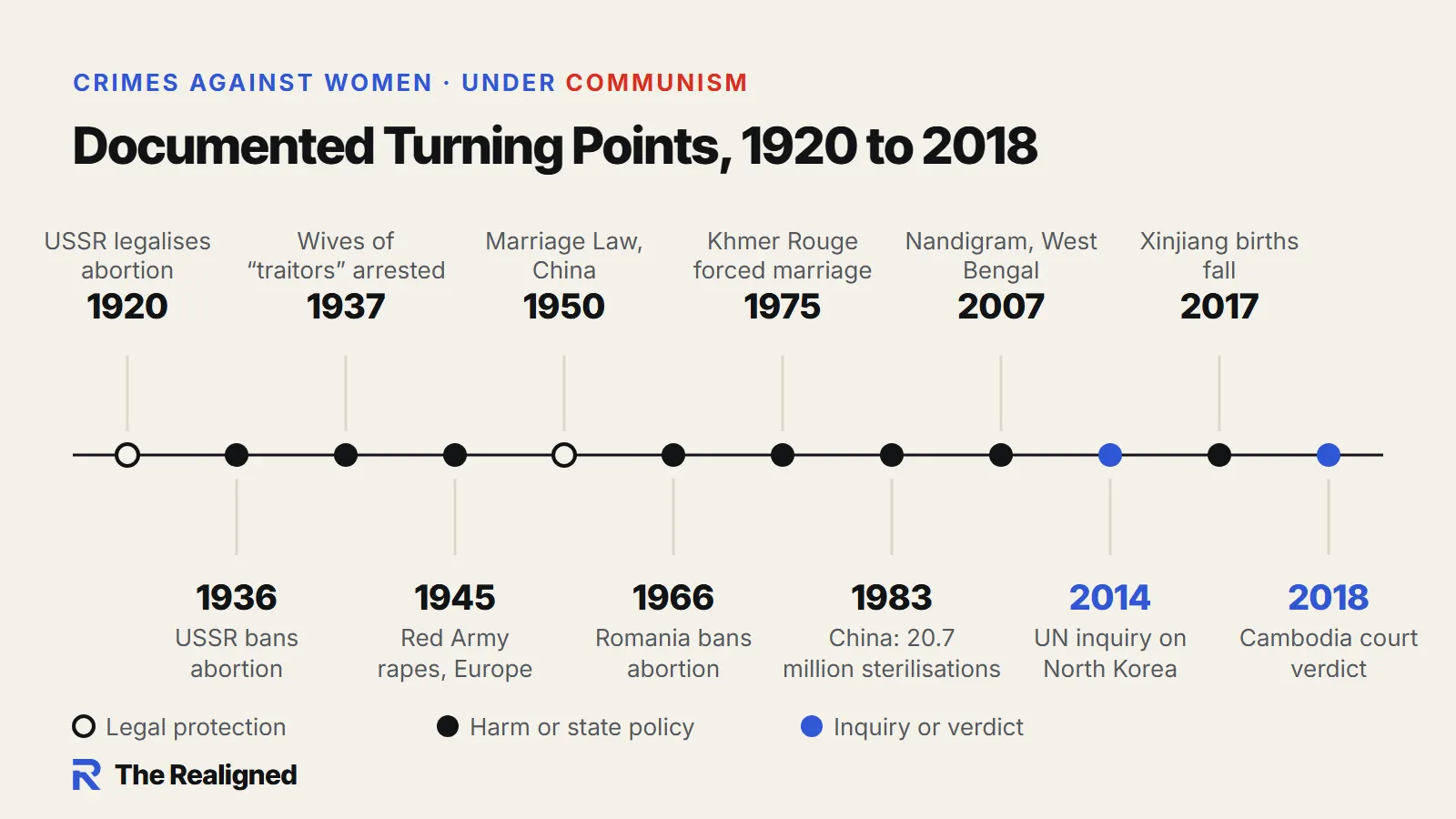
- 1920Soviet Russia legalises abortionSource 24 (opens the source in a new tab)
- 1936USSR bans abortionSource 27 (opens the source in a new tab)
- 1937NKVD Order 00486 orders the repression of wives of traitorsSource 25 (opens the source in a new tab)
- 1944-45Mass rape by Soviet soldiers across EuropeSource 1 (opens the source in a new tab)
- 1950China's Marriage Law outlaws concubinage and child betrothalSource 53 (opens the source in a new tab)
- 1960ICJ reports rape and forced marriage of monks in TibetSource 210 (opens the source in a new tab)
- 1966Romania bans abortionSource 37 (opens the source in a new tab)
- 1971-83China's birth-planning campaigns peak at 20.7 million sterilisationsSource 12 (opens the source in a new tab)
- 1975-79Khmer Rouge forced marriageSource 4 (opens the source in a new tab)
- 1985UN rapporteur reports rapes by Soviet and Afghan forcesSource 224 (opens the source in a new tab)
- 2007Rapes at Nandigram, West BengalSource 119 (opens the source in a new tab)
- 2014UN Commission of Inquiry on North KoreaSource 5 (opens the source in a new tab)
- 2017Xinjiang birth rates begin to collapseSource 14 (opens the source in a new tab)
- 2018Cambodian court convicts for forced marriage and rape within itSource 4 (opens the source in a new tab)
- 2025UN human rights office reports on North Korea ten years onSource 217 (opens the source in a new tab)
Reproductive control by decree
The most distinctive pattern is the state's direct control over whether women bore children. Romania banned abortion and policed pregnancy in the workplace; the Soviet Union and Hungary did the same for shorter periods; China and later Xinjiang imposed quotas enforced with sterilisation, IUDs and abortion; Czechoslovakia paid Roma women to be sterilised; North Korea forces abortion on women returned from China. The direction varied: some states forced women to give birth, others forced them not to.
What these policies share is that the state, not the woman, decided, and the decision was written down. That is why the evidence for them is among the strongest in this review.
Collective punishment of women for men's acts
Stalin's order on the wives of traitors and Albania's internment of opponents' families at Tepelena both punished women for their relationships to men. This pattern also leaves documents, because it was policy.
Sexual violence in detention with impunity
From the Gulag to Xinjiang, North Korea's camps, Ethiopia's Red Terror prisons, Afghanistan's secret police and Nicaragua's prisons, women held by the state were exposed to rape by guards and interrogators. Where the state has fallen or been investigated, courts and UN bodies have confirmed it. Where the state still rules, the evidence is testimony that the state denies.
Rape as a weapon of rule
The study above sorts the evidence into three kinds. Some sexual violence was ordered or built into the system: the coerced pairing of monks and nuns in Tibet, Khmer Rouge forced marriage, forced abortion in North Korean custody, and the forced abortion and contraception of women fighters in the Shining Path and the FARC. Much more was tolerated by leaderships who knew from their own reports, as with the Red Army in 1945, land reform cadres in China, the Derg's garrison towns and the communist guards at Hanke. And a great deal was custodial, in prisons and interrogation rooms from Western Ukraine to Kabul to Pyongyang, with almost no one punished.
Mass rape by armies
The Red Army's rapes in 1944-45 are the largest single episode of sexual violence in this review. No order to rape has been found, but the leadership's response is on record: a Soviet general dismissed Yugoslav complaints as an insult to the Red Army, and Stalin answered them with an excuse.29 They belong to a wider history of wartime rape in which other armies, including the German army that invaded the Soviet Union and, on a smaller scale, the Western Allies, took part.1
Trafficking and missing women where women became scarce
China's birth limits, combined with old son preference, produced tens of millions of missing women and a market in trafficked brides drawing on Vietnam, Laos, Myanmar and North Korea. Vietnam has the same problem at a smaller scale. These are harms produced by a combination of policy and social practice, and India shows that the second can produce them without the first.3
Punishing those who spoke up
Across the record, the state turned on the people who exposed crimes against women. China seized Chen Guangcheng after he documented forced abortions in Linyi,63 and sent Tang Hui to a labour camp for demanding justice for her raped and prostituted daughter.72 Officials in Fengxian first denied that the chained woman had been trafficked.68 Cuba detained the Ladies in White more than 1,600 times in ten months of 2016.98
Impunity was the norm: of the tens of thousands of killers in Guangxi's Cultural Revolution massacres, ten were executed,57 and North Korea reported five rape convictions in all of 2015.17
Does the evidence support our first claim?
Our first working claim was that communist governments produced patterns of crimes against women directed by the state, not merely tolerated. The evidence supports it. In at least seven states in Europe and Asia, a court, a UN body or the regime's own documents shows a policy or order that caused the harm: the NKVD order on wives in the USSR, the deportation decree of 1944, Romania's Decree 770, East Germany's venereal ward system, Czechoslovakia's sterilisation payments, Cambodia's forced marriage policy found by the ECCC, and North Korea's treatment of repatriated women found by the UN commission.
China's birth quota system, with its own statistics on sterilisation, belongs on the same list. Not every crime was ordered. The 1945 rapes, the abuse of sent-down girls and the sexual violence in the Cultural Revolution killings were committed by soldiers and cadres acting without a written order, and communist armies were not the only ones to rape in war. But the line between ordered and tolerated is thinner than it looks.
In each of these cases the perpetrators were the state's own agents, the leadership knew, and punishment was rare: Stalin excused the Red Army, Guangxi executed ten killers out of tens of thousands, and the campaign against abuse of sent-down youth came only after a letter reached Mao in 1973.295759
Why did communist states produce these patterns?
The record points to a structural explanation. Each of the state-directed harms above required three things: a government that claimed authority over private life, including marriage and reproduction; a security apparatus that answered to the party rather than to courts; and no free press or independent courts through which women could complain. Where those conditions held, policies that harmed women could be written and enforced without challenge, and agents who abused women could expect impunity. These were not accidents of particular leaders.
Every state in this review ruled by a Marxist-Leninist party had all three, because one-party rule, a police answerable to the party and a party-controlled press were how those states were built, from the Soviet Union in the 1920s to North Korea today. The economists F. A. Hayek (https://therealigned.com/thinker/f-a-hayek) and Ludwig von Mises (https://therealigned.com/thinker/ludwig-von-mises) made the general argument that concentrating economic power in the state concentrates power over individuals; this review offers one body of evidence on what that can mean for women.
Written protections did not save women once the party held unchecked power. The Soviet state legalised abortion in 1920 and banned it again in 1936, when the leadership wanted more births.2427 China's 1950 Marriage Law freed women from forced marriage and concubinage,53 and the same state later carried out 20.7 million sterilisations in a single year.61 The rights existed at the party's pleasure, and the party withdrew them when its goals changed.
China's later turn to markets, examined in our case study of China's 1978 economic reform (https://therealigned.com/case/china-1978-economic-reform), changed the economy but not the birth quota system, which continued for decades. India's elected Left governments are the control case. Their supporters committed rapes in political and land conflicts, at Nandigram, Dhantala and Singur, and the party's response often disparaged the victims; but because they faced independent courts, a free press and elections they could lose, they could not write such harms into law, and courts could order national investigators in. What turned communist parties' power into state-directed crimes against women was the one-party state they built wherever they could.
Keep reading
Case studyChina 1978 Economic Reform Without Shock TherapyThe Realigned · 16 min read · 11 sources
Limitations
What could mislead in this review?
The first limitation is that the evidence is strongest where regimes fell and opened their archives, and weakest where they still rule. We know a great deal about the Soviet Union, East Germany and Romania because their successors published the records. We know less about China, North Korea, Vietnam, Laos and Cuba, where the governments that committed the acts still control the evidence. A shorter list of documented crimes for a country can mean fewer crimes or less access. Readers should not rank countries by how much appears here.
The second is that many of the largest numbers are estimates built on chains of assumptions. The Red Army rape figures for Germany, Hungary and Austria, the forced marriage figure for Cambodia and the share of North Korean women trafficked in China all rest on extrapolation from limited data. We have reported the method and range for each, but a reader should treat them as orders of size.
The third is that testimony from closed states cannot be fully verified. The UN commission on North Korea, the UN office's Xinjiang assessment and Human Rights Watch all relied mainly on interviews with people who had left. They used careful methods, but they could not visit the places concerned, and the governments involved reject their findings. We have reported those rejections.
The fourth is that recorded crime in India measures reporting as much as crime. Fewer than one woman in a hundred who suffered violence in the 2005-06 survey told the police. Changes in recorded crime between parties and years may reflect changes in police practice, in the law, or in women's willingness to come forward, more than changes in violence.
The fifth is coverage. We could not open the full texts of several important books, including Gail Kligman's study of Romania, Michel Bonnin's history of the sent-down youth and Frank Dikotter's history of the Great Leap famine, and relied on articles and reviews that summarise them. We found little or no documented evidence for Bulgaria, Mongolia, South Yemen, Benin and the Republic of the Congo.
Bengali-language newspapers such as Anandabazar Patrika, Ei Samay and the Telegraph block automated reading, so several Indian cases reach us only through writers who cited them. Some well-known Indian cases, including rapes at Marichjhapi in 1979 and the Bantala verdict of the 1990s, could not be confirmed in court records and are reported as allegations or with that caveat.
The sixth is what we could not find. We found no verifiable source for sexual violence by North Korean or Chinese troops in the Korean War, no documented rape by Viet Cong or North Vietnamese forces, and little on Mongolia, Laos, Bulgaria, South Yemen, Benin or the Baltic republics. Sources for the Red Army's conduct in Manchuria and northern Korea give no counts, and the Soviet wartime tribunal files remain classified. We leave these gaps open instead of filling them with unsourced claims.
The seventh is comparison. We set communist cases beside the conduct of other armies and governments where the sources allowed, but this is not a systematic comparison of all regimes. A full answer to whether communist states were worse for women than other dictatorships of the same era would need a study of right-wing military governments, colonial regimes and absolute monarchies on the same terms. We have not done that, and our findings should not be read as if we had.
Eighth, nothing here proves that communism as an idea causes crimes against women. The patterns we describe are the record of particular states and parties. Where the same patterns appear in non-communist states, as with missing women in India or wartime rape by other armies, that is evidence that the causes lie at least partly in power, war and social practice rather than in ideology alone.
Would a systematic comparison of one-party communist states with one-party non-communist states of the same period, measured on the same sources, show different rates of state-directed harm to women?
Conflicts
Conflicts of interest
The Realigned has no commercial relationship with any government, party, court, UN body or human rights organisation whose work is cited here, and no funding tied to this research. The analysis was done by The Realigned. Our wider coverage includes economists critical of central planning; we have tried to report the evidence for and against each finding as its sources state it, including the positions of the governments concerned.
Sources
- 1Vergewaltigungen von Frauen im Zweiten Weltkrieg: Ausgewahlte Literatur zu Schatzungen der Anzahl (WD 1-3000-023/21) (opens the source in a new tab) · Deutscher Bundestag, 2021 · Report · https://www.bundestag.de/resource/blob/872014/6f0f8229e73376473c576aa0aba143b2/WD-1-023-21-pdf-data.pdf
- 2Romania Reproductive Health Survey 1993: Final Report (opens the source in a new tab) · US Centers for Disease Control and Prevention, 1995 · Survey · https://stacks.cdc.gov/view/cdc/8248
- 3How Many More Missing Women? Excess Female Mortality and Prenatal Sex Selection, 1970-2050 (opens the source in a new tab) · Population and Development Review, 2015 · Paper · https://doi.org/10.1111/j.1728-4457.2015.00046.x
- 4Case 002/02 Summary of Judgement (Nuon Chea and Khieu Samphan) (opens the source in a new tab) · Extraordinary Chambers in the Courts of Cambodia, 2018 · Primary source · https://www.eccc.gov.kh/sites/default/files/documents/courtdoc/%5Bdate-in-tz%5D/20181217%20Summary%20of%20Judgement%20Case%20002-02%20ENG_FINAL%20FOR%20PUBLICATION.pdf
- 5Report of the Commission of Inquiry on Human Rights in the Democratic People's Republic of Korea (A/HRC/25/63) and detailed findings (A/HRC/25/CRP.1) (opens the source in a new tab) · UN Human Rights Council, 2014 · Report · https://www.michaelkirby.com.au/images/stories/pdf/COI_DPRK_REPORT.pdf
- 6District-wise crimes committed against women, 2001-2012 (NCRB, data.gov.in) (opens the source in a new tab) · Open Government Data Platform India (mirror), 2013 · Dataset · https://raw.githubusercontent.com/Sidd7893/crime-analysis/master/42_District_wise_crimes_committed_against_women_2001_2012.csv
- 7Crime in India 2020, Volume I (opens the source in a new tab) · National Crime Records Bureau, Ministry of Home Affairs, 2021 · Dataset · https://production.ruralindiaonline.org/uploads/Crime_in_India_2020_Volume_I_0dc3ce72a9.pdf
- 8GULAG (istoriko-sotsiologicheskii aspekt) (opens the source in a new tab) · Sotsiologicheskie issledovaniia, 1991 · Paper · https://scepsis.net/library/id_937.html
- 9Labor force participation rate, female (% of female population ages 15+) (modeled ILO estimate): China (opens the source in a new tab) · World Bank, 2025 · Dataset · https://data.worldbank.org/indicator/SL.TLF.CACT.FE.ZS?locations=CN
- 10Ne po svoei vole: Istoriia i geografiia prinuditelnykh migratsii v SSSR (opens the source in a new tab) · OGI-Memorial, 2001 · Book · https://imwerden.de/pdf/polyan_ne_po_svoej_vole_2001.pdf
- 11Final Statement of the Public Defender of Rights in the Matter of Sterilisations Performed in Contravention of the Law and Proposed Remedial Measures (opens the source in a new tab) · Public Defender of Rights (Czech Republic), 2005 · Primary source · https://www.ochrance.cz/uploads-import/ENGLISH/Sterilisation.pdf
- 12Challenging Myths About China's One-Child Policy (opens the source in a new tab) · The China Journal, 2015 · Paper · https://pmc.ncbi.nlm.nih.gov/articles/PMC6701844/
- 13Sex-selective abortions over the past four decades in China (opens the source in a new tab) · Population Health Metrics, 2025 · Paper · https://link.springer.com/article/10.1186/s12963-025-00368-y
- 14OHCHR Assessment of human rights concerns in the Xinjiang Uyghur Autonomous Region, People's Republic of China (opens the source in a new tab) · Office of the UN High Commissioner for Human Rights, 2022 · Report · https://www.ohchr.org/sites/default/files/documents/countries/2022-08-31/22-08-31-final-assesment.pdf
- 15Xinjiang Population Dynamics and Data (white paper) (opens the source in a new tab) · State Council Information Office of the PRC, 2021 · Primary source · https://news.cgtn.com/news/whitepaper/Xinjiang-Population-Dynamics-And-Data.pdf
- 16'I still feel the pain...': Human rights violations against women detained in the Democratic People's Republic of Korea (opens the source in a new tab) · Office of the UN High Commissioner for Human Rights, 2020 · Report · https://www.ohchr.org/sites/default/files/Documents/Countries/KP/HR_Violations_against_Women_DPRK_EN.pdf
- 17'You Cry at Night but Don't Know Why': Sexual Violence against Women in North Korea (opens the source in a new tab) · Human Rights Watch, 2018 · Report · https://www.hrw.org/report/2018/11/01/you-cry-night-dont-know-why/sexual-violence-against-women-north-korea
- 18Like Ghost Changes Body: A Study on the Impact of Forced Marriage under the Khmer Rouge Regime (opens the source in a new tab) · Transcultural Psychosocial Organization Cambodia, 2014 · Study · https://kh.boell.org/sites/default/files/forced_marriage_study_report_tpo_october_2014.pdf
- 19National Family Health Survey (NFHS-5) 2019-20: State Fact Sheet Compendium, Phase I (opens the source in a new tab) · Ministry of Health and Family Welfare, Government of India, 2020 · Survey · https://nhm.gov.in/uhc-day/Session%202/NFHS-5%20State%20Factsheet%20Compendium_Phase-I%20(1).pdf
- 20Prevalence and correlates of domestic violence against ever married women of reproductive age in India: changes during 2005-2015 (opens the source in a new tab) · Journal of Injury and Violence Research, 2022 · Paper · https://pmc.ncbi.nlm.nih.gov/articles/PMC9805662/
- 21Tip of the iceberg: reporting and gender-based violence in developing countries (opens the source in a new tab) · American Journal of Epidemiology, 2014 · Paper · https://doi.org/10.1093/aje/kwt295
- 22The Criminal Law (Amendment) Act, 2013 (India) (opens the source in a new tab) · Cornell Legal Information Institute (summary), 2013 · Law · https://www.law.cornell.edu/gender-justice/resource/the_criminal_law_(amendment)_act_2013
- 23Sexual Violence during Pogroms: The Civil War in Ukraine as a Laboratory for Anti-Jewish Violence (1917-22) (opens the source in a new tab) · Ukraina Moderna, 2020 · Paper · https://doi.org/10.3138/ukrainamoderna.29.258
- 24On the Protection of Women's Health (decree legalising abortion) (opens the source in a new tab) · Izvestiia VTsIK, 1920 · Law · https://soviethistory.msu.edu/1917/new-woman/new-woman-texts/on-the-protection-of-womens-health/
- 25NKVD Operational Order No. 00486 on the repression of wives of traitors to the motherland (opens the source in a new tab) · NKVD of the USSR (text via Wikisource from Memorial), 1937 · Primary source · https://ru.wikisource.org/wiki/%D0%9F%D1%80%D0%B8%D0%BA%D0%B0%D0%B7_%D0%9D%D0%9A%D0%92%D0%94_%D0%BE%D1%82_15.08.1937_%E2%84%96_00486
- 26Special report of Yezhov and Beria to Stalin on the repression of wives of traitors, 15 October 1938 (opens the source in a new tab) · Lubianka. Stalin i GUGB NKVD 1937-1938 (MFD, 2004), 1938 · Primary source · https://istmat.org/node/33125
- 27Abolition of Legal Abortion (1936) (opens the source in a new tab) · Seventeen Moments in Soviet History (Michigan State University), 2015 · Essay · https://soviethistory.msu.edu/1936/abolition-of-legal-abortion/
- 28Stenogram of the July 1953 CPSU Central Committee plenum on Beria (opens the source in a new tab) · Lavrentii Beriia. 1953 (MFD, 1999), 1953 · Primary source · https://istmat.org/node/26502
- 29Conversations with Stalin (opens the source in a new tab) · Harcourt, Brace & World, 1962 · Book · https://archive.org/details/milovan-djilas-conversations-with-stalin-1967
- 30The Red Army in Yugoslavia, 1944-1945 (opens the source in a new tab) · Slavic Review, 2016 · Paper · https://doi.org/10.5612/slavicreview.75.2.396
- 31They raped every German female from eight to 80 (opens the source in a new tab) · The Guardian, 2002 · Essay · https://www.theguardian.com/books/2002/may/01/news.features11
- 32Die grosse Angst vor den Russen (opens the source in a new tab) · Wiener Zeitung, 2020 · Essay · https://www.wienerzeitung.at/nachrichten/reflexionen/vermessungen/2056487-Die-grosse-Angst-vor-den-Russen.html
- 33Kobieca gehenna (opens the source in a new tab) · Polityka, 2009 · Essay · https://wydarzenia.interia.pl/kraj/news-kobieca-gehenna,nId,855504
- 34The women of Kurokawa: sexual sacrifice of Japanese settlers in Manchuria (opens the source in a new tab) · Nippon.com, 2025 · Reporting · https://www.nippon.com/en/japan-topics/c030314/
- 35The Deportation of Germans from Romania to the Soviet Union in 1944-1945 (opens the source in a new tab) · Acta Universitatis Sapientiae, European and Regional Studies, 2015 · Paper · https://doi.org/10.1515/auseur-2015-0004
- 36Demograficheskie poteri SSSR v Velikoi Otechestvennoi voine (Demoscope Weekly 559-560) (opens the source in a new tab) · Demoscope Weekly (HSE Institute of Demography), 2013 · Essay · https://www.demoscope.ru/weekly/2013/0559/tema02.php
- 37Decree No. 770 of 1 October 1966 on regulating the termination of pregnancy (opens the source in a new tab) · Buletinul Oficial (text via comunismulinromania.ro), 1966 · Law · https://www.comunismulinromania.ro/index.php/1966-decret-770-intreruperea-sarcinii/
- 38Commentary: The public health consequences of restricted induced abortion - lessons from Romania (opens the source in a new tab) · American Journal of Public Health, 1992 · Paper · https://pmc.ncbi.nlm.nih.gov/articles/PMC1695851/
- 39How AIDS Came to Romania (opens the source in a new tab) · New York Review of Books, 1990 · Essay · https://www.nybooks.com/articles/1990/11/08/how-aids-came-to-romania/
- 40Starvation, Abuse: New Details Emerge About The Horrors Of Romania's Communist-Era Orphanages (opens the source in a new tab) · Radio Free Europe/Radio Liberty, 2023 · Reporting · https://www.rferl.org/a/romania-communist-orphanages-starvation-abuse/32711948.html
- 41Romania's Orphans: A Legacy of Repression (opens the source in a new tab) · Human Rights Watch, 1990 · Report · https://www.hrw.org/report/1990/12/01/romanias-orphans-legacy-repression
- 42A Ratko-korszak (opens the source in a new tab) · KorFa (KSH Nepessegtudomanyi Kutatointezet), 2013 · Paper · https://www.demografia.hu/kiadvanyokonline/index.php/korfa/article/download/727/191
- 43Leid und Unrecht in der 'Tripperburg' (opens the source in a new tab) · Arzte Zeitung, 2018 · Reporting · https://www.aerztezeitung.de/Panorama/Leid-und-Unrecht-in-der-Tripperburg-224199.html
- 44Zwangseingewiesene Madchen und Frauen in Venerologischen Einrichtungen (opens the source in a new tab) · Deutschland Archiv (Bundeszentrale fur politische Bildung), 2020 · Paper · https://www.bpb.de/themen/deutschlandarchiv/303823/
- 45Expert hearing of the SED Victims' Commissioner on closed venereal wards in the GDR (opens the source in a new tab) · Deutscher Bundestag, 2026 · Primary source · https://www.bundestag.de/dokumente/textarchiv/2026/kw10-sed-opferbeauftragte-1150350
- 46Wer war wer in Hoheneck? (opens the source in a new tab) · Bundesarchiv, 2023 · Primary source · https://www.bundesarchiv.de/themen-entdecken/online-entdecken/themenbeitraege/wer-war-wer-in-hoheneck/
- 47Studie zu Zwangsadoptionen in der DDR: neue Forschungsergebnisse vorgestellt (opens the source in a new tab) · Berliner Zeitung, 2026 · Reporting · https://www.berliner-zeitung.de/news/studie-zu-zwangsadoptionen-in-der-ddr-neue-forschungsergebnisse-vorgestellt-li.10015565
- 48'Ruined my life': sterilised Czech Roma await compensation (opens the source in a new tab) · France 24, 2025 · Reporting · https://www.france24.com/en/live-news/20250203-ruined-my-life-sterilised-czech-roma-await-compensation
- 49Body and Soul: Forced Sterilization and Other Assaults on Roma Reproductive Freedom in Slovakia (opens the source in a new tab) · Center for Reproductive Rights, 2003 · Report · https://reproductiverights.org/wp-content/uploads/2020/12/bo_slov_part1.pdf
- 50Vlada sa ospravedlnila zenam, ktore podstupili nezakonnu sterilizaciu (opens the source in a new tab) · Slovenska televizia a rozhlas, 2021 · Reporting · https://spravy.stvr.sk/2021/11/vlada-sa-ospravedlnila-zenam-ktore-podstupili-nezakonnu-sterilizaciu/
- 51Remember Albania's History of Repression, Urge Prison Camp Survivors (opens the source in a new tab) · Balkan Insight (BIRN), 2023 · Reporting · https://balkaninsight.com/2023/09/13/remember-albanias-history-of-repression-urge-prison-camp-survivors/btj/
- 52Czech nation pays tribute to Milada Horakova on 70th anniversary of her judicial murder (opens the source in a new tab) · Radio Prague International, 2020 · Reporting · https://english.radio.cz/czech-nation-pays-tribute-milada-horakova-70th-anniversary-her-judicial-murder-8684855
- 53The Marriage Law of the People's Republic of China (1950) (opens the source in a new tab) · Central People's Government of the PRC, 1950 · Law · https://commonprogram.science/documents/the%20marriage%20law.pdf
- 54The Rocky History of China's Marriage Law Reforms (opens the source in a new tab) · The World of Chinese, 2025 · Reporting · https://www.theworldofchinese.com/2025/07/rocky-history-of-chinas-marriage-law-reforms/
- 55More Than 100 Million Women Are Missing (opens the source in a new tab) · New York Review of Books, 1990 · Essay · https://www.nybooks.com/articles/1990/12/20/more-than-100-million-women-are-missing/
- 56The Worst Man-Made Catastrophe, Ever (review of Dikotter, Mao's Great Famine) (opens the source in a new tab) · New York Review of Books, 2011 · Essay · https://www.nybooks.com/articles/2011/02/10/worst-man-made-catastrophe-ever/
- 57Guangxi wenge juemi dang'an zhong de datusha he xingbaoli (Massacres and sexual violence in the secret Guangxi Cultural Revolution archives) (opens the source in a new tab) · Independent Chinese PEN Center, 2017 · Paper · https://www.chinesepen.org/blog/archives/93641
- 58Review: The Killing Wind by Tan Hecheng (opens the source in a new tab) · Berkshire Publishing, 2017 · Essay · https://www.berkshirepublishing.com/blog/review-the-killing-wind-tan-hecheng/
- 59Review of Michel Bonnin, The Lost Generation: The Rustication of China's Educated Youth (1968-1980) (opens the source in a new tab) · Journal of Asian Studies, 2015 · Paper · https://doi.org/10.1017/s0021911814001788
- 60Review of Emily Honig and Xiaojian Zhao, Across the Great Divide (opens the source in a new tab) · Twenty-First Century (CUHK), 2020 · Paper · https://www.cuhk.edu.hk/ics/21c/media/articles/c181-202004019.pdf
- 61The End of China's One-Child Policy: Implications (opens the source in a new tab) · Brookings Institution, 2016 · Essay · https://www.brookings.edu/articles/the-end-of-chinas-one-child-policy/
- 62336 million Chinese abortions in 40 years (opens the source in a new tab) · Al Jazeera, 2013 · Reporting · https://www.aljazeera.com/news/2013/3/16/336-million-chinese-abortions-in-40-years
- 63Population Planning Official Confirms Abuses in Linyi City, Shandong (opens the source in a new tab) · Congressional-Executive Commission on China, 2005 · Report · https://www.cecc.gov/publications/commission-analysis/population-planning-official-confirms-abuses-in-linyi-city-shandong
- 64China apologizes, suspends officials in forced abortion case (opens the source in a new tab) · CBS News, 2012 · Reporting · https://www.cbsnews.com/news/china-apologizes-suspends-officials-in-forced-abortion-case
- 65Concluding observations on the combined seventh and eighth periodic reports of China (CEDAW/C/CHN/CO/7-8) (opens the source in a new tab) · United Nations, 2014 · Primary source · https://documents.un.org/api/symbol/access?s=CEDAW%2FC%2FCHN%2FCO%2F7-8&l=en&t=pdf
- 66The Challenge of Normalizing Sex Ratio at Birth in China (opens the source in a new tab) · UNFPA China, 2024 · Report · https://china.unfpa.org/sites/default/files/pub-pdf/2024-11/China%20SRB%20Policy%20Brief%20EN%20final.pdf
- 67Ministry of Public Security Cracks Down on Abduction and Sale of Women and Children (opens the source in a new tab) · Congressional-Executive Commission on China, 2009 · Report · https://www.cecc.gov/publications/commission-analysis/ministry-of-public-security-cracks-down-on-abduction-and-sale-of
- 6817 punished in trafficked woman case (opens the source in a new tab) · China Daily, 2022 · Reporting · https://www.chinadaily.com.cn/a/202202/24/WS6216c060a310cdd39bc88846.html
- 69Give Us a Baby and We'll Let You Go: Trafficking of Kachin 'Brides' from Myanmar to China (opens the source in a new tab) · Human Rights Watch, 2019 · Report · https://www.hrw.org/news/2019/03/21/myanmar-women-girls-trafficked-brides-china
- 702024 Trafficking in Persons Report: China (opens the source in a new tab) · US Department of State, 2024 · Report · https://www.state.gov/reports/2024-trafficking-in-persons-report/china/
- 71Report of the Special Rapporteur on torture, Manfred Nowak: Mission to China (E/CN.4/2006/6/Add.6) (opens the source in a new tab) · United Nations Commission on Human Rights, 2006 · Primary source · https://documents.un.org/api/symbol/access?s=E%2FCN.4%2F2006%2F6%2FAdd.6&l=en&t=pdf
- 72Changing the soup but not the medicine? Abolishing re-education through labour in China (opens the source in a new tab) · Amnesty International, 2013 · Report · https://www.amnesty.org/en/wp-content/uploads/2021/06/asa170422013en.pdf
- 73Tibet: Human Rights and the Rule of Law (opens the source in a new tab) · International Commission of Jurists, 1997 · Report · https://www.icj.org/wp-content/uploads/1997/01/Tibet-human-rights-and-the-rule-of-law-thematic-report-1997-eng.pdf
- 74Family De-planning: The Coercive Campaign to Drive Down Indigenous Birth-rates in Xinjiang (opens the source in a new tab) · Australian Strategic Policy Institute, 2021 · Report · https://s3-ap-southeast-2.amazonaws.com/ad-aspi/2021-05/Family%20deplanning%20v2.pdf
- 75Sterilizations, IUDs, and Mandatory Birth Control: The CCP's Campaign to Suppress Uyghur Birthrates in Xinjiang (opens the source in a new tab) · Jamestown Foundation, 2020 · Report · https://jamestown.org/wp-content/uploads/2020/06/Zenz-Sterilizations-IUDs-and-Mandatory-Birth-Control-FINAL-27June.pdf
- 76China cuts Uighur births with IUDs, abortion, sterilization (opens the source in a new tab) · PBS NewsHour, 2020 · Reporting · https://www.pbs.org/newshour/world/ap-report-china-stifling-uighur-births-with-iuds-abortion-sterilization
- 77'Their goal is to destroy everyone': Uighur camp detainees allege systematic rape (opens the source in a new tab) · BBC News, 2021 · Reporting · https://www.bbc.com/news/world-asia-china-55794071
- 78Uyghur Tribunal Judgment (opens the source in a new tab) · Uyghur Tribunal (non-governmental people's tribunal), 2021 · Primary source · https://uyghurtribunal.com/wp-content/uploads/2022/01/Uyghur-Tribunal-Judgment-9th-Dec-21.pdf
- 79Global Times rebuttal on Xinjiang IUD figures (opens the source in a new tab) · Global Times, 2020 · Reporting · https://www.globaltimes.cn/content/1193454.shtml
- 80North Korean Women Are Being Sold Into Sex Slavery in China, Report Says (opens the source in a new tab) · TIME, 2019 · Reporting · https://time.com/5593352/north-korea-women-sex-slavery-china/
- 81Number of North Korean defectors entering South Korea, by year and sex (opens the source in a new tab) · Ministry of Unification, Republic of Korea, 2026 · Dataset · https://www.unikorea.go.kr/web/eng_unikorea/contents/statistics_defectors
- 82Abductions of Japanese Citizens by North Korea (opens the source in a new tab) · Government of Japan, 2026 · Primary source · https://www.rachi.go.jp/en/ratimondai/index.html
- 83Applying the WHO Strategic Approach to Strengthening First and Second Trimester Abortion Services in Mongolia (opens the source in a new tab) · Reproductive Health Matters, 2008 · Paper · https://pubmed.ncbi.nlm.nih.gov/18772093/
- 84The boundaries of genocide: Quantifying the uncertainty of the death toll during the Pol Pot regime in Cambodia (1975-79) (opens the source in a new tab) · Population Studies, 2015 · Paper · https://doi.org/10.1080/00324728.2015.1045546
- 85Case 002/01 Judgement (E313) (opens the source in a new tab) · Extraordinary Chambers in the Courts of Cambodia, 2014 · Primary source · https://www.eccc.gov.kh/sites/default/files/documents/courtdoc/2014-08-07%2017:04/E313_Trial%20Chamber%20Judgement%20Case%20002_01_ENG.pdf
- 86Symposium on the ECCC: Forced Marriage in the ECCC (opens the source in a new tab) · Opinio Juris, 2022 · Essay · https://opiniojuris.org/2022/11/02/symposium-on-the-eccc-forced-marriage-in-the-eccc/
- 87This Is Now the Most Important Trial in the World: A New Reading of Code #6, the Rule Against Immoral Offenses Under the Khmer Rouge Regime (opens the source in a new tab) · Cambodia Law and Policy Journal, 2014 · Paper · https://www.cambodialpj.org/article/this-is-now-the-most-important-trial-in-the-world-a-new-reading-of-code-6-the-rule-against-immoral-offenses-under-the-khmer-rouge-regime/
- 88Rape during the Khmer Rouge (opens the source in a new tab) · GBVKR.org (TPO Cambodia), 2015 · Report · http://gbvkr.org/gender-based-violence-under-khmer-rouge/facts-and-figures/rape-during-the-khmer-rouge/
- 89The effect of trauma and confinement on functional health and mental health status of Cambodians living in Thailand-Cambodia border camps (opens the source in a new tab) · JAMA, 1993 · Study · https://pubmed.ncbi.nlm.nih.gov/8331755/
- 90Report of an Amnesty International Mission to the Socialist Republic of Viet Nam, 10-21 December 1979 (opens the source in a new tab) · Amnesty International, 1981 · Report · https://www.amnesty.org/fr/wp-content/uploads/2021/06/asa410051981en.pdf
- 91Thailand: Piratical Murders and Rape at Sea (opens the source in a new tab) · TIME, 1981 · Reporting · https://time.com/archive/6856529/thailand-piratical-murders-and-rape-at-sea/
- 92The Rehab Archipelago: Forced Labor and Other Abuses in Drug Detention Centers in Southern Vietnam (opens the source in a new tab) · Human Rights Watch, 2011 · Report · https://www.hrw.org/reports/vietnam0911WebToPostR.pdf
- 932025 Trafficking in Persons Report: Vietnam (opens the source in a new tab) · US Department of State, 2025 · Report · https://www.state.gov/reports/2025-trafficking-in-persons-report/vietnam/
- 94Sex Ratio at Birth in Viet Nam: 2019 Population and Housing Census factsheet (opens the source in a new tab) · UNFPA Viet Nam, 2021 · Survey · https://vietnam.unfpa.org/sites/default/files/pub-pdf/20210301_final_srb_factsheet_eng_1.pdf
- 95Lao PDR: Hiding in the jungle - Hmong under threat (opens the source in a new tab) · Amnesty International, 2007 · Report · https://www.amnesty.org/es/wp-content/uploads/2021/07/asa260032007en.pdf
- 962025 Trafficking in Persons Report: Laos (opens the source in a new tab) · US Department of State, 2025 · Report · https://www.state.gov/reports/2025-trafficking-in-persons-report/laos/
- 97Sanders correct on Cuba literacy campaign, but skimps on propaganda (opens the source in a new tab) · PolitiFact, 2020 · Reporting · https://politifact.com/factchecks/2020/feb/24/bernie-sanders/sanders-correct-cuba-literacy-campaign-skimps-prop/
- 98Annual Report 2016, Chapter IV.B: Cuba (opens the source in a new tab) · Organization of American States, 2017 · Report · http://www.oas.org/en/iachr/docs/annual/2016/docs/InformeAnual2016cap.B.Cuba-en.pdf
- 99Annual Report 2025, Chapter IV.B: Cuba (opens the source in a new tab) · Organization of American States, 2026 · Report · https://www.oas.org/en/iachr/docs/annual/2025/Chapters/IA2025_4B_CUB_EN.pdf
- 100Cuba cierra 2025 con 134 nuevos presos politicos, termina con 1,197 en total (opens the source in a new tab) · Prisoners Defenders, 2026 · Report · https://www.prisonersdefenders.org/2026/01/15/cuba-cierra-2025-con-134-nuevos-presos-politicos-termina-con-1197-total/
- 101Cuba's Repressive Machinery: Human Rights Forty Years After the Revolution (opens the source in a new tab) · Human Rights Watch, 1999 · Report · https://www.hrw.org/reports/1999/cuba/Cuba996-05.htm
- 102Joint communication AL CUB 6/2019 on Cuban medical missions (opens the source in a new tab) · Office of the UN High Commissioner for Human Rights, 2019 · Primary source · https://spcommreports.ohchr.org/TMResultsBase/DownLoadPublicCommunicationFile?gId=24868
- 1032025 Trafficking in Persons Report: Cuba (opens the source in a new tab) · US Department of State, 2025 · Report · https://www.state.gov/reports/2025-trafficking-in-persons-report/cuba/
- 104Evil Days: 30 Years of War and Famine in Ethiopia (opens the source in a new tab) · Human Rights Watch, 1991 · Report · https://www.hrw.org/sites/default/files/reports/Ethiopia919.pdf
- 105Abebe-Jira v. Negewo, 72 F.3d 844 (11th Cir. 1996) (opens the source in a new tab) · International Crimes Database (Asser Institute), 1996 · Primary source · https://www.internationalcrimesdatabase.org/Case/903/Abebe-Jira-v-Negewo/
- 106Ethiopia's red terror goes to court in the U.S. (opens the source in a new tab) · JusticeInfo.net, 2019 · Reporting · https://www.justiceinfo.net/en/40409-ethiopia-s-red-terror-goes-to-court-in-the-u-s.html
- 107Mengistu sentenced to death (opens the source in a new tab) · Al Jazeera, 2008 · Reporting · https://www.aljazeera.com/news/2008/5/26/mengistu-sentenced-to-death
- 108UN Mapping Report: Afghanistan 1978-2001 (opens the source in a new tab) · Afghanistan Analysts Network (republished), 2024 · Report · https://www.afghanistan-analysts.org/en/wp-content/uploads/sites/2/2024/08/UNMappingReportAfghanistan.pdf
- 109Reeducation Camps, Austerity, and the Carceral Regime in Socialist Mozambique (1974-79) (opens the source in a new tab) · Journal of African History, 2019 · Paper · https://doi.org/10.1017/s0021853719001014
- 110Angola: Political Imprisonment (AFR 12/01/84) (opens the source in a new tab) · Amnesty International, 1984 · Report · https://www.amnesty.org/en/wp-content/uploads/2021/06/afr120011984en.pdf
- 111Nepal Conflict Report (opens the source in a new tab) · Office of the UN High Commissioner for Human Rights, 2012 · Report · https://www.ohchr.org/sites/default/files/Documents/Countries/NP/OHCHR_Nepal_Conflict_Report2012.pdf
- 112Silenced and Forgotten: Survivors of Nepal's Conflict-Era Sexual Violence (opens the source in a new tab) · Human Rights Watch, 2014 · Report · https://www.hrw.org/report/2014/09/23/silenced-and-forgotten/survivors-nepals-conflict-era-sexual-violence
- 113Trafficking in Persons: National Report 2019 (opens the source in a new tab) · National Human Rights Commission of Nepal, 2019 · Report · https://www.nhrcnepal.org/uploads/publication/TIP_Report_2019_compressed.pdf
- 114Report of the Group of Human Rights Experts on Nicaragua (A/HRC/58/26) (opens the source in a new tab) · UN Human Rights Council, 2025 · Report · https://www.ohchr.org/sites/default/files/documents/hrbodies/hrcouncil/grhe-nicaragua/a-hrc-58-26-auv-en.pdf
- 115Report No. 118/01, Case 12.230, Zoilamerica Narvaez Murillo v. Nicaragua (admissibility) (opens the source in a new tab) · Organization of American States, 2001 · Primary source · https://cidh.oas.org/annualrep/2001eng/Nicaragua12230.htm
- 116WomenOnRecord: crimes against women in India from NCRB Crime in India, 2014-2024 (opens the source in a new tab) · GitHub, 2025 · Dataset · https://github.com/Varnasr/WomenOnRecord
- 117Crimes against women increase in India (opens the source in a new tab) · Al Jazeera, 2013 · Reporting · https://www.aljazeera.com/features/2013/3/11/crimes-against-women-increase-in-india
- 118Reported spousal violence declines across India but rises sharply in Kerala: NFHS-6 (opens the source in a new tab) · The South First, 2026 · Reporting · https://thesouthfirst.com/karnataka/reported-spousal-violence-declines-across-india-but-rises-sharply-in-kerala-nfhs-6/
- 119Association for Protection of Democratic Rights v. State of West Bengal, Calcutta High Court, 16 November 2007 (Indian Kanoon) (opens the source in a new tab) · Indian Kanoon, 2007 · Primary source · https://indiankanoon.org/doc/1186017/
- 120Dwelling on Morichjhanpi: When Tigers Became 'Citizens', Refugees 'Tiger-Food' (opens the source in a new tab) · Economic and Political Weekly, 2005 · Paper · https://sanhati.com/wp-content/uploads/2009/04/jalais-morichjhanpi.pdf
- 121Bantala: Anatomy of a Lynching Foretold (opens the source in a new tab) · Mainstream Weekly, 2021 · Reporting · http://mainstreamweekly.net/article10675.html
- 122Women's Movement and Communist Party: Patriarchal Common Sense (opens the source in a new tab) · CPI(ML) Liberation, 2008 · Report · https://publications.cpiml.net/book/women%E2%80%99s-movement-and-communist-party-ideology-programme-practice-a-note-on-policies-positions-and-direction-of-work-of-the-women%E2%80%99s-5
- 123Massive Sexual Violence on Women and the Collapse of Left Pretensions (opens the source in a new tab) · Radical Socialist, 2003 · Essay · https://radicalsocialist.in/massive-sexual-violence-on-women-and-the-collapse-of-left-pretensions/
- 124Singur murder: CBI files charge sheet against CPI(M) leader (The Hindu, reposted) (opens the source in a new tab) · The Hindu, via a reposting blog, 2007 · Reporting · https://naxalresistance.wordpress.com/2007/09/21/tapasi-malik-murder-cbi-files-charge-sheet-agianst-cpim-leader/
- 125Nandigram rivals paid back in their own coin: Buddhadeb (opens the source in a new tab) · TwoCircles.net, 2007 · Reporting · https://twocircles.net/2007nov13/nandigram_rivals_paid_back_their_own_coin_buddhadeb.html
- 126I regret saying rivals paid back in own coin: Buddhadeb (opens the source in a new tab) · TwoCircles.net, 2007 · Reporting · https://twocircles.net/2007dec04/i_regret_saying_rivals_paid_back_own_coin_buddhadeb.html
- 127CPI(M) leader sentenced to life imprisonment (opens the source in a new tab) · DNA India, 2008 · Reporting · https://www.dnaindia.com/india/report-cpim-leader-sentenced-to-life-imprisonment-1205768
- 128Dhantala (opens the source in a new tab) · Wikipedia, 2026 · Reporting · https://en.wikipedia.org/wiki/Dhantala
- 129Nandigram case: WB govt withdraws petition filed by CPI(M) govt (opens the source in a new tab) · DNA India, 2012 · Reporting · https://www.dnaindia.com/india/report-nandigram-case-wb-govt-withdraws-petition-filed-by-cpim-govt-1654349
- 130India: Urgent need to address large scale human rights abuses during Nandigram 'recapture' (ASA 20/001/2008) (opens the source in a new tab) · Amnesty International, 2008 · Report · https://www.amnesty.org/fr/wp-content/uploads/2021/07/asa200012008eng.pdf
- 131Independent Citizens' Team from Kolkata: interim report on Nandigram, 30 November 2007 (opens the source in a new tab) · Sanhati, 2007 · Report · https://sanhati.com/news/537/
- 132Nearly 350 women tortured, 11 raped in Nandigram on March 14: Report (opens the source in a new tab) · PTI (repost on Indian Vanguard), 2007 · Reporting · https://indianvanguard.wordpress.com/2007/09/18/
- 133People's Tribunal on Nandigram: report (opens the source in a new tab) · Countercurrents, 2007 · Report · https://www.countercurrents.org/tribunal090807.htm
- 134Rape and its proof (Anandabazar Patrika, translated) (opens the source in a new tab) · Sanhati (translation of Anandabazar Patrika), 2007 · Reporting · https://sanhati.com/excerpted/589/
- 135Nandigram's forgotten rape victims (opens the source in a new tab) · Khet Majoor Samity blog, 2015 · Report · https://khetmajoorsamity.blogspot.com/2015/03/nandigrams-forgotten-rape-victims.html
- 136CBI arrests elderly witness in the 2007 Nandigram gang-rape case (Bengali: TV9 Bangla) (opens the source in a new tab) · TV9 Bangla (Bengali-language), 2026 · Reporting · https://tv9bangla.com/west-bengal/purba-medinipur/after-19-years-cbi-arrests-elderly-witness-in-nandigram-gang-physical-assault-case-1276966.html
- 137Witness in a Nandigram crime case arrested by the CBI (Bengali: Zee News Bangla) (opens the source in a new tab) · Zee News Bangla (Bengali-language), 2026 · Reporting · https://zeenews.india.com/bengali/state/witness-in-a-nandigram-crime-case-arrested-by-cbi_636838.html
- 138Looking back at Nandigram: the blood of 14 March (Bengali: ETV Bharat Bangla) (opens the source in a new tab) · ETV Bharat Bangla (Bengali-language), 2026 · Reporting · https://www.etvbharat.com/bn/politics/looking-back-at-nandigram-the-blood-of-march-14-the-turning-point-in-politics-wbs26031402248
- 139India: Urgent Inquiry Needed Into Nandigram Violence (opens the source in a new tab) · Human Rights Watch, 2008 · Report · https://www.hrw.org/news/2008/01/15/india-urgent-inquiry-needed-nandigram-violence
- 140CPI(M) Central Committee statement on Nandigram, 3 April 2007 (opens the source in a new tab) · People's Democracy, 2007 · Primary source · https://archives.peoplesdemocracy.in/2007/0408/04082007_cc%20statement.html
- 141Nandigram Act II (opens the source in a new tab) · Mainstream Weekly, 2008 · Essay · https://www.mainstreamweekly.net/article680.html
- 142CPI-M leaders get bail in Tapasi Malik murder case (opens the source in a new tab) · TwoCircles.net, 2009 · Reporting · https://twocircles.net/2009feb11/cpi_m_leaders_get_bail_tapasi_malik_murder_case.html
- 143UPDATE (India): Alleged rape and killing of a girl increase tensions in Singur (UP-231-2006) (opens the source in a new tab) · Asian Human Rights Commission, 2006 · Report · https://humanrights.asia/news/urgent-appeals/UP-231-2006/
- 144CPI(M) man confesses to raping Singur girl (opens the source in a new tab) · DNA India, 2007 · Reporting · https://www.dnaindia.com/india/report-cpim-man-confesses-to-raping-singur-girl-1106845
- 145Sister Soldier (opens the source in a new tab) · The Caravan, 2014 · Reporting · https://caravanmagazine.in/reportage/sister-soldier
- 146Suhrid arrest a political conspiracy: Jyoti Basu (opens the source in a new tab) · Oneindia, 2007 · Reporting · https://www.oneindia.com/2007/06/29/suhrid-arrest-a-political-conspiracyjyoti-basu-1183110282.html
- 147Tapasi Malik's father expresses anger over the death of Suhrid Dutta (Bengali: ETV Bharat Bangla) (opens the source in a new tab) · ETV Bharat Bangla (Bengali-language), 2023 · Reporting · https://www.etvbharat.com/bengali/west-bengal/state/hooghly/father-of-taapsee-malik-expressed-anger-over-suhrid-dutta-death/wb20231109211228273273196
- 148Tapasi Malik murder accused Suhrid Dutta at a CPI(M) district conference (Bengali: ETV Bharat Bangla) (opens the source in a new tab) · ETV Bharat Bangla (Bengali-language), 2024 · Reporting · https://www.etvbharat.com/bn/!state/singur-tapasi-malik-murder-accused-suhrid-dutta-is-the-face-of-cpim-district-conference-west-bengal-news-wbs24121806320
- 149Social Movements and Democratic Politics in West Bengal: Singur and Nandigram (opens the source in a new tab) · The Leaflet, 2021 · Essay · https://theleaflet.in/analysis/social-movements-and-democratic-politics-in-west-bengal-singur-and-nandigram
- 150NAPM Report: To Nandigram via Singur (opens the source in a new tab) · Kafila, 2007 · Report · https://kafila.online/2007/02/27/napm-report-to-nandigram-via-singur/
- 151Lok Sabha Debates, 12 March 2003 (opens the source in a new tab) · Lok Sabha (via Indian Kanoon), 2003 · Primary source · https://indiankanoon.org/doc/188419/
- 1521990 Bantala rape case (opens the source in a new tab) · Wikipedia, 2026 · Reporting · https://en.wikipedia.org/wiki/1990_Bantala_rape_case
- 153Reflections on Birati Rape Cases: Gender Ideology in Bengal (opens the source in a new tab) · Economic and Political Weekly, 1991 · Paper · https://www.epw.in/journal/1991/5/prespectives-perspectives/reflections-birati-rape-cases-gender-ideology-bengal.html
- 154Refugee Resettlement in Forest Reserves: West Bengal Policy Reversal and the Marichjhapi Massacre (opens the source in a new tab) · Journal of Asian Studies, 1999 · Paper · https://www.sanhati.com/wp-content/uploads/2007/12/mallick-marichjhapi.pdf
- 155Deep Halder's Blood Island brings back the haunting memories of Marichjhapi massacre (opens the source in a new tab) · Swarajya, 2019 · Reporting · https://swarajyamag.com/books/deep-halders-blood-island-brings-back-the-haunting-memories-of-marichjhapi-massacre
- 156India: Time to act to stop torture and impunity in West Bengal (ASA 20/033/2001) (opens the source in a new tab) · Amnesty International, 2001 · Report · https://www.amnesty.org/ar/wp-content/uploads/2021/06/asa200332001en.pdf
- 157West Bengal: A Case of Costly Arrogance (opens the source in a new tab) · Mainstream Weekly (first published 23 January 1993), 1993 · Essay · https://www.mainstreamweekly.net/article444.html
- 158Lack of investigation into the gang-rape of two women in West Bengal (Urgent Intervention IND 130608.VAW) (opens the source in a new tab) · OMCT, 2008 · Report · https://www.omct.org/en/resources/urgent-interventions/lack-of-investigation-into-the-gang-rape-of-two-women-in-west-bengal
- 159Police atrocities on the women of Sonamukhi near Jhargram (opens the source in a new tab) · Sanhati, 2010 · Report · https://sanhati.com/articles/2581/
- 160Fifth Letter of the People's Committee Against Police Atrocities (opens the source in a new tab) · Sanhati (excerpted), 2010 · Report · https://sanhati.com/excerpted/2753/
- 161West Bengal: Women on the Move against Growing Violence (opens the source in a new tab) · CPI(ML) Liberation, 2003 · Reporting · https://archive.cpiml.org/liberation/year_2003/April/aadhizameen3.htm
- 162Governor sanctions relief to rape victim (opens the source in a new tab) · Cooch Behar Calling (local blog), 2007 · Reporting · http://coochbeharcalling.blogspot.com/2007/11/
- 163The Marxists' Private Army (opens the source in a new tab) · Open magazine, 2010 · Reporting · https://openthemagazine.com/features/india/the-marxists-private-army/
- 164Report of the All-India Fact-finding Team on Lalgarh (10-11 April 2009) (opens the source in a new tab) · Mainstream Weekly, 2009 · Report · https://www.mainstreamweekly.net/article1478.html
- 165Problems for a Contemporary Theory of Gender (opens the source in a new tab) · Subaltern Studies IX (Oxford University Press), 1996 · Paper · http://tejaswininiranjana.net/wp-content/uploads/2017/04/Problems_for_a_Contemporary_Theory_of_Ge.pdf
- 166Lessons from the Left in Bengal (excerpt from Left Politics in Bengal) (opens the source in a new tab) · Indian History Collective (excerpt of Orient BlackSwan, 2012), 2012 · Essay · https://indianhistorycollective.com/lessons-from-the-left-bengal/
- 167Tripura Left leader arrested for sexual offence (opens the source in a new tab) · ummid.com, 2016 · Reporting · https://www.ummid.com/news/2016/January/09.10.2016/tripura-left-leader-arrested-for-sexual-offence.html
- 168Special public prosecutor in Walayar case removed, Kerala CM promises probe into lapses (opens the source in a new tab) · The News Minute, 2019 · Reporting · https://www.thenewsminute.com/article/special-public-prosecutor-walayar-case-removed-kerala-cm-promises-probe-lapses-112506
- 169Walayar sisters' deaths: the Palakkad POCSO case (opens the source in a new tab) · Onmanorama, 2019 · Reporting · https://www.onmanorama.com/news/kerala/2019/11/01/walayar-sisters-deaths-palakkad-pocso-case-kerala.html
- 170Walayar rape-death case: Kerala High Court sets aside acquittal, orders retrial (opens the source in a new tab) · LiveLaw, 2021 · Reporting · https://www.livelaw.in/top-stories/walayar-rape-death-case-kerala-high-court-sets-aside-acquittal-retrial-167997
- 171CPI(M) goes tough: councillor accused in gang rape case may lose membership (opens the source in a new tab) · The News Minute, 2016 · Reporting · https://www.thenewsminute.com/kerala/cpim-goes-tough-councillor-accused-gang-rape-case-may-lose-membership-52388
- 1722 Kerala CPI-M leaders arrested for harassing female party worker (opens the source in a new tab) · The Weekend Leader, 2021 · Reporting · https://www.theweekendleader.com/Headlines/62946/2-kerala-cpim-leaders-arrested-for-harassing-female-party-worker.html
- 173Months after he was suspended for sexual misconduct, CPI(M)'s PK Sasi pushes comeback (opens the source in a new tab) · The News Minute, 2019 · Reporting · https://www.thenewsminute.com/article/months-after-he-was-suspended-sexual-misconduct-cpim-s-pk-sasi-pushes-comeback-107960
- 174Kerala MeToo: chargesheet filed against actor-politician Mukesh in sexual assault case (opens the source in a new tab) · The Week, 2025 · Reporting · https://www.theweek.in/news/entertainment/2025/02/02/kerala-me-too-chargesheet-filed-against-actor-politician-mukesh-in-sexual-assault-case.html
- 175Dileep acquitted in 2017 actor assault case, Pulsar Suni convicted (opens the source in a new tab) · The News Minute, 2025 · Reporting · https://www.thenewsminute.com/kerala/dileep-acquitted-in-2017-actor-assault-case-pulsar-suni-convicted
- 176Kerala High Court on Justice Hema Committee report: full version to Special Investigation Team (opens the source in a new tab) · LiveLaw, 2024 · Reporting · https://www.livelaw.in/high-court/kerala-high-court/kerala-high-court-justice-hema-committee-report-full-version-special-investigation-team-269116
- 177All 35 sexual harassment cases related to Hema Committee report dropped: State to Kerala High Court (opens the source in a new tab) · Bar & Bench, 2025 · Reporting · https://www.barandbench.com/news/all-35-sexual-harassment-cases-related-to-hema-committee-report-dropped-state-to-kerala-high-court
- 178The Power of Political Voice: Women's Political Representation and Crime in India (opens the source in a new tab) · American Economic Journal: Applied Economics, 2012 · Paper · https://doi.org/10.1257/app.4.4.165
- 179All you need to know about the Park Street rape case (opens the source in a new tab) · DNA India, 2015 · Reporting · https://www.dnaindia.com/india/report-all-you-need-to-know-about-the-park-street-rape-case-2154310
- 180Kamduni rape-murder: Calcutta High Court commutes sentence of two death row convicts, acquits one (opens the source in a new tab) · Bar & Bench, 2023 · Reporting · https://www.barandbench.com/news/kamduni-rape-murder-calcutta-high-court-commutes-sentence-two-death-row-convicts-acquits-one
- 181Calcutta High Court directs CBI probe into alleged rape and land grabbing in Sandeshkhali (opens the source in a new tab) · SCC Online, 2024 · Reporting · https://www.scconline.com/blog/post/2024/04/10/calcutta-high-court-directs-cbi-probe-into-alleged-rape-and-land-grabbing-in-sandeshkhali-by-tmc-leader-shahjahan-sheikh/
- 182RG Kar rape-murder case: Sanjay Roy sentenced to life imprisonment till death (opens the source in a new tab) · The Business Standard (Bangladesh), 2025 · Reporting · https://www.tbsnews.net/world/south-asia/rg-kar-rape-murder-case-sanjay-roy-sentenced-life-imprisonment-till-death-kolkata
- 183More than 13 lakh girls, women went missing between 2019 and 2021: govt data (opens the source in a new tab) · ETV Bharat, 2023 · Reporting · https://www.etvbharat.com/english/state/delhi/more-than-13-lakh-girls-women-went-missing-between-2019-and-2021-govt-data/na20230730173632494494127
- 184NCRB data 2016: crimes against women, human trafficking, cyber crime (opens the source in a new tab) · DailyO, 2017 · Reporting · https://www.dailyo.in/variety/ncrb-data-2016-crimes-against-women-human-trafficking-cyber-crime-20867
- 185Sex Ratio of India: child sex ratio by state, Census 2001 and 2011 (opens the source in a new tab) · census2011.co.in, 2011 · Dataset · https://www.census2011.co.in/sexratio.php
- 186Armed Groups and Sexual Violence: When Is Wartime Rape Rare? (opens the source in a new tab) · Politics & Society 37(1), 2009 · Paper · https://doi.org/10.1177/0032329208329755
- 187Special report of NKVD plenipotentiary Tkachenko to Beria, 17 March 1945 (published as 'Part of the population is committing suicide') (opens the source in a new tab) · Kommersant-Vlast no. 6, 2000 · Primary source · https://www.kommersant.ru/doc/16482
- 188The Rape of Berlin (BBC World Service documentary transcript) (opens the source in a new tab) · BBC World Service, 2015 · Reporting · https://www.gelfand.de/Zeitung/KopieZeitung156/156-EN.pdf
- 189SMERSH: Stalin's Secret Weapon (chapter 'In the Heart of Europe') (opens the source in a new tab) · Biteback Publishing, 2011 · Book · https://erenow.org/ww/smersh-stalins-secret-weapon-soviet-military-counterintelligence-wwii/23.php
- 190Report of Major-General of Justice L. Yachenin, military prosecutor of the 1st Belorussian Front, to the Front Military Council, 2 May 1945 (opens the source in a new tab) · Russkii arkhiv: Velikaia Otechestvennaia, vol. 15 (doc. 165), 1945 · Primary source · https://warhistory.livejournal.com/2009384.html
- 191The Red Army in Europe in 1945: old and new stereotypes of perception in Russia and the West (opens the source in a new tab) · Obozrevatel'-Observer no. 2, 2012 · Essay · https://www.perspektivy.info/history/krasnaja_armija_v_jevrope_v_1945_godu_staryje_i_novyje_stereotipy_vosprijatija_v_rossii_i_na_zapade_2012-05-04.htm
- 192The Rapes of Polish Women by Red Army Soldiers in 1945 in the Pomeranian Voivodeship (opens the source in a new tab) · Kwartalnik Historyczny 131 (English edition 8), 2024 · Paper · https://rcin.org.pl/Content/244495/WA303_281290_A52-KH-131-EE-8_Lawniczak.pdf
- 193The Red Army rapes (opens the source in a new tab) · Veridica, 2021 · Reporting · https://www.veridica.ro/en/opinions/the-red-army-rapes
- 194Ambassador Harriman to the Secretary of State, 14 April 1945, FRUS 1945 vol. V, doc. 630 (opens the source in a new tab) · US Department of State, Foreign Relations of the United States, 1945 · Primary source · https://history.state.gov/historicaldocuments/frus1945v05/d630
- 195Review of Norman Naimark, The Russians in Germany (opens the source in a new tab) · H-German (H-Net), 1996 · Paper · https://www.h-net.org/reviews/showrev.php?id=420
- 196The Fall of Berlin 1945, chapter 3 (opens the source in a new tab) · Viking, 2002 · Book · https://erenow.org/ww/thefallofberlin1945antonybeevor/5.php
- 197Terminating Pregnancies Resulting from Wartime Rapes in Poland in 1945 (opens the source in a new tab) · Zeitschrift fur Ostmitteleuropa-Forschung 71(2), 2022 · Paper · https://www.zfo-online.de/portal/zfo/article/view/11165
- 198Remembering Rape: Divided Social Memory and the Red Army in Hungary 1944-1945 (opens the source in a new tab) · Past & Present 188, 2005 · Paper · https://doi.org/10.1093/pastj/gti020
- 199Nationalism, Pronatalism, and the Guild of Gynecology: The Complex Legacy of Abortion Regulation in Hungary (opens the source in a new tab) · Central European History 57, 2024 · Paper · https://doi.org/10.1017/s0008938924000037
- 200The internment camp 'Hanke' in Moravska Ostrava in 1945 (opens the source in a new tab) · Ostrava 18, 1997 · Paper · https://www.mecislavborak.cz/dokumenty/publikace/periodika/42-Internacni_tabor_Hanke_v_Moravske_Ostrave.pdf
- 201Crime by members of the occupation forces in Czechoslovakia in 1968 (opens the source in a new tab) · Bezpecnostni aparat, propaganda a Prazske jaro (USTR), 2009 · Paper · https://www.ustrcr.cz/data/pdf/publikace/sborniky/prazske-jaro/cvrcek-lukas.pdf
- 202Narrating the Danube Swabian Identity and Experience from Women's Perspective (opens the source in a new tab) · Hungarian Cultural Studies 16, 2023 · Paper · https://doi.org/10.5195/ahea.2023.484
- 203The Tragedy of Liberation: A History of the Chinese Revolution 1945-1957 · Bloomsbury, 2013 · Book
- 204War and peace in liberated North Korea: Soviet military administration and the creation of the North Korean police force in 1945 (opens the source in a new tab) · International Journal of Asian Studies 19(1), 2022 · Paper · https://doi.org/10.1017/s1479591421000127
- 205North Korea's hidden history (opens the source in a new tab) · International Socialism 109, 2006 · Essay · https://www.marxists.org/history/etol/newspape/isj2/2006/isj2-109/miller.html
- 206Gender and policing in Soviet West Ukraine, 1944-1948 (opens the source in a new tab) · Cahiers du monde russe 42/2-4, 2001 · Paper · https://journals.openedition.org/monderusse/8454
- 207Memorandum of Colonel of Justice Kosharsky, military prosecutor of MVD troops, to N. S. Khrushchev on grave violations of Soviet legality by MGB special groups, 15 February 1949 (opens the source in a new tab) · TsDAHO f. 1, op. 16, d. 68 (text reproduced online), 1949 · Primary source · https://langohrigel.livejournal.com/12938.html
- 208Fanshen: A Documentary of Revolution in a Chinese Village (opens the source in a new tab) · Monthly Review Press, 1966 · Primary source · https://archive.org/details/fanshen
- 209Land Wars: The Story of China's Agrarian Revolution · Stanford University Press, 2019 · Book
- 210Tibet and the Chinese People's Republic: report of the Legal Inquiry Committee on Tibet (opens the source in a new tab) · International Commission of Jurists, 1960 · Primary source · https://www.icj.org/wp-content/uploads/1960/07/Tibet-China-thematic-report-1960-eng.pdf
- 211The 70,000 Character Petition, in From the Heart of the Panchen Lama (opens the source in a new tab) · Department of Information and International Relations, Central Tibetan Administration, 1998 · Primary source · https://tibet.net/wp-content/uploads/2015/04/FROM-THE-HEART-OF-THE-PANCHEN-LAMA-1998.pdf
- 212Violence and Discrimination Against Tibetan Women, section III: Torture (opens the source in a new tab) · Tibet Justice Center, 1999 · Report · https://www.tibetjustice.org/reports/women/iii.html
- 213Tibetan nuns' ordeal, suicides are detailed (opens the source in a new tab) · The Baltimore Sun, 2000 · Reporting · https://www.baltimoresun.com/2000/10/06/tibetan-nuns-ordeal-suicides-are-detailed/
- 214Submission to the UN Special Rapporteur on North Korea (HRC 52): women and girls (opens the source in a new tab) · Database Center for North Korean Human Rights (NKDB), 2022 · Report · https://www.ohchr.org/sites/default/files/documents/countries/korea-dpr/cfi-hrc52/Database-Center-for-North-Korean-Human-Rights.pdf
- 215Situation of human rights in the DPRK: focus on women and girls (A/HRC/52/65) (opens the source in a new tab) · UN Human Rights Council, 2023 · Primary source · https://documents.un.org/api/symbol/access?s=A%2FHRC%2F52%2F65&l=en&t=pdf
- 216White Paper on Human Rights in North Korea 2022 (opens the source in a new tab) · Korea Institute for National Unification, 2022 · Report · https://repo.kinu.or.kr/bitstream/2015.oak/14302/1/White%20Paper%20on%20Human%20Rights%20in%20North%20Korea%202022.pdf
- 217Situation of human rights in the Democratic People's Republic of Korea (A/HRC/60/58) (opens the source in a new tab) · OHCHR, 2025 · Primary source · https://seoul.ohchr.org/sites/default/files/2025-09/Report_Eng_0.pdf
- 218Submission to OHCHR on accountability for human rights violations in North Korea (HRC 55) (opens the source in a new tab) · Database Center for North Korean Human Rights (NKDB), 2023 · Report · https://www.ohchr.org/sites/default/files/documents/countries/korea-dpr/cfi-hrc55/subm-progress-accountability-hr-cso-database-center-north-korean-hum-ights.pdf
- 219Judgement, Case 001: Prosecutor v. Kaing Guek Eav alias Duch (E188) (opens the source in a new tab) · Extraordinary Chambers in the Courts of Cambodia, 2010 · Primary source · https://www.eccc.gov.kh/sites/default/files/documents/courtdoc/20100726_Judgement_Case_001_ENG_PUBLIC.pdf
- 220Sexual violence against ethnic minorities during the Khmer Rouge regime (opens the source in a new tab) · Cambodian Defenders Project, 2014 · Report · https://www.ziviler-friedensdienst.org/sites/default/files/media/file/2022/zfd-sexual-violence-against-ethnic-minorities-during-khmer-rouge-regime-2274_22.pdf
- 221Recycling violence: The theory and practice of reeducation camps in postwar Vietnam (opens the source in a new tab) · Experiments with Marxism-Leninism in Cold War Southeast Asia (ANU Press), ch. 7, 2022 · Paper · https://press-files.anu.edu.au/downloads/press/n10284/pdf/ch07.pdf
- 222Report on the situation of human rights in Afghanistan (E/CN.4/1985/21) (opens the source in a new tab) · UN Commission on Human Rights, 1985 · Primary source · https://digitallibrary.un.org/record/86023/files/E_CN-4_1985_21-EN.pdf
- 223Tears, Blood and Cries: Human Rights in Afghanistan Since the Invasion 1979-1984 (opens the source in a new tab) · U.S. Helsinki Watch Committee, 1984 · Report · https://www.hrw.org/reports/1984/afghan1284.pdf
- 224Report to the General Assembly on the situation of human rights in Afghanistan (A/40/843) (opens the source in a new tab) · UN General Assembly, 1985 · Primary source · https://digitallibrary.un.org/record/103225/files/A_40_843-EN.pdf
- 225To Die in Afghanistan: A Supplement to 'Tears, Blood and Cries' (opens the source in a new tab) · Helsinki Watch, 1985 · Report · https://www.hrw.org/reports/1985/afghan1285.pdf
- 226Final Report, Volume VI, chapter 1.5: Sexual violence against women (opens the source in a new tab) · Comision de la Verdad y Reconciliacion, 2003 · Primary source · https://www.cverdad.org.pe/ifinal/pdf/TOMO%20VI/SECCION%20CUARTA-Crimenes%20y%20violaciones%20DDHH/FINAL-AGOSTO/1.5.VIOLENCIA%20SEXUAL%20CONTRA%20LA%20MUJER.pdf
- 227Final Report, Volume V, chapter 2.8: Indigenous peoples and the Ashaninka case (opens the source in a new tab) · Comision de la Verdad y Reconciliacion, 2003 · Primary source · https://www.cverdad.org.pe/ifinal/pdf/TOMO%20V/SECCION%20TERCERA-Los%20Escenarios%20de%20la%20violencia%20(continuacion)/2.%20HISTORIAS%20REPRESENTATIVAS%20DE%20LA%20VIOLENCIA/2.8%20LOS%20PUEBLOS%20INDIGENAS%20Y%20ASHANINKAS.pdf
- 228La guerra inscrita en el cuerpo: Informe nacional de violencia sexual en el conflicto armado (opens the source in a new tab) · Centro Nacional de Memoria Historica, 2017 · Report · https://centrodememoriahistorica.gov.co/descargas/informes-accesibles/guerra-inscrita-en-el-cuerpo_accesible.pdf
- 229Mi cuerpo es la verdad: experiencias de mujeres y personas LGBTIQ+ en el conflicto armado (opens the source in a new tab) · Comision para el Esclarecimiento de la Verdad, 2022 · Primary source · https://www.comisiondelaverdad.co/sites/default/files/descargables/2022-07/Informe%20final%20Mi%20Cuerpo%20Es%20La%20Verdad%20mujeres%20LGTBIQ.pdf
- 230Statistical annex to Mi cuerpo es la verdad (opens the source in a new tab) · Comision para el Esclarecimiento de la Verdad, 2022 · Primary source · https://www.comisiondelaverdad.co/sites/default/files/2022-08/04_Anexo_MiCuerpoVerdad_07312022.pdf
- 231Auto SRVR-05 of 6 September 2023 opening Case 11 (sexual and reproductive violence) (opens the source in a new tab) · Jurisdiccion Especial para la Paz, 2023 · Primary source · https://www.jep.gov.co/Notificaciones/ESTADOSJ.SRVR.0001291.2023%20SRVR%20CASO%2011%20A.%20SRVR-05-2023.pdf
- 232Children and armed conflict in the Philippines (S/2024/626) (opens the source in a new tab) · United Nations, 2024 · Primary source · https://digitallibrary.un.org/record/4064148/files/S_2024_626-EN.pdf
- 233(En)Gendering the Maoist Insurgency in India: Between Rhetoric and Reality (opens the source in a new tab) · Postcolonial Studies 19(4), 2016 · Paper · https://doi.org/10.1080/13688790.2016.1317397
Plain-language version
The short version
Communist governments did serious harm to women in many countries, and in many cases it was written into policy. Stalin's police jailed wives for their husbands' supposed crimes. The Red Army raped very large numbers of women in 1945, though how many is uncertain. Romania banned abortion, and almost ten thousand women died. East Germany locked healthy girls in venereal wards. Czechoslovakia paid Roma women to be sterilised. China enforced birth quotas with hundreds of millions of abortions and sterilisations, some of them forced, and tens of millions of women are missing from its population.
The Khmer Rouge forced people to marry, and North Korea forces abortions on women sent back from China. Courts and UN bodies have confirmed many of these acts. Some of these crimes, such as rape in war, also happened under other kinds of regime; what stands out in the communist record is how often the harm was written into law and policy.
In West Bengal under the Left Front, women were raped by ruling-party supporters or police in conflicts from Marichjhapi to Nandigram, and the party often answered by doubting the victims, though the state's overall crime statistics are mixed.
Key takeaways
- Courts, UN bodies or the regimes' own records show crimes against women written into policy in at least seven communist states.
- Romania's abortion ban killed almost ten thousand women between 1966 and 1989.
- China recorded 20.7 million sterilisations in 1983 alone; tens of millions of women are missing from its population.
- Estimates of women raped by Soviet soldiers in Germany in 1945 range up to about two million and are uncertain, but the Soviet army's own reports to Beria and its front prosecutors confirm the rapes.
- Sexual violence was ordered or built into the system in Tibet, Cambodia, North Korea and the Shining Path and FARC, and tolerated, with almost no punishment, in the Red Army, Chinese land reform and Ethiopia's garrison towns.
- In West Bengal, court, Assembly and Amnesty records link Left Front supporters to rapes at Nandigram, Dhantala and Singur; no party leader was convicted of rape.