- Place
- East Germany (GDR), later the new federal states
- Years
- 1949–2013
- Policy
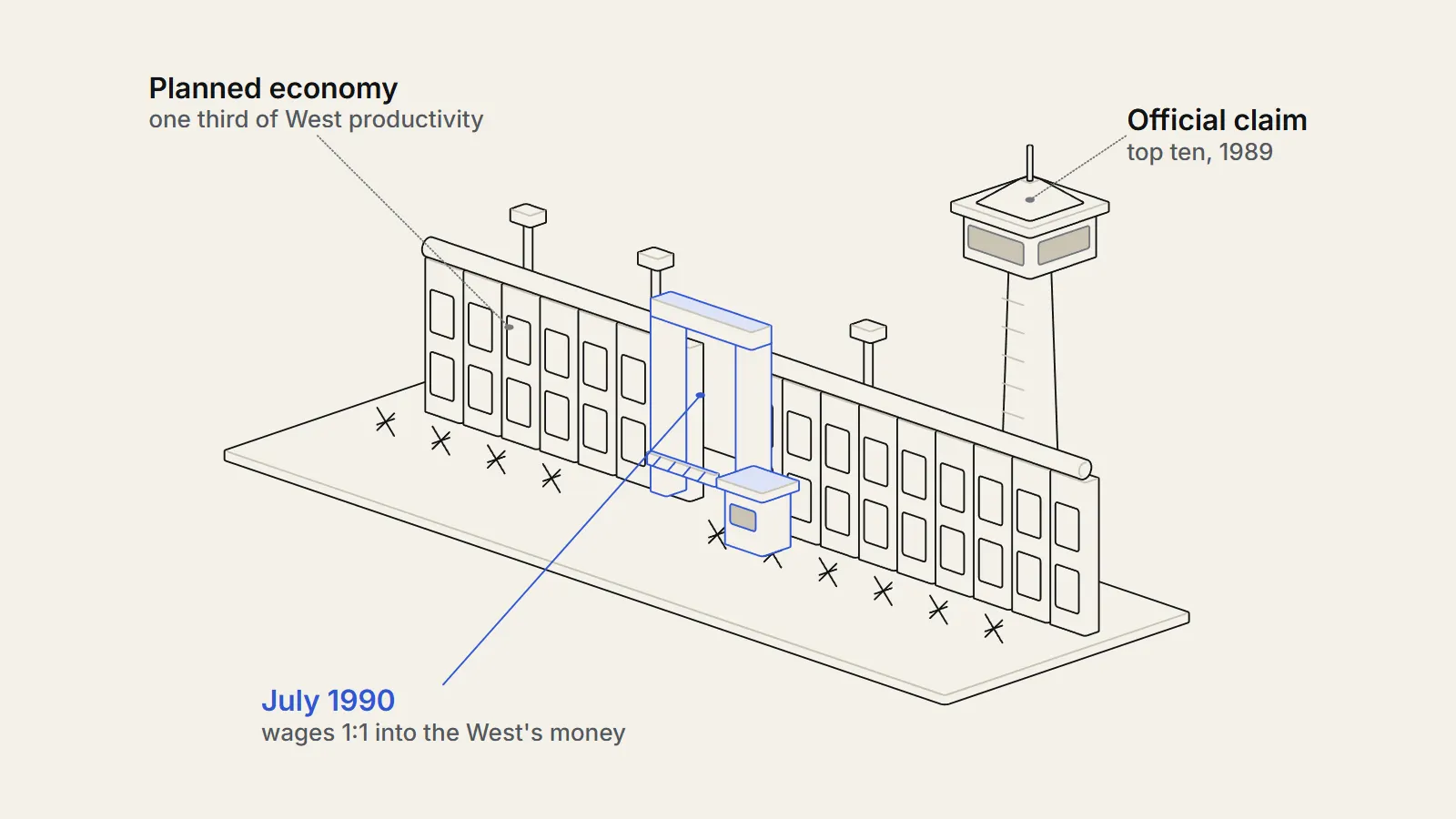
- The GDR ran a centrally planned economy until 1989; on 1 July 1990 it joined the West German currency union, converting wages at 1:1 and most savings at 2:1.
- Outcome
- GDP fell roughly 30% from 1989 to 1992 and industrial value added by over 60%; by 2013 eastern GDP per capita was 71% of the West.
The East Germany economy was a centrally planned system that, by its own leaders' account in late 1989, was close to insolvency, and in July 1990 it was merged into West Germany's currency area at a rate of 1:1 for wages. Output then fell roughly 30 percent between 1989 and 19921, industrial value added by more than 60 percent, and unemployment rose from officially zero to more than 15 percent.21 This case study looks at what the planned economy actually produced, what the currency union changed, and what is still argued about.
Before
A planned economy that lived beyond its means
The German Democratic Republic ran an economy planned from the centre and organised in large combines, or Kombinate. Its labour force was about 8.96 million in 1987, and 37.5 percent of workers were in industry.3 The Central Intelligence Agency's 1990 Factbook put gross national product at $159.5 billion, or $9,679 per head, and counted real growth of 1.2 percent in 1989.3
Estimates of the economy's size and productivity differ widely. Charles Maier, writing for UNU-WIDER, notes that estimates of the GDR economy run from the implausibly high official statistics to pessimistic values.4 He cites value added per manufacturing worker in 1987 of 30.5 percent of the West German level and 21.4 percent of the United States level.4 Estimates cited in the DIW's bulletins of the productivity gap are wider still: West German government estimates of about one third, publications rating it from 25 to 50 percent, and a range of 14 to 35 percent in a 1999 study.56
Official claims were very different. On 7 October 1989, at the 40th anniversary, leader Erich Honecker said the country had developed an economy with a modern structure and great economic potential, and that its productivity was among the ten highest of the industrial nations.5
an economy with a modern structure and great economic potential
— Erich Honecker, 7 October 1989, as quoted in DIW Economic Bulletin 27/2015
Debt, consumption and the cost of earning hard currency
Karl Brenke of the DIW Berlin describes a country that had lived far beyond its means. A growing share of resources went to consumption and too little to the investment needed to renew plant, which he calls a social policy of capital erosion.5 Hans-Hermann Hertle, whose article reproduces the Politburo papers, puts the same policy in the party's own words: the unity of economic and social policy. The investment quota was lowered, capacity was cut and infrastructure decayed, while imports of consumer and investment goods from the West were financed by credit.2
The debt was known inside the leadership. On 16 May 1989 Gerhard Schurer, the head of the State Planning Commission, told a small circle of party leaders that the GDR's debt to the West was increasing by 500 million Valutamark a month, and that on that path the country would be insolvent by 1991.2 By the end of October leading economists judged that a cut in living standards of 25 to 30 percent was needed, but that it could not be imposed without risking the regime.2
On 1 November 1989 Egon Krenz briefed Mikhail Gorbachev in Moscow. According to the record published by the Cold War International History Project (https://zzf-potsdam.de/sites/default/files/mitarbeiter/hertle/2009_04_08_cwihp_bulletin_12_hertle_fall_wall.pdf), he said that foreign debt would reach 26.5 billion US dollars, or 49 billion valuta marks2, by the end of the year. Income in convertible currency was 5.9 billion dollars against expenses of 18 billion, and interest alone cost 4.5 billion dollars, or 62 percent of annual export earnings in foreign currency.2 The Factbook gave a lower figure for external debt, 20.6 billion dollars for 1989.3 The two numbers may measure different things, and we have not reconciled them.
The cost of earning hard currency was high. Using unpublished planning data for 116 combines, Akerlof, Rose, Yellen and Hessenius (https://www.brookings.edu/wp-content/uploads/1991/01/1991a_bpea_akerlof_rose_yellen_hessenius_dornbusch_guitian.pdf) calculate that in 1989 East German firms spent on average 3.73 marks, at producer prices, to earn one deutsche mark in sales to non-socialist countries. Such exports amounted to about 20 percent of GNP.7 The Valutamark was a statistical unit worth about four East marks, and exports to the West were credited at an internal rate of 4.3 marks to one deutschmark.5
The political break
The collapse came faster than anyone planned for. In 1989 the leadership had prepared to celebrate the 40th anniversary of the state. Hungary opened its border in September, Honecker resigned in mid-October and the Berlin Wall fell on 9 November.5 Emigration was heavy: 73,000 people left for the West in November 1989, 59,000 in December and almost 50,000 a month in the first three months of 1990.5
The decision
Monetary union in 1990: the terms
Monetary union was first raised in the political arena in mid-January 1990 as a way to slow the exodus, and the West German government presented it publicly on 6 February.5 The Bundesbank said on the same day that any such step lay in the distant future.5 Most economists agreed with the Bundesbank that union should wait for fundamental reforms.5
The East German elections in mid-March 1990 returned the Ost-CDU and its allies, and DIW's Brenke reads the result partly as a vote for the deutschmark. Afterwards, monthly departures halved.5 The terms were set in a treaty that took effect on 1 July 1990. The Bundesbank's later account (https://www.bundesbank.de/resource/blob/706190/ddf80f46a063f36065177cb012577e6e/mL/2002-03-circulation-mark-data.pdf) says wages and salaries were converted at 1:18, assets in principle at 2:1, with a social component under which 2,000, 4,000 or 6,000 marks per person, depending on age, were exchanged at 1:1.8
| Item | Rate or fact |
|---|---|
| Wages and salaries | 1:1 |
| Assets, in principle | 2:1 |
| Savings, social component | 2,000, 4,000 or 6,000 marks per person at 1:1, by age |
| Method | Through bank accounts in the GDR; no cash exchanged |
| Effect on money supply | New M3 balances about 15% of western German M3 |
DIW reports that, in practice, the conversion ratio for stock variables such as bank balances and debts was 1.6 to 1.5 The justification for the 1:1 rate on wages was that wages were only around one third of West German levels, and the Bundesbank's 2002 review adds that the 2:1 rate seemed justifiable because the inflationary overhang of money in the GDR was apparently relatively small.58
Who wanted something else
In an open letter of 9 February 1990, the German Council of Economic Experts recommended that the planned-economy price system be dismantled first, the financial system rebuilt and state firms privatised, with a fixed exchange rate for the East German mark and convertibility phased in as soon as possible.5 DIW itself argued for a low conversion rate, as low as five East German marks to one deutschmark, which it expected to protect exports and attract investment.5 Some economists argued for a rapid union, because a common currency would set reliable prices and avoid exchange-rate risk for investors.5
- 16 May 1989Schurer warns SED leaders that the GDR will be insolvent by 1991 at the current paceSource 2 (opens the source in a new tab)
- 7 Oct 1989Honecker claims a modern economy among the ten most productive in the worldSource 5 (opens the source in a new tab)
- 1 Nov 1989Krenz tells Gorbachev of 26.5 billion dollars of foreign debtSource 2 (opens the source in a new tab)
- 9 Nov 1989The Berlin Wall fallsSource 5 (opens the source in a new tab)
- Mid-Jan 1990Monetary union first proposed in the political arenaSource 5 (opens the source in a new tab)
- 6 Feb 1990West German government presents the plan; the Bundesbank calls it distantSource 5 (opens the source in a new tab)
- 9 Feb 1990Council of Economic Experts proposes reform first and a fixed rateSource 5 (opens the source in a new tab)
- Mid-Mar 1990Volkskammer election returns the Ost-CDU and alliesSource 5 (opens the source in a new tab)
- 1 Jul 1990Currency, economic and social union takes effectSource 8 (opens the source in a new tab)
- Late 1990About 3 million of a labour force potential of 9.8 million are jobless, in schemes or pensioned offSource 5 (opens the source in a new tab)
- End 1994Treuhandanstalt closes with reported privatisation losses of 260 billion DMSource 9 (opens the source in a new tab)
The strongest case against a fast 1:1 union
The evidence gathered after the event gives the argument some force. Akerlof and co-authors found that, at the wage and cost levels of late 1990, firms employing only about 8 percent of the industrial workforce could cover their short-run costs at world prices, which was 14 of the combines they studied.7 They also estimated that a 50 percent cut in labour costs would make 47 combines viable, employing almost 37 percent of the workers, and a 75 percent cut would make 88 combines viable, employing 77 percent.7
The consequence was swift. Within weeks of union, DIW reports, industrial production fell by almost 50 percent, which it calls historically unique.5 By late 1990 about three million of the 9.8 million people who had been counted as potential labour force were unemployed, on labour-market schemes or pensioned off.5 The authors of the Brookings paper described the start of a depression in the plainest terms.7
One of the worst and sharpest depressions in European history had begun.
— Akerlof, Rose, Yellen and Hessenius, Brookings Papers on Economic Activity, 1991
Wage policy compounded the problem. Wages in the second quarter of 1990 were 11 percent higher than in the first, before the union took effect, and in the metal and electrical industry pay rose by a good 40 percent in two steps by early October 1990.5 Akerlof and co-authors put the wage rise through October at 42 percent.7
What happened
The East Germany economy after union: collapse, then partial catch-up
Burda and Hunt, in the Brookings Papers on Economic Activity, summarise the first three years: from 1989 to 1992 GDP in the former GDR declined by roughly 30 percent, value added in industry by more than 60 percent and employment by 35 percent. Unemployment rose from officially zero to more than 15 percent, and to 33 percent if hidden unemployment is included.1 More than 1 million people, 6 percent of the eastern population, moved west between 1989 and 1991.1
How far the East caught up
Output per head recovered quickly at first. In Burda and Hunt's Table 3, eastern GDP per capita rose from 42 percent of the western level in 1991 to 64 percent in 1994 and 65 percent in 2000, while labour productivity rose from 44 percent to 73 percent.1 Wages rose from 50 percent of the western level in 1991 to 76 percent in 1997, running ahead of productivity for most of the period.1
Consumption converged faster than output, and Burda and Hunt attribute that to generous transfers from the west. They report that total financial transfers from the west exceeded 1.5 trillion marks over 1990 to 2000, an annual net transfer of about 5 percent of German GDP.1 Hans-Werner Sinn, writing in 2000, reported that about one third of eastern spending came from the West and that labour productivity had stalled at roughly 55 percent of the western level.10 We could not confirm from Sinn's abstract how he defines productivity, so we do not reconcile his 55 percent with Burda and Hunt's 73 percent.
By 2013 the DIW found that eastern GDP per capita was 71 percent of the western figure, productivity per employee 79 percent and per hour worked 74 percent.6 Unemployment in August 2014 was 10.9 percent in the East against 6.6 percent in the West.6 The labour market had changed in other ways too: the employed share of the eastern working-age population fell from 83 percent in 1990 to 65.2 percent in 1999, while the western share was a steady 73 percent.1 Births halved from about 200,000 in 1990 to just under 100,000 in 1994.6
The Treuhand and the combines
The state-owned combines were taken over by the Treuhandanstalt, a public trust set up to privatise them. Dierk Hoffmann of the Institut fur Zeitgeschichte writes that it handled about 12,000 enterprises, of which 30 percent were liquidated, and that only about a third of the original four million jobs remained.9 The labour market adjusted in several ways at once. Maier reports that East German industry cut working time for 900,000 employees between 1990 and 1991, that early retirement at 55 applied to perhaps 800,000 people after 1992 and that job retraining took another 400,000. By 1993 agriculture and forestry had fallen to one-fourth of its 1989 size and industrial employment to one-third.4 He adds that the total of unemployed, early retired, state-created jobs and retraining places was perhaps a third of the potentially employable, a total he compares with the Great Depression (https://therealigned.com/story/what-caused-the-great-depression).4 It carried legacy debts of about 120 billion marks after the currency conversion and reported privatisation losses of 260 billion marks when it closed in 1994, which Hoffmann says is only the lower end of the true cost.9
What economists still disagree on
What caused the collapse of the East Germany economy?
Maier lists the explanations on offer: the East's long-standing failure to match West German productivity, the currency settlement, the policies of the Treuhandanstalt, and a supposed lack of entrepreneurial vigour among the East German population.4 He leans on a fifth, that the former GDR was assigned an economic role with little purpose and no real market demand, and that the networks of capacity inside the combines may have been dismembered by selling them in pieces.4
Brenke puts the weight on the conversion rate and wage policy. He argues the rate did not reflect productivity, that demand for Eastern goods fell as consumers turned to Western ones, and that the true cause lies on the supply side.5 He adds that demand from the rest of the Eastern bloc fell too, but that the federal government supported firms trading with the bloc, so that without the support production would have fallen even further.5
Hoffmann is cautious about blaming the Treuhand alone. He calls its record devastating but says it is inappropriate and one-sided to call it a failure of the agency, and points to the SED's refusal to modernise the economy, which made restructuring harder.9 This is close to what the 1989 evidence suggests: leaders who knew the debt, could not cut consumption and did not change course.2
Even the size of the gap before 1990 is uncertain. The range of productivity estimates runs from 14 to 35 percent in one study to one third in West German government estimates, and the Factbook's per capita GNP of $9,679 sits uneasily beside Maier's estimate of 45 percent of rich Western countries' per capita income in 1980.6534 These are different measures, so we do not average them. The Brookings paper was also flagged by its own editors as based on data that had not been independently verified, which is one reason we use it as an indication of scale and not as a precise estimate.7
- Agreed in the sources: the planned economy was far less productive than West Germany's, it was heavily indebted by 1989, and output fell sharply in 1990 to 1992.
- Disputed: how large the productivity gap was, and how much of the collapse came from the conversion rate, wages, the Eastern bloc market, the Treuhand or the legacy of planning.
- Disputed: how far eastern incomes have converged, with measures from 55 to 79 percent depending on the indicator and year.
- Not known: how the East would have fared with a separate currency at a lower rate, because that path was not taken.
If the East German mark had been converted at a rate closer to its internal clearing rate of 4.3 to 1, would more firms and jobs have survived in the East, or would still more people have left for the West?
Lessons
Key takeaways
- Official claims and independent estimates of the planned economy diverged widely. By late 1989 the leadership itself saw debt and low productivity as grave, while the public message stayed positive.
- The terms of a currency union can matter more than its timing. A rate that suits households and savers may overprice the output of firms that sell at low prices.
- The shock was large and the recovery partial. GDP fell roughly 30 percent in three years, and 25 years later the East's GDP per head was 71 percent of the West's.
- The causes of the collapse remain disputed, and the data used to judge them are patchy. No one can rerun the alternative.
What carries over is the question of sequence and price: reform, privatisation and the exchange rate interact, and changing one without the others can move costs faster than productivity. What does not carry over is the setting. East Germany joined a rich state that provided its legal system, welfare entitlements and annual transfers of about 5 percent of German GDP, which other transition economies did not have.14
Sources
- 1From Reunification to Economic Integration: Productivity and the Labor Market in Eastern Germany (opens the source in a new tab) · Brookings Papers on Economic Activity, 2:2001, 2001 · Paper · https://www.brookings.edu/wp-content/uploads/2001/06/2001b_bpea_burda.pdf
- 2The Fall of the Wall: The Unintended Self-Dissolution of East Germany's Ruling Regime (with documents) (opens the source in a new tab) · Cold War International History Project Bulletin, Issue 12/13, 2001 · Primary source · https://zzf-potsdam.de/sites/default/files/mitarbeiter/hertle/2009_04_08_cwihp_bulletin_12_hertle_fall_wall.pdf
- 3The World Factbook (1990): German Democratic Republic (opens the source in a new tab) · CIA (text transcribed on Wikisource), 1990 · Primary source · https://en.wikisource.org/wiki/The_World_Factbook_(1990)/German_Democratic_Republic
- 4The Travails of Unification: East Germany's Economic Transition since 1989 (UNU-WIDER Working Paper 2010/60) (opens the source in a new tab) · UNU-WIDER, 2010 · Paper · https://www.wider.unu.edu/sites/default/files/wp2010-60.pdf
- 5A Critical Retrospective: German Monetary Union (DIW Economic Bulletin 27/2015) (opens the source in a new tab) · DIW Berlin, 2015 · Report · https://www.diw.de/documents/publikationen/73/diw_01.c.510026.de/diw_econ_bull_2015-27-3.pdf
- 6Eastern Germany Still Playing Economic Catch-Up (DIW Economic Bulletin 11/2014) (opens the source in a new tab) · DIW Berlin, 2014 · Report · https://www.diw.de/documents/publikationen/73/diw_01.c.491941.de/diw_econ_bull_2014-11.pdf
- 7East Germany in from the Cold: The Economic Aftermath of Currency Union (opens the source in a new tab) · Brookings Papers on Economic Activity, 1:1991, 1991 · Paper · https://www.brookings.edu/wp-content/uploads/1991/01/1991a_bpea_akerlof_rose_yellen_hessenius_dornbusch_guitian.pdf
- 8Circulation of the Deutsche Mark from currency reform to European monetary union (Monthly Report, March 2002) (opens the source in a new tab) · Deutsche Bundesbank, 2002 · Primary source · https://www.bundesbank.de/resource/blob/706190/ddf80f46a063f36065177cb012577e6e/mL/2002-03-circulation-mark-data.pdf
- 9In the engine room of East Germany's transformation (opens the source in a new tab) · Leibniz Lab Umbrüche und Transformationen, 2025 · Report · https://leibniz-lab-transformationen.de/2025/12/18/in-the-engine-room-of-east-germanys-transformation/?lang=en
- 10Germany's Economic Unification: An Assessment after Ten Years (opens the source in a new tab) · NBER Working Paper 7586 (published in Review of International Economics, 2002), 2000 · Paper · https://www.nber.org/papers/w7586