Why Britain first? Historians do not agree on a single cause, but the leading explanations are cheap coal combined with high wages, political institutions shaped by Atlantic trade, and a culture that put scientific knowledge to practical use. Each has real evidence behind it and each has critics. This piece sets out the main arguments, where they collide, and what remains unsettled.
Did cheap coal and high wages push Britain first?
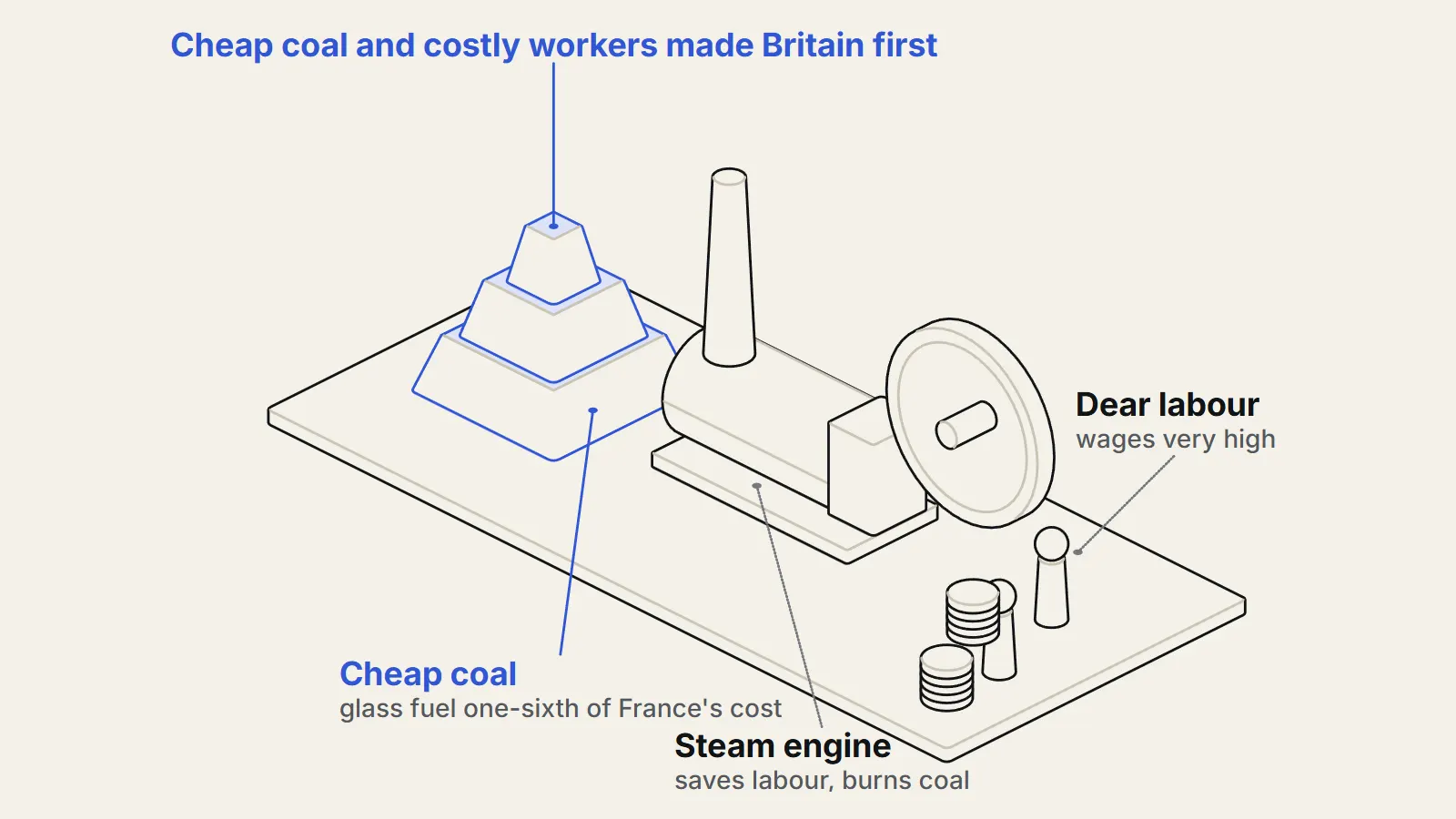
The most influential economic explanation comes from Robert Allen. In a 2011 article (https://people.bu.edu/chamley/HSFref/Allen11.pdf) in the Economic History Review he argues that eighteenth-century Britain had a unique wage and price structure: wages were very high by international standards and energy was very cheap. That combination, he says, gave British firms a reason to invent machines that replaced labour with capital and energy.1 A spinning machine or a steam engine would not have paid for itself where labour was cheap and fuel dear.
The evidence is a comparison of cities. Allen finds that Newcastle had the highest ratio of labour costs to energy costs in the world1, and that the only place outside Britain with a similar ratio was probably the coal district around Liege and Mons in present-day Belgium.1 He quotes prospectuses of the 1770s estimating that the fuel cost of English glass making was only one-sixth of that in France.1 High wages did a second job as well: he argues they let British workers afford education and training, which increased the supply of skills.1
Allen also explains why the high wages existed. He says the wage and price structure came from Britain's success in international trade, which owed much to mercantilism and imperialism, while cheap fuel came from geography.1 That makes his story a bridge between the coal argument and the argument about empire.
Did institutions and Atlantic trade matter most?
A second explanation looks at politics. Daron Acemoglu, Simon Johnson and James Robinson argue in the American Economic Review that the rise of Western Europe after 1500 came largely from countries with access to the Atlantic Ocean and with substantial trade with the New World, Africa and Asia.2 In their 2005 paper (https://economics.mit.edu/sites/default/files/publications/rise-of-europe.pdf), where political institutions already placed checks on the monarchy, Atlantic trade strengthened merchants, who then won changes that protected property rights.2
The paper backs this with city-size data. Countries that traded across the Atlantic started with an average urbanization rate of 10.1 percent in 1500 and reached 24.5 percent in 18502, overtaking the rest of Western Europe between 1600 and 1700.2 They point to Britain and the Netherlands, and to the English Civil War of 1642 to 1649 and the Glorious Revolution of 1688 to 1689 as milestones in limiting royal power.2
The authors are careful about what they are not claiming. Studies they cite suggest that profits from Atlantic trade and the volume of trade appear too small to account directly for much of European growth. Their case rests mainly on the indirect route through institutions.2
Was it science and culture?
A third group stresses ideas. Joel Mokyr traces the intellectual origins of the Industrial Revolution to the seventeenth-century Baconian programme of using natural philosophy to solve technological problems, and argues that the eighteenth-century Enlightenment spread that programme through institutions that raised the amount of useful knowledge and made it easier to reach.3 Without the Enlightenment, he writes, an Industrial Revolution could not have turned into sustained economic growth.3
Mokyr is not claiming that science directly produced the key machines. He acknowledges that it is very difficult to show that the seventeenth-century scientific revolution had a direct effect on the main breakthroughs.3 His point is about habits and networks: what people believed was possible, and how easily craftsmen, instrument makers and gentlemen could share what they knew.
Where do historians disagree?
The sharpest disagreement concerns coal. E. A. Wrigley and Kenneth Pomeranz made coal central. Gregory Clark and David Jacks tested that in a 2007 paper (https://academic.oup.com/ereh/article/11/1/39/534584) using new series on coal rents and prices. They concluded that England's coal reserves made a negligible contribution to Industrial Revolution incomes4, and that coal output grew mainly because demand rose rather than because mining technology improved.4 They add that the expansion could have happened at any time before 1760.4 That does not settle matters. Allen's argument is about the price of fuel relative to labour, not about the income that coal owners earned, so the two findings can both be true.
Mokyr raises a different complaint about the whole field. He says scholars have offered a "smorgasbord" of explanations for Britain's success, including the Glorious Revolution, a colonial empire, a powerful navy and a greedy middle class, and that none can carry the weight without relying on technological change.3 He also warns that looking for causes particular to Britain may mislead, because he sees the Industrial Revolution as a Western phenomenon, "more than just a British affair".3
Allen answers this partly with the Dutch case. He notes that the Dutch economy was a high-wage economy but lacked cheap coal, and he treats culture as something that could encourage invention but could not make up for the wrong prices.1 The AJR and Allen accounts also overlap: both link Britain's position to trade, though they differ on whether the key effect ran through institutions or through relative prices.
What is not known?
Several things are not settled. First, the explanations are hard to test against one another because the factors moved together: trade, wages, coal use, scientific culture and institutions all changed over the same two centuries. Allen himself calls the importance of the Industrial Enlightenment a very difficult question, because cultural change was intermingled with changes in prices and demand.1 Second, none of the studies here gives a share of the outcome to each cause, so the weights are judgements rather than measurements. Third, Britain may not have been predestined: Allen cites a historian who has suggested that Britain's lead was fortuitous, although his own view is that the wage and price structure was the key.1
The sensible reading is that the leading accounts are less rivals than layers. Trade and empire may have raised wages, geography supplied cheap fuel, institutions protected investment and a culture of useful knowledge helped inventions spread. But that is a hypothesis built from these papers, not a result any of them proves, and the relative weights remain open.
Key takeaways
- Allen argues that high British wages and cheap energy made labour-saving, fuel-using machines pay off in Britain first; Newcastle had the highest ratio of labour to energy costs in the world.
- Acemoglu, Johnson and Robinson argue that Atlantic trade strengthened merchants where monarchs were already constrained, protecting property rights; Atlantic traders' urbanization rose from 10.1 to 24.5 percent between 1500 and 1850.
- Mokyr emphasises the Enlightenment and useful knowledge, and says the Industrial Revolution was a Western rather than only a British phenomenon.
- Clark and Jacks find coal reserves added negligibly to incomes, which challenges the strongest coal story but does not directly test the fuel price argument.
- The factors are intertwined and no study assigns each a share, so the question remains open.
Sources
- 1Why the industrial revolution was British: commerce, induced invention, and the scientific revolution (opens the source in a new tab) · The Economic History Review 64(2), 357-384, 2011 · Paper · https://people.bu.edu/chamley/HSFref/Allen11.pdf
- 2The Rise of Europe: Atlantic Trade, Institutional Change, and Economic Growth (opens the source in a new tab) · American Economic Review 95(3), 546-579, 2005 · Paper · https://economics.mit.edu/sites/default/files/publications/rise-of-europe.pdf
- 3The Intellectual Origins of Modern Economic Growth (opens the source in a new tab) · The Journal of Economic History 65(2), 285-351, 2005 · Paper · https://e-tcs.org/wp-content/uploads/2012/10/mokyr-the_intellectual_origins_of_modern_economic_growth.pdf
- 4Coal and the Industrial Revolution, 1700-1869 (opens the source in a new tab) · European Review of Economic History 11(1), 39-72, 2007 · Paper · https://academic.oup.com/ereh/article/11/1/39/534584