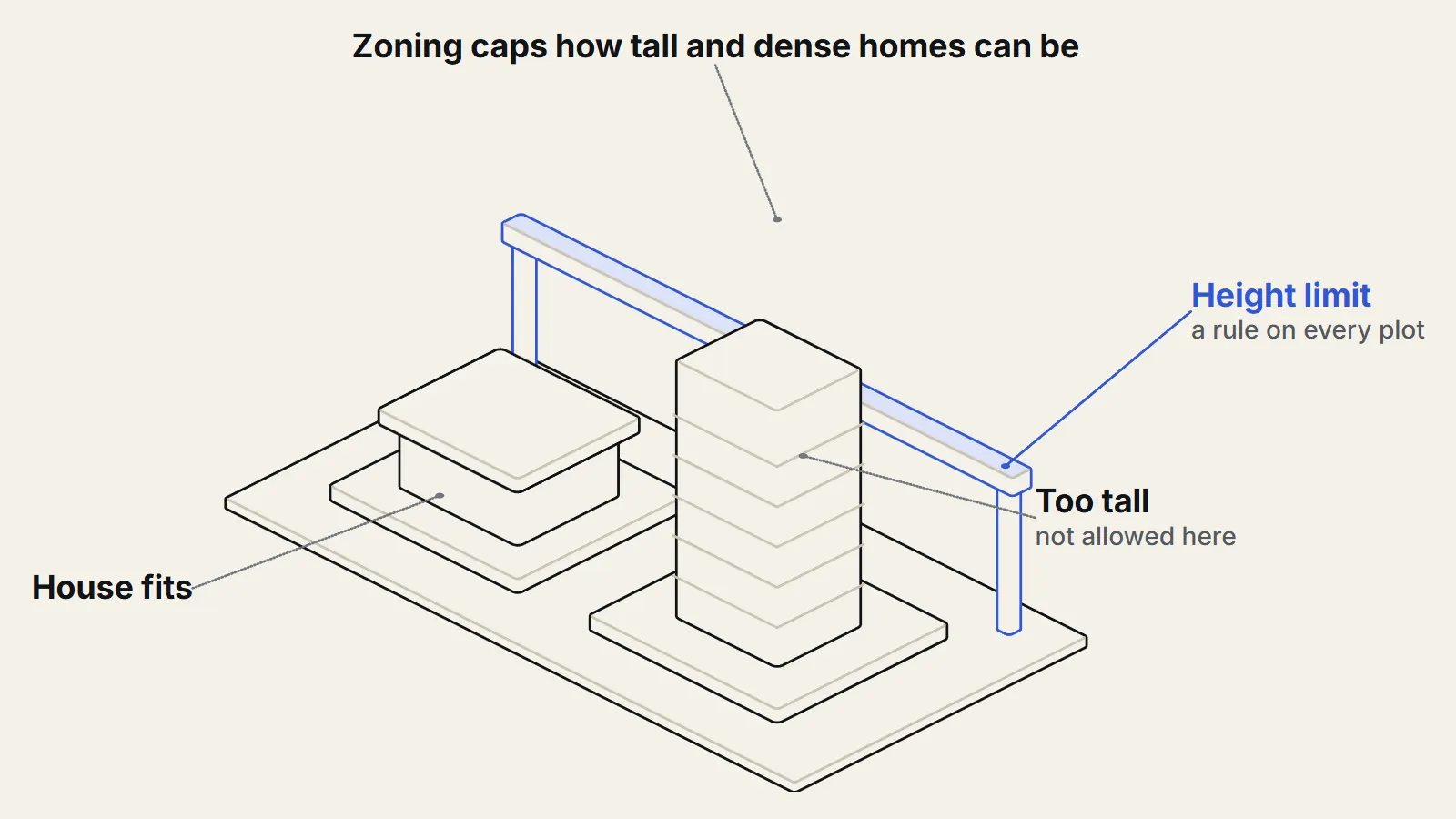
Zoning is a set of local laws that divides land into districts and says what can be built in each: homes or shops, how tall, how close together, and how many parking spaces must come with them. In most of the United States the rules are written by cities, towns and counties, and they shape how much housing a plot of land can hold. Because that limits supply, most studies find that stricter zoning goes with higher prices. This piece explains what zoning rules are, who sets them, what the research finds, and where it is uncertain.
What is zoning and who writes the rules?
According to a review of the research by economists Joseph Gyourko and Raven Molloy (https://www.oregon.gov/lcd/Housing/Documents/w20536.pdf), modern land use regulation in the United States began with zoning laws in the 1910s1, with the aim of separating different kinds of land use and limiting harm from, for example, industrial or commercial activity.1 Land use is controlled mostly by local governments, because the federal government was not given power over land and the states have generally left it to localities. The review notes that this is one reason rules differ so much from place to place.1
The toolbox has grown since then. The same review lists urban growth boundaries, minimum lot sizes, density restrictions and height restrictions among the rules now in use.1 A minimum lot size says how much land every house must sit on. A density limit caps homes per acre. A parking minimum requires builders to provide a set number of spaces per home or per square foot of floor space. Each one reduces how much housing can be built on a parcel of a given size.
What did Euclid v. Ambler decide in 1926?
Zoning faced a legal test soon after cities adopted it. Ambler Realty owned 68 acres in the village of Euclid, Ohio, and argued the village's ordinance cut the value of its land. The Supreme Court disagreed. In a 6-3 decision on November 22, 19262, it held that the ordinance was not an unreasonable use of the village's police power, the government's authority to regulate for public health and safety.2
The ruling also set a standard that courts still use. According to the Cornell Legal Information Institute (https://www.law.cornell.edu/wex/village_of_euclid_v_ambler_realty_(1926)), an ordinance can be struck down only if it is clearly arbitrary and unreasonable and without substantial relation to public health, safety, morals, or general welfare3.3 That is a hard test for a challenger to meet. Houston, Texas, is the largest US city without zoning; it relies on deed restrictions, private covenants attached to property, instead.2
How do lot sizes, density limits and parking rules affect prices?
Gyourko and Molloy conclude that most studies find substantial effects: regulation appears to raise house prices, reduce construction and make housing supply less responsive to demand.1 One way researchers measure the effect is a gap they call a regulatory tax, the difference between what a home sells for and what it costs to build, after allowing for the value of the land. For single-family markets in 1999 and 2000, the review reports estimates ranging from zero in Birmingham, Cincinnati and Houston to nearly 20 percent of house value in Boston, over 30 percent in Los Angeles, and upwards of 50 percent in the San Francisco Bay Area1.1
Lot-size rules are among the better documented. In a detailed study of communities around Boston, summarised in the review, each quarter-acre increase in minimum lot size was linked to roughly 10 percent fewer houses permitted over time.1 The review also reports that more than 50 percent of highly regulated communities have a one-acre minimum lot size in at least one neighbourhood, against under 5 percent of lightly regulated ones.1
Parking rules add a cost that does not show up as a lot size. A 2017 study by C. J. Gabbe and Gregory Pierce estimated that renters pay about $1,700 a year, around 17 percent of rent, for a bundled garage space, and that about 708,000 car-free households have a garage space.4 Their estimate concerns bundled parking in general, not only legal minimums, but the authors argue it understates the full cost of minimum requirements.4
What do zoning defenders say, and what is still unknown?
Zoning was meant to solve a real problem: keeping, for example, a factory away from homes. Gyourko and Molloy say that some specific rules clearly reduce negative spillovers, and that one cannot presume regulation is inefficient, because it has both costs and benefits.1 They also stress that the regulatory tax is an indirect measure that cannot isolate the effect of any single rule, and that the benefits of broad regulation are hard to quantify.1 On balance they report that a few recent studies suggest the efficiency losses from binding limits on building could be large, but they treat this as unsettled.1
Several questions remain open. It is hard to separate zoning from other causes of high prices, such as a scarcity of land or strong demand, because cities with high prices may also adopt tougher rules. The effect of one rule, such as a parking minimum, depends on what else is allowed in the same place. And this piece does not say what any city should do; those choices involve trade-offs between neighbours, builders and renters that research alone cannot settle.
Key takeaways
- Zoning is a set of mostly local rules on land use, height, lot size, density and parking.
- Euclid v. Ambler (1926) upheld zoning 6-3 and set a deferential test that courts still use.
- Most studies find that stricter rules go with higher house prices and less construction.
- Estimated regulatory taxes ranged from zero to over 50 percent of house value across US markets in 1999-2000.
- Some rules prevent real harms, and the research cannot fully separate rule effects from other causes.
Sources
- 1Regulation and Housing Supply (opens the source in a new tab) · NBER Working Paper 20536 (later Handbook of Regional and Urban Economics, vol. 5B), 2014 · Paper · https://www.oregon.gov/lcd/Housing/Documents/w20536.pdf
- 2Village of Euclid v. Ambler Realty Co. (opens the source in a new tab) · Wikipedia, 2005 · Reporting · https://en.wikipedia.org/wiki/Village_of_Euclid_v._Ambler_Realty_Co.
- 3Village of Euclid v. Ambler Realty (1926) (opens the source in a new tab) · Legal Information Institute, Cornell Law School, 1926 · Law · https://www.law.cornell.edu/wex/village_of_euclid_v_ambler_realty_(1926)
- 4The Hidden Cost of Bundled Parking (opens the source in a new tab) · Access magazine, UC Transportation Center, 2017 · Report · https://scholarcommons.scu.edu/ess/72/