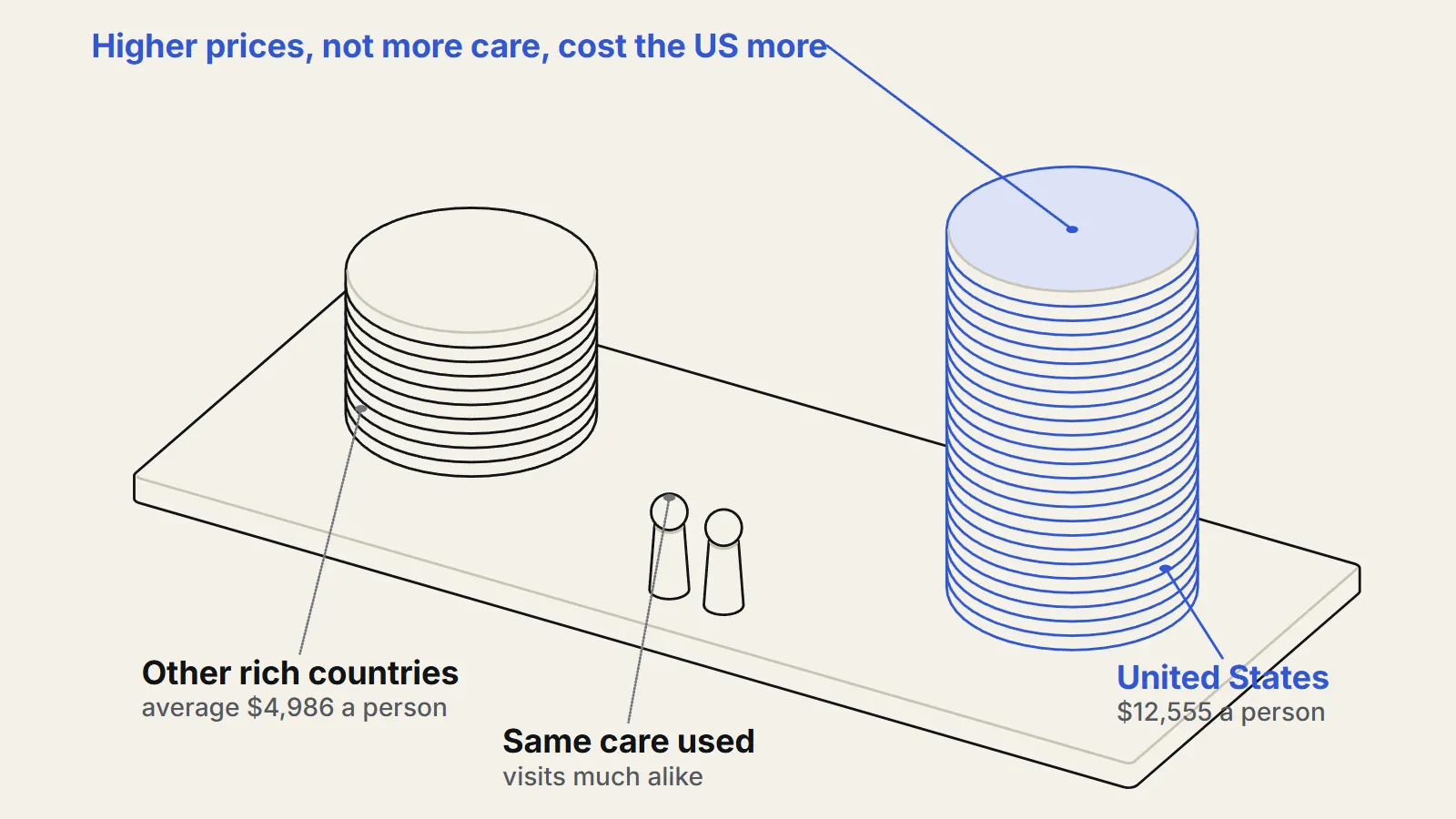
America spends more on health because it pays higher prices and carries heavier administrative costs, not because Americans use far more care. A widely cited 2018 comparison of 11 high-income countries found that US use of services was broadly similar to elsewhere, while prices for labor and goods, including drugs and doctors' pay, plus the cost of running a fragmented insurance system, were much higher. The spending gap is very large. Whether it buys better health is a separate question, and the evidence there is mixed.
How much more does the US spend on health care?
The OECD, the club of mostly rich economies that collects comparable statistics, reported in its 2023 country note that the US spent $12,555 per person1 on health, against an OECD average of $4,986, in dollars adjusted for what money can buy. That was 16.6 percent of the US economy, compared with 9.2 percent on average across the OECD.1 The figures are in the OECD Health at a Glance 2023 country note (https://www.oecd.org/content/dam/oecd/en/publications/reports/2025/07/health-at-a-glance-2023_39bcb58d/united-states_1bd99de8/4268c3ef-en.pdf).
A study published in the Journal of the American Medical Association by Irene Papanicolas, Liana Woskie and Ashish Jha compared the US with 10 other high-income countries using 2016 data. It found the US spent 17.8 percent of GDP2 on health care, while the other countries ranged from 9.6 percent in Australia to 12.4 percent in Switzerland.2 The study is available on the JAMA website (https://jamanetwork.com/journals/jama/fullarticle/2674671).
Do Americans simply use more health care?
Mostly not. Papanicolas and her colleagues found that the US had a similar number of hospital beds, and numbers of doctors and nurses that did not differ substantially from the comparison countries. The US did use more of some high-tech services, with 118 MRI exams and 245 CT scans per 1,000 people, which were higher than elsewhere.2 Their conclusion was that efforts aimed only at cutting utilization were unlikely to slow US spending growth.
The OECD figures point the same way on capacity. The US had 2.7 practising doctors per 1,000 people against an OECD average of 3.7, and 2.8 hospital beds per 1,000 against 4.3.1 Fewer doctors and beds, but far more spending, implies that each unit of care costs more.
Why are prices and administration so high?
The JAMA authors identified labor and goods prices, including drugs, along with administrative costs as the major drivers of the gap. Drug spending was $1,443 per person2 in the US, against $466 to $939 elsewhere. Administration took about 8 percent of US health spending, against 1 to 3 percent in the other countries. A generalist physician earned $218,173 in the US, against $86,607 to $154,126 elsewhere.2
Why prices are high is partly about competition. Economists Zack Cooper, Stuart Craig, Martin Gaynor and John Van Reenen analyzed insurance claims covering 28 percent of Americans with employer coverage. They found that hospitals that faced no local rivals charged about 12 percent more3 than hospitals with four or more rivals, and that prices varied across regions, across hospitals in one region, and even inside one hospital.3 The paper appeared in the Quarterly Journal of Economics (https://cep.lse.ac.uk/_NEW/PUBLICATIONS/abstract.asp?index=8868) (see the LSE summary). A 2019 analysis by Gerard Anderson and colleagues reached a similar overall view, concluding that prices remain the main reason the US spends more and that the gap between public and private payments has grown.4
Administration is the other piece. The US has many insurers, each with its own forms, rules and billing, and providers need staff to deal with all of them. That cost is built into the 8 percent figure above, but the evidence does not say how much of it could be avoided under any particular reform.
Does the higher spending buy better health?
The answer is mixed. The OECD note shows life expectancy of 76.4 years in the US, 3.9 years below the OECD average, and higher rates of preventable and treatable deaths. It also shows the US doing better on some medical measures, such as 30-day death after stroke at 4.3 percent against an OECD average of 7.8 percent, and breast cancer screening.1 Papanicolas and her colleagues reported life expectancy of 78.8 years, the lowest of the 11 countries in 2016, and the highest share of adults who were overweight or obese.
What is not known?
Several questions are open. The share of the price gap that comes from market power, from higher pay for clinicians, or from the cost of innovation has not been pinned down. Cooper and colleagues find that in their data about half of the regional variation in private spending comes from prices and half from the quantity of services, so prices are not the whole story even within the US.3 The spending numbers also come from different years in different sources, so the exact gap depends on the date. And neither the OECD note nor the JAMA study can say how much any particular policy change, such as price limits, would shift costs, or what it would do to access and quality.
Key takeaways
- The US spent 16.6 percent of its economy on health in the OECD 2023 country note, against a 9.2 percent OECD average.
- A 2018 JAMA comparison found US use of services was broadly similar to other rich countries, with higher prices and administrative costs as the main drivers.
- Hospital prices rise where competition is thin: monopoly hospitals charged about 12 percent more than those with four or more rivals.
- Higher spending has not meant longer life: US life expectancy is below the OECD average, though some medical outcomes are better.
- How much of the gap is waste and how much is need or choice remains disputed.
Sources
- 1Health at a Glance 2023 Country Note: The United States (opens the source in a new tab) · OECD, 2023 · Report · https://www.oecd.org/content/dam/oecd/en/publications/reports/2025/07/health-at-a-glance-2023_39bcb58d/united-states_1bd99de8/4268c3ef-en.pdf
- 2Health Care Spending in the United States and Other High-Income Countries (opens the source in a new tab) · JAMA 319(10), 2018 · Study · https://jamanetwork.com/journals/jama/fullarticle/2674671
- 3The Price Ain't Right? Hospital Prices and Health Spending on the Privately Insured (opens the source in a new tab) · Quarterly Journal of Economics 134(1), 2019 · Paper · https://cep.lse.ac.uk/_NEW/PUBLICATIONS/abstract.asp?index=8868
- 4It's Still The Prices, Stupid: Why The US Spends So Much On Health Care, And A Tribute To Uwe Reinhardt (opens the source in a new tab) · Health Affairs 38(1), 2019 · Paper · https://doi.org/10.1377/hlthaff.2018.05144