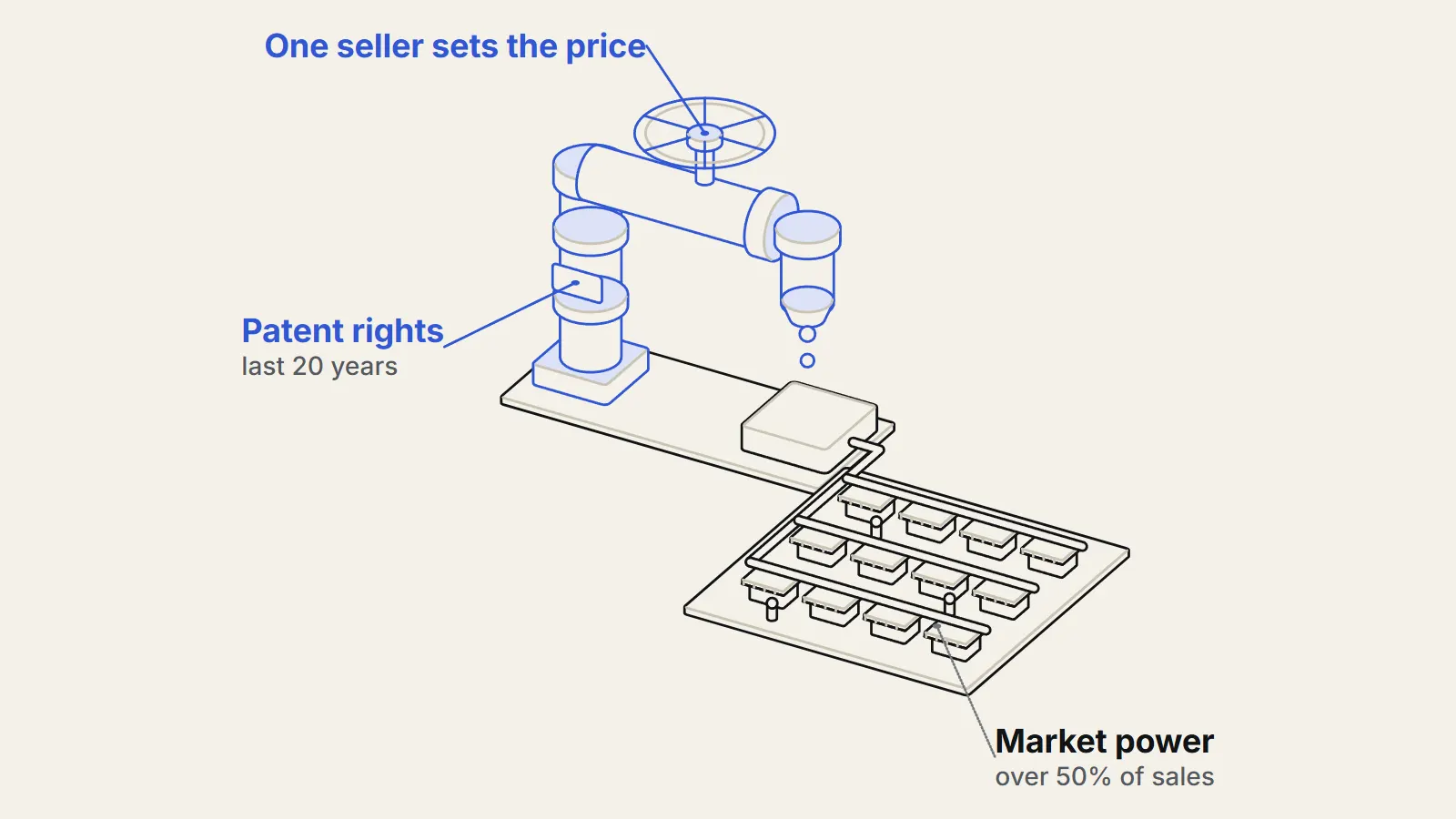
A monopoly is a market in which one seller supplies all or most of a product and rivals cannot easily enter. A monopoly is a problem when the seller uses that position to charge more, supply less or block competitors, and when nothing is likely to erode it. It is not a problem just because a firm is large or successful. This piece explains how monopolies form, what the economics say about their harm, and how the law separates the harmful ones from the rest.
What makes a monopoly?
The core ingredient is a barrier to entry: something that stops other firms from entering and competing away high prices. The OpenStax microeconomics textbook lists several: economies of scale, control of a physical resource, legal restrictions, and patent, trademark and copyright protection, plus tactics such as predatory pricing, which means selling below cost to drive rivals out.1
Two of these are worth a closer look. A natural monopoly arises when economies of scale, meaning costs per unit that fall as output grows, persist over so wide a range of output that one firm serving the whole market leaves any entrant at a cost disadvantage.1 A legal monopoly is created by law. In the United States, exclusive patent rights last for 20 years2, which gives an inventor a temporary monopoly on the invention.2
Why can a monopoly harm consumers?
A firm facing competition has to sell near its cost or lose customers. A monopolist does not, so it picks the quantity that maximises its own profit. The textbook summary says that, compared with a competitive industry, a monopoly produces less and charges a higher price1, and is not allocatively efficient because it does not produce where price equals marginal cost, the extra cost of making one more unit.1 In plain terms, some buyers who would have paid more than it costs to make the product are priced out, and nobody gains from those lost sales. The same source notes that a monopolist may lack incentives to innovate, since it need not fear new entrants.1
When is a monopoly not a problem?
Economists and courts both draw a line between how a firm got its position and what it does with it. The Federal Trade Commission, the US agency that enforces competition law, says that winning a monopoly through superior products, innovation, or business acumen3 is legal, while exclusionary conduct such as exclusive deals, tying and predatory pricing can raise antitrust concerns.3 Its guidance on monopolization (https://www.ftc.gov/advice-guidance/competition-guidance/guide-antitrust-laws/single-firm-conduct/monopolization-defined) also describes a monopolist as a firm with significant and durable market power, and says courts do not typically find monopoly power when a firm has less than 50 percent of sales in a market.3 The word durable matters: if new entrants could discipline the firm, a high share today may mean little.
Patents show the trade-off. The textbook explains that without protection, firms could copy a new product and undercut the inventor, so many would not fund research. Patents therefore provide limited monopoly power so that innovative firms can recoup their investment, and other firms may produce the product more cheaply once the patent expires.2 A short-lived monopoly is the price paid for the invention.
Natural monopolies are handled differently. The FTC's 2000 staff report on electric power (https://www.ftc.gov/reports/competition-consumer-protection-perspectives-electric-power-regulatory-reform) says the industry was long treated as a vertically integrated natural monopoly subject to rate-of-return regulation, meaning a regulator limits the profit a utility can earn.4 The report also says scale economies in power generation have diminished, allowing efficient small producers to enter, while transmission lines still show major economies of scale and are likely to stay regulated monopolies.4 The lesson is that whether a market is a natural monopoly can change as technology changes.
How does the law respond?
Competition law works in two main ways. Conduct rules ban actions that create or maintain monopoly power by blocking rivals, and the FTC cites the Microsoft case, in which the company was found to have an operating system monopoly and to have bundled Internet Explorer with Windows.3 Merger rules look ahead: Section 7 of the Clayton Act bars deals whose effect may be substantially to lessen competition, or to tend to create a monopoly5.5 A third tool, used for natural monopolies, is price regulation, which accepts that there will be one supplier and tries to control what it charges.
What is disputed or not known?
Several points are argued over. First, how to weigh a monopolist's lost output against the research that the prospect of monopoly profits may fund; the textbook treats patents as a deliberate trade-off, but it does not say what the right length is. Second, where the market begins and ends: whether a firm holds 40 or 70 percent depends on how a market is defined, and the FTC page notes that some courts have required much higher shares than 50 percent. Third, how much weight to give a firm's efficiency defence, since the FTC says a legitimate business justification, such as greater efficiency, can matter in a case. This piece does not settle those arguments, and it does not say whether any named company is a monopoly, which courts decide case by case.
Key takeaways
- A monopoly is a single dominant seller protected by barriers to entry such as scale, control of a resource, or law.
- Compared with a competitive market, a monopoly produces less and charges more, and some buyers are priced out for no gain to anyone.
- US law does not punish a firm for winning through better products; it targets exclusionary conduct and mergers that lessen competition.
- Patents and regulated utilities are monopolies by design, with limits on length or price.
- Whether a monopoly is a problem depends on how it arose, how durable it is, and how the market is defined.
Sources
- 1Principles of Microeconomics 3e, Chapter 9 Key Concepts and Summary (opens the source in a new tab) · OpenStax, Rice University, 2022 · Book · https://openstax.org/books/principles-microeconomics-3e/pages/9-key-concepts-and-summary
- 2How Monopolies Form: Barriers to Entry (Principles of Microeconomics 3e, OpenStax) (opens the source in a new tab) · OpenStax via LibreTexts, 2023 · Book · https://socialsci.libretexts.org/Bookshelves/Economics/Microeconomics/Principles_of_Microeconomics_3e_(OpenStax)/09:_Monopoly/9.01:_How_Monopolies_Form-_Barriers_to_Entry
- 3Monopolization Defined (opens the source in a new tab) · Federal Trade Commission, 2013 · Primary source · https://www.ftc.gov/advice-guidance/competition-guidance/guide-antitrust-laws/single-firm-conduct/monopolization-defined
- 4Competition and Consumer Protection Perspectives on Electric Power Regulatory Reform (opens the source in a new tab) · Federal Trade Commission staff, 2000 · Report · https://www.ftc.gov/reports/competition-consumer-protection-perspectives-electric-power-regulatory-reform
- 5Mergers (opens the source in a new tab) · Federal Trade Commission, 2013 · Primary source · https://www.ftc.gov/advice-guidance/competition-guidance/guide-antitrust-laws/mergers