What a degree is worth depends on whose degree it is. On average, American workers with a bachelor's degree earn far more than those with only a high school diploma, and economists who try to isolate the effect of schooling itself usually find a real payoff, with gains in the studies reviewed here of roughly 4 to 14 percent for each extra year. But averages hide wide variation: by person, by field, by whether the degree is finished, and by how selective the college is. The return to schooling is a distribution, not a single number.
How much more do graduates earn?
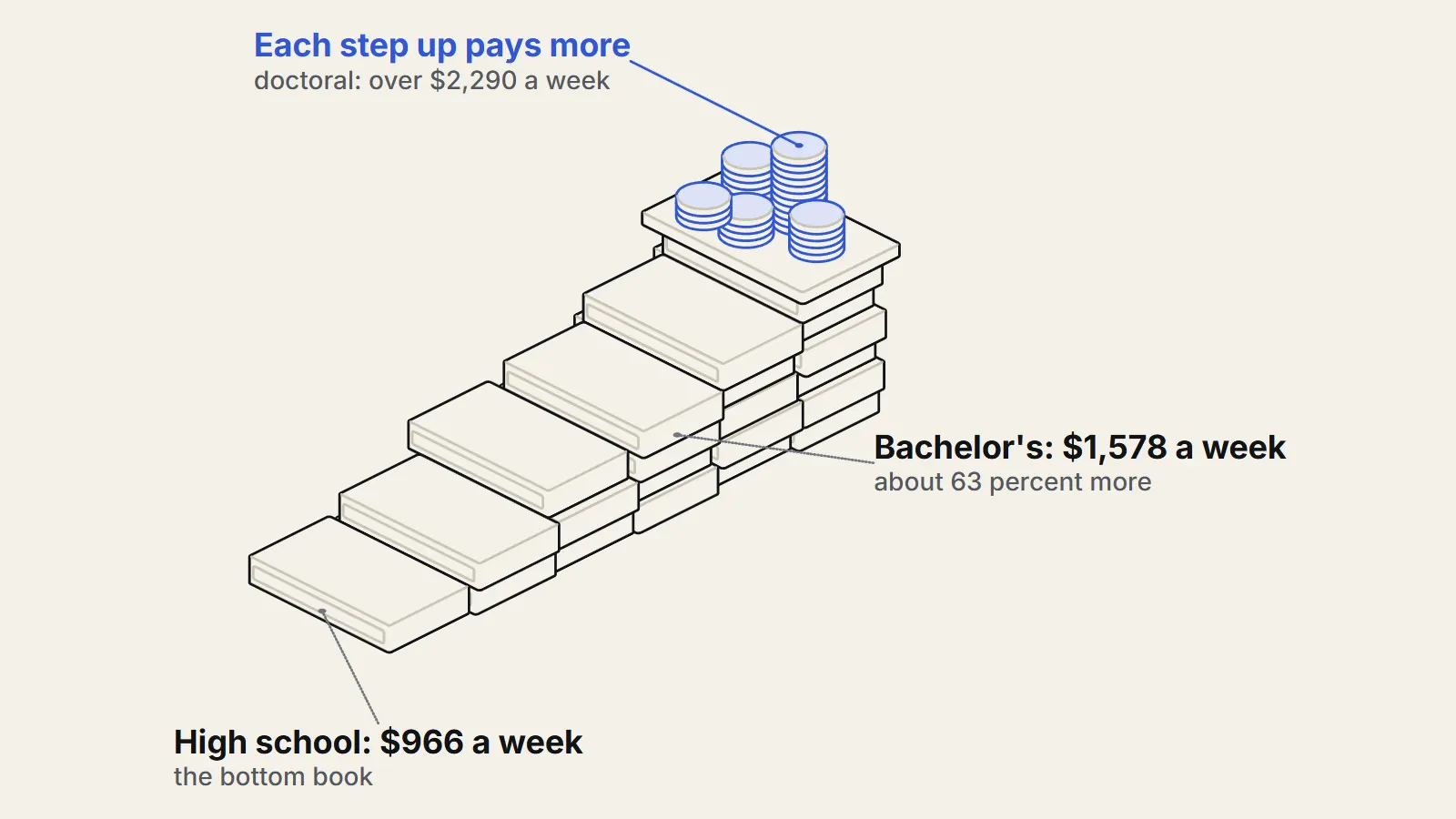
The US Bureau of Labor Statistics publishes median earnings by education for full-time workers aged 25 and over. In 2025, workers with a bachelor's degree had median weekly earnings of $1,5781, against $9661 for those with a high school diploma, and the unemployment rate for the two groups was 2.8 percent against 4.3 percent.1 That is a weekly earnings gap of about 63 percent, calculated from the two figures. The full table is on the BLS education and earnings page (https://www.bls.gov/emp/tables/unemployment-earnings-education.htm).
The BLS gives a ladder: associate's degree holders earned $1,135 a week, master's degree holders $1,876, and doctoral and professional degree holders more than $2,290.1 The BLS notes that the 2025 figures are 11-month averages that leave out October, so they are not strictly comparable with other years. These are raw gaps. They compare groups of people who differ in many ways, not only in schooling.
How much of the gap is caused by the degree?
This is the hard question. People who finish college may have been more able, better prepared or better connected anyway, so part of the gap could reflect who goes rather than what college does. Researchers try to get around this with natural experiments, such as differences in how close people live to a college. Philip Oreopoulos and Uros Petronijevic reviewed this research and reported that one such study found an earnings gain of 10 to 14 percent2 for each additional year of schooling.2 They concluded that, despite tremendous differences among students, college appears to pay off for both the average student and the marginal one, the student on the edge of attending. The review is available as an NBER working paper (https://www.nber.org/papers/w19053).
The same review notes that credible estimates are not all alike, and the authors warn that there is room for skepticism about every estimate. A causal estimate also applies only to the students whose choice was changed by the natural experiment, not to everyone.
Who gains most, and who gains least?
Returns vary a great deal. The review describes a study that grouped students by their predicted chance of finishing college. For men with a 0 to 10 percent predicted chance, finishing raised earnings by about 30 percent. For those with a 60 to 100 percent chance, it raised earnings by about 10 percent.2 Those least likely to finish gained the most from finishing, which also means they face the highest risk of not finishing.
Finishing matters. The review reports that workers with only some college earned only marginally more than high school graduates at every point in the earnings distribution, while bachelor's degree holders earned more than both. It also reports a return of about 4 to 7 percent for a year of community college, against about 6 to 9 percent for a year at a four-year college, in a study from the 1990s.2 The 2025 BLS table shows the same pattern: people with some college and no degree earned $1,062 a week, not far above the $966 for a high school diploma.1
In one major study, where you go mattered much less than expected, with exceptions. Economists Stacy Dale and Alan Krueger studied students who entered college in 1976 and 1989, using Social Security earnings records. When they compared students with similar abilities, as shown by the colleges they applied to, the return to attending a more selective college fell substantially and was generally indistinguishable from zero. But for Black and Hispanic students and for students from less-educated families, the estimated return stayed large.3 Their paper is an NBER working paper (https://www.nber.org/papers/w17159).
What is the case that a degree is worth less than it seems?
The New York Fed figures are from its labor market for recent college graduates (https://www.newyorkfed.org/research/college-labor-market) page, which says conditions stayed challenging for recent graduates through the second quarter of 2026.4 Oreopoulos and Petronijevic, writing in 2013, also point to rising costs and more borrowing, and they note the benefits of a degree include effects beyond pay.
What is not known?
Several things remain uncertain. Nobody can measure what a particular student would have earned without the degree, so every estimate is a statistical inference. Results from older cohorts may not hold as the supply of graduates and the shape of the economy change. The averages above do not net out tuition, debt or years out of the workforce, which differ by person. And the figures say little about non-pay benefits, such as health or job satisfaction, which the Oreopoulos review mentions only as possible non-pecuniary benefits.
Key takeaways
- In 2025, US workers with a bachelor's degree had median weekly earnings of $1,578, against $966 for high school graduates, a gap of about 63 percent.
- Studies that try to isolate the effect of schooling often find gains of roughly 4 to 14 percent per year of schooling, but they rest on assumptions.
- Returns vary by person: finishing the degree matters, and people least likely to finish may gain the most when they do.
- Attending a more selective college shows little extra return in one major study once student ability is accounted for, except for some groups.
- Recent graduates face a harder job market than averages from past cohorts suggest, so the payoff is an average, not a guarantee.
Sources
- 1Table 5.1 Unemployment rates and earnings by educational attainment, 2025 (opens the source in a new tab) · US Bureau of Labor Statistics, 2025 · Dataset · https://www.bls.gov/emp/tables/unemployment-earnings-education.htm
- 2Making College Worth It: A Review of Research on the Returns to Higher Education (opens the source in a new tab) · NBER Working Paper 19053 (The Future of Children 23(1)), 2013 · Paper · https://www.nber.org/papers/w19053
- 3Estimating the Return to College Selectivity over the Career Using Administrative Earnings Data (opens the source in a new tab) · NBER Working Paper 17159, 2011 · Paper · https://www.nber.org/papers/w17159
- 4The Labor Market for Recent College Graduates (opens the source in a new tab) · Federal Reserve Bank of New York, 2026 · Dataset · https://www.newyorkfed.org/research/college-labor-market