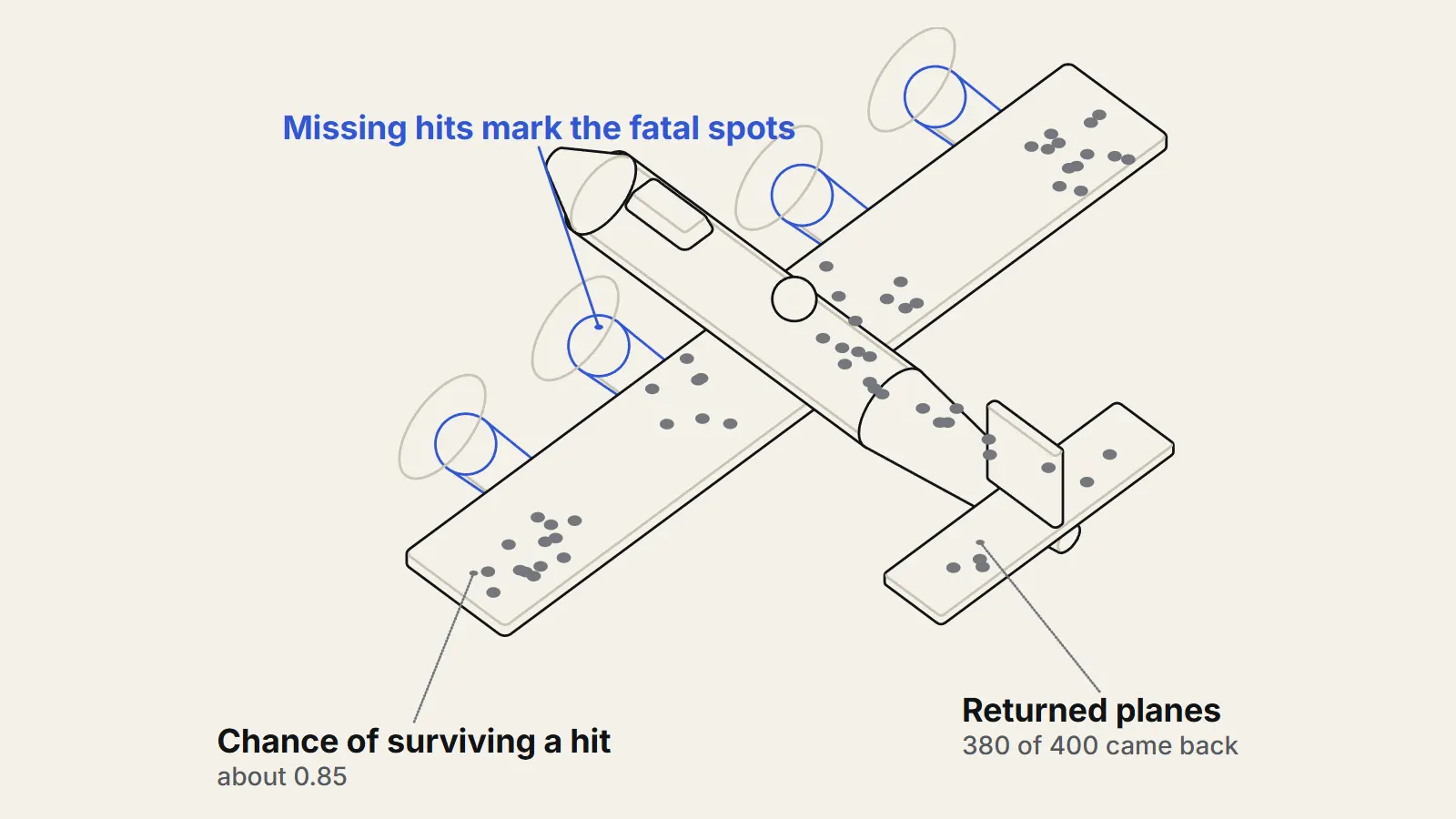
Survivorship bias is the error of studying only the things that made it through a selection process and forgetting the ones that did not. The best-known illustration comes from Abraham Wald, a mathematician who worked out, during the Second World War, how to read bullet-hole data from bombers that came home without being fooled by the bombers that never did. The same trap appears when we judge investment funds, and in any list built from what is left.
Abraham Wald and the planes: what problem was he asked to solve?
Wald belonged to the Statistical Research Group (SRG), a team of mathematicians and statisticians based at Columbia University in New York and formed in the summer of 1942.1 He was born in 1902 in the city now called Cluj, began as a pure mathematician in Vienna, lost his academic post in Austria because he was Jewish, and moved to the United States.1
Among the questions put to the group was how vulnerable aircraft were to enemy fire. The material Wald had to work with was thin. As far as his surviving memoranda show, he was given the number of planes sent on a mission, the number that came back, and the number of hits on each plane that did return.1 About the planes that were lost, nothing was known except that they had not come home.
The tempting reading of such data is to protect the places where returning planes show the most damage. W. Allen Wallis, a colleague who later wrote a history of the group, recalled that the military was inclined to do exactly that.1
Survivorship bias example: how did Wald get around the missing planes?
Wald began from two assumptions. The first, which Wallis said rested on good evidence, was that hits in combat land more or less evenly across a plane. The second was that planes are lost because of enemy fire rather than, say, mechanical failure.1
If hits fall evenly, returning planes should show hits spread evenly too. Where they show fewer hits than expected, the likely reason is that planes hit in that spot did not make it home. A clean patch on the returning planes is therefore not proof that the patch is safe; it may be where damage is fatal. Wallis summed up the logic in just these terms: the more vulnerable a part, the less likely it is that hits on it show up on planes that survive to be counted.1
Wald’s memoranda go well beyond that argument. Five of the eight1 that survive deal with estimating the chance that a plane survives a hit, using only the records of planes that returned.12 Mathematician Bill Casselman, writing for the American Mathematical Society, reproduces a small teaching example taken from a 1984 guide to the memoranda by Marc Mangel and Francisco Samaniego. Of 400 planes on a mission, 380 return and 20 are lost. Of the returners, 320 have no hits, 32 have one hit, and the remaining 28 have between two and five. If every hit is assumed to carry the same chance of bringing a plane down, Wald’s basic equation puts the chance of surviving a given hit at about 0.85, or roughly 15 chances in 100 of being lost per hit.1 The numbers are for illustration, not wartime data.
How much of the popular story is documented?
The version told online says Wald advised putting armour on the engines, where returning planes had few holes. In a 2016 column for the American Mathematical Society (https://www.ams.org/publicoutreach/feature-column/fc-2016-06), Casselman finds very little source material behind the details. He points to only two kinds of evidence: two short, vague mentions in Wallis’s memoir, and the memoranda themselves, which are technical and say nothing about what the military should do.1
The memoranda were written around 1943. They stayed unpublished for nearly forty years, until the Center for Naval Analyses issued them around 1980 after Wallis handed over a box of old papers.1 Wald died in a plane accident in southern India in 1950 and left no autobiography.1
That does not make the lesson false. Casselman added a postscript noting that Wallis did describe Wald’s work in survivorship terms. But the engine story, the meeting with the generals and the sketches of bullet-ridden planes belong, in Casselman’s phrase, to “plausible reconstruction.”1
When did Abraham Wald die?
Abraham Wald died in a plane accident in southern India in 1950. He left no autobiography.1 His memoranda were written around 1943 and stayed unpublished for nearly forty years, until the Center for Naval Analyses issued them around 1980.1
Examples of survivorship bias in investing
Fund performance is the cleanest modern example. In 1992 Stephen Brown, William Goetzmann, Roger Ibbotson and Stephen Ross showed (https://terpconnect.umd.edu/~wermers/ftpsite/FAME/Brown_Goetzmann_Ibbotson_Ross.pdf) that when a sample of funds is cut down to those that survive, the link between volatility and returns can create the appearance that past performance predicts future performance. In their numerical examples the effect was strong enough to account for the evidence then cited in favour of predictability.3
How large is the missing group? S&P Dow Jones Indices publishes a scorecard, called SPIVA, that deliberately counts every fund alive at the start of a period, not only the ones that last. Its year-end 2025 edition (https://www.ariesadvisors.com/files/spiva-us-year-end-2025.pdf) began with 1,082 large-cap US equity funds fifteen years earlier, and only 50.55 percent of them were still in existence at the end4.4 A list of today’s funds would leave out about half of the group an investor could have chosen from.
When the whole starting group is counted, 89.93 percent underperformed the S&P 500 over the 15 years4. The average fund returned 11.28 percent a year against 14.06 percent for the index.4 The same logic applies to any ranking assembled from what remains: companies that have lasted decades, restaurants still open, patients who finished a treatment. The question is always who is missing and why.
What is disputed or limited?
A correction for survivorship removes one distortion. It does not show that nobody has skill. The 1992 paper shows that survivorship can produce apparent predictability, strong enough in its examples to account for the evidence then cited. That is a statement about what is possible, not proof that skill never exists.3
Wald’s own method also rested on assumptions. Casselman notes that some wartime losses were mechanical, and that Wald had to be very careful about how his assumptions entered the results.1 If hits had not been spread evenly, the inference would change. Every survivorship correction depends on a guess about the missing group, and the guess can be wrong.
What is not known?
It is not known what Wald said to commanders, whether armour was moved because of his work, or how many of the vivid details come from anywhere but later retelling. The memoranda are silent on recommendations.1 In investing, the scorecard measures US fund categories over fixed periods; it cannot say what any one investor would have experienced.
How can you spot it in a claim?
- Ask who or what is missing from the data, and why they dropped out.
- Ask whether the sample was chosen before or after the outcome was known.
- Look for the starting count, not only the number that finished.
- Treat an empty area as a question: it may be where failure is fatal.
Key takeaways
- Survivorship bias means judging a group by the members that remain and ignoring those that left.
- Wald’s insight, supported by Wallis’s own account, was that missing damage on returning planes could mark the spots that were fatal.
- Much of the popular detail about engines and generals is not documented in the surviving sources.
- In fund data, only about half of a starting group of large-cap funds still existed after 15 years, so surviving-fund lists flatter the result.
Sources
- 1The Legend of Abraham Wald (opens the source in a new tab) · American Mathematical Society (Feature Column), 2016 · Essay · https://www.ams.org/publicoutreach/feature-column/fc-2016-06
- 2Abraham Wald’s Work on Aircraft Survivability (opens the source in a new tab) · Journal of the American Statistical Association 79(386), pp. 259-267, 1984 · Paper · https://doi.org/10.1080/01621459.1984.10478038
- 3Survivorship Bias in Performance Studies (opens the source in a new tab) · The Review of Financial Studies 5(4), pp. 553-580, 1992 · Paper · https://terpconnect.umd.edu/~wermers/ftpsite/FAME/Brown_Goetzmann_Ibbotson_Ross.pdf
- 4SPIVA U.S. Scorecard, Year-End 2025 (opens the source in a new tab) · S&P Dow Jones Indices, 2026 · Report · https://www.ariesadvisors.com/files/spiva-us-year-end-2025.pdf