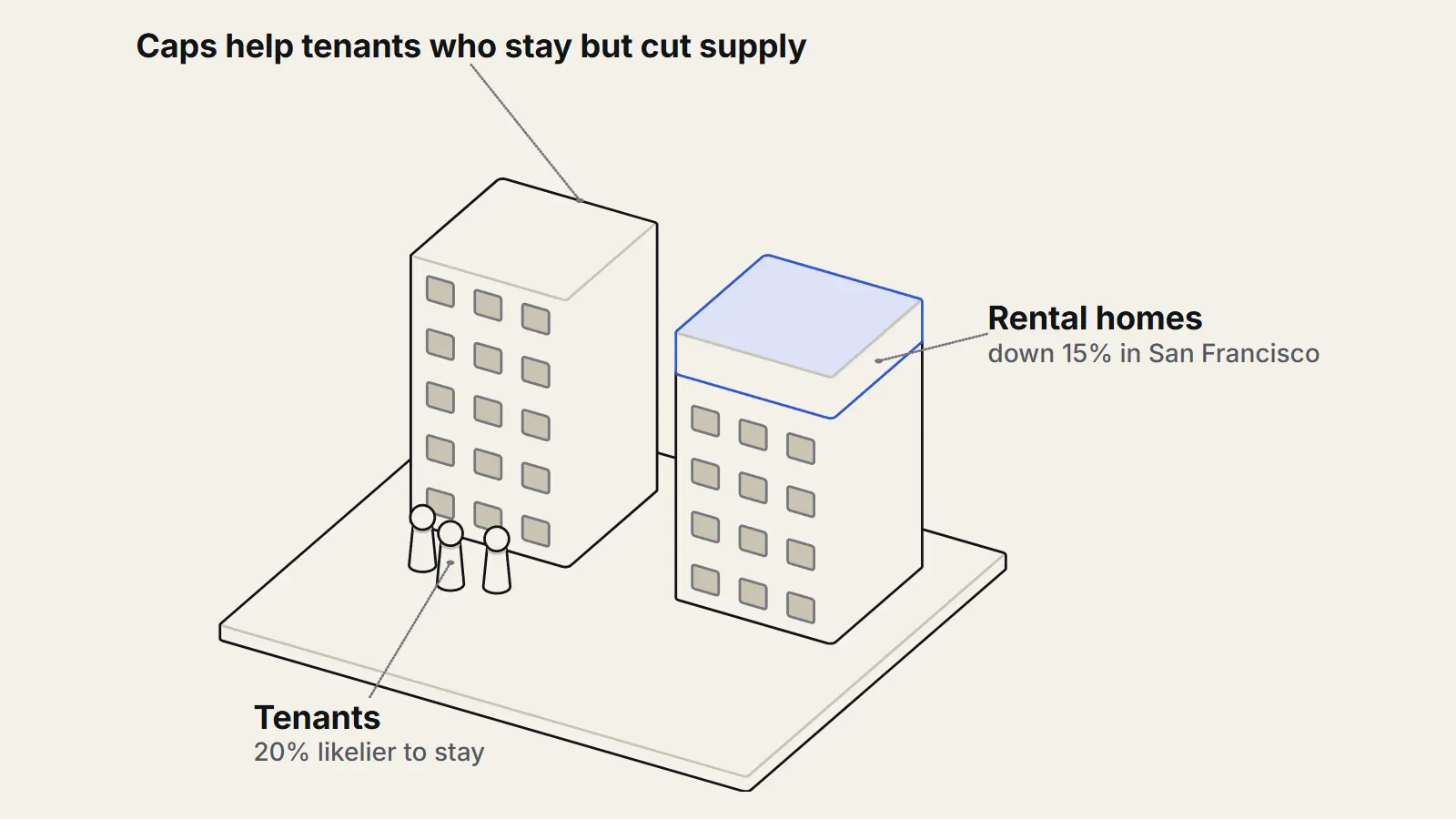
Rent control is a law that limits how much a landlord can raise the rent on a home that is already rented. Its aim is to keep tenants from being priced out of their homes. Studies of the best-known cases suggest it does what it promises for the tenants it covers, who stay longer, but that it can also shrink the supply of rental housing, which can raise rents for everyone else. How the policy is designed decides how large each effect is.
How does rent control work?
Many recent rent control laws cap yearly increases rather than fix a price. Oregon, which passed a statewide version, allows an annual increase of no more than the lesser of 10 percent or 7 percent plus the change in a regional consumer price index. 1 That is a rent stabilisation rule: rents can still rise, but the pace is bounded.
Designs differ in four main ways: how big the allowed increase is, which buildings are covered, whether the cap resets when a tenant leaves, and how long new buildings are exempt. Oregon, for example, does not apply its cap to a unit whose first certificate of occupancy was issued less than 15 years before the notice of increase. 2 Exempting new buildings is meant to keep the rule from discouraging construction. San Francisco, by contrast, has long covered older buildings, and in 1994 a ballot initiative lifted an exemption for small multi-family buildings built in 1979 or earlier. 3
Who does rent control help?
The clearest winners are tenants who already live in a controlled unit. In San Francisco, economists Rebecca Diamond, Tim McQuade and Franklin Qian compared tenants in buildings that the 1994 change newly covered with tenants in similar buildings that it did not. In their American Economic Review paper (https://www.aeaweb.org/articles?id=10.1257%2Faer.20181289), they found that rent control limits renters' mobility by 20 percent4 and lowers displacement from the city.4 Put simply, covered tenants moved less, and fewer of them were forced out of San Francisco. The authors estimate large benefits to those tenants.5
Benefits are not guaranteed to reach the poorest renters. A cap protects whoever happens to hold the lease, whatever their income. When the University of Chicago's IGM Forum surveyed US economists in 2012, Caroline Hoxby commented that controlled units do not end up with low-income people, and David Autor noted that existing renters gain from capped prices. 6
What happens to housing supply under rent control?
The main cost is on the other side of the market. If a landlord can no longer raise the rent to the market level, selling the building or changing its use can look more attractive. In the San Francisco study, landlords whose buildings came under rent control reduced the supply of rental housing by 15 percent4, by selling to owner-occupants and redeveloping buildings.4 The authors argue that this loss of rentals probably raised market rents over the long run, partly undoing the policy's goal.4
The working-paper version (https://www.nber.org/papers/w24181) of the study puts a number on the citywide effect: a 5.1 percent5 rent increase.5 This is an estimate from one city and one policy change, not a general law. But it shows the trade-off: the people protected are those inside the controlled stock, and the people who bear the cost are those looking for a home, who face fewer rentals and higher rents.
Does rent control affect prices of nearby homes?
Effects can spread beyond controlled units. Cambridge, Massachusetts ended its strict rent controls suddenly in 1995. Economists David Autor, Christopher Palmer and Parag Pathak, in an NBER study (https://www.nber.org/papers/w18125), found that decontrol raised the prices of nearby properties that had never been controlled, and that it added about $1.8 billion to the value of Cambridge's housing stock7 between 1994 and 2004, close to a quarter of all price growth in that period.7 More than half of that gain came from spillovers onto never-controlled homes. In other words, controls appear to have held down the value of neighbouring housing too.
A rise in property values is good news for owners and not necessarily for renters, so this finding speaks to what controls did to the housing market, not to who was better off overall.
What do economists think, and where do they disagree?
Economists lean strongly against traditional rent control. In the 2012 IGM survey (https://kentclarkcenter.org/surveys/rent-control/), 41 panelists were asked whether such ordinances had improved the amount and quality of broadly affordable rental housing over three decades. Of the 37 who gave a scored answer, 33 disagreed or strongly disagreed, three were uncertain and one agreed.6 The panel was asked about affordable housing supply and quality, not about whether tenants gain from stability, so the vote does not settle every question.
The strongest counterargument is about security. Supporters point to moving costs, disrupted schools and lost neighbourhood ties, and a tenant who can plan on staying has something valuable. The San Francisco authors themselves find large benefits to covered tenants, and they suggest that rent insurance paid through government social insurance, rather than a mandate on landlords, could offer similar protection without the supply loss.5 Even a panelist who voted uncertain in the IGM survey pointed out that without controls few people outside the top 1 percent might remain in Manhattan, while also noting that price controls reduce the incentive to add supply.6
What is not known about rent control?
The evidence is concentrated on a few places, mainly San Francisco and Cambridge, with older, stricter forms of control. Newer caps such as Oregon's, which exempt new buildings and tie increases to inflation, may behave differently, and the studies cited here do not test them. Whether a given city would see San Francisco's results depends on how much of its housing is covered and how easily landlords can switch to other uses. The studies also cannot say how much of the supply loss would have happened anyway.
Key takeaways
- Rent control caps how fast rents on existing rentals can rise; Oregon's version ties the cap to inflation and exempts new buildings.
- In San Francisco, covered tenants moved less, but landlords cut rental supply by 15 percent, and the authors estimate a 5.1 percent rise in citywide rents.
- Cambridge's end of strict controls in 1995 raised the value of nearby uncontrolled homes.
- Most surveyed economists doubt that traditional rent control improved affordable housing, but the San Francisco study finds large benefits for covered tenants.
- Effects of newer, milder caps are less studied in the sources used here.
Sources
- 1ORS 90.324 Maximum annual rent increase (Oregon Revised Statutes) (opens the source in a new tab) · Oregon Revised Statutes, 2023 · Law · https://oregon.public.law/statutes/ors_90.324
- 2ORS 90.323 Rent increases (Oregon Revised Statutes) (opens the source in a new tab) · Oregon Revised Statutes, 2023 · Law · https://oregon.public.law/statutes/ors_90.323
- 3Who benefits from rent control? Evidence from San Francisco (opens the source in a new tab) · Microeconomic Insights, 2019 · Essay · https://microeconomicinsights.org/who-benefits-from-rent-control-evidence-from-san-francisco/
- 4The Effects of Rent Control Expansion on Tenants, Landlords, and Inequality: Evidence from San Francisco (opens the source in a new tab) · American Economic Review, 2019 · Paper · https://www.aeaweb.org/articles?id=10.1257%2Faer.20181289
- 5The Effects of Rent Control Expansion on Tenants, Landlords, and Inequality: Evidence from San Francisco (NBER Working Paper 24181) (opens the source in a new tab) · National Bureau of Economic Research, 2018 · Paper · https://www.nber.org/papers/w24181
- 6Rent Control (IGM Economic Experts Panel, 7 February 2012) (opens the source in a new tab) · Clark Center Forum, University of Chicago Booth School of Business, 2012 · Survey · https://kentclarkcenter.org/surveys/rent-control/
- 7Housing Market Spillovers: Evidence from the End of Rent Control in Cambridge Massachusetts (NBER Working Paper 18125) (opens the source in a new tab) · National Bureau of Economic Research, 2012 · Paper · https://www.nber.org/papers/w18125